Pizza yeast, baker percentages, ferment time, and dough balls
How Much Yeast In Pizza Dough Calculator
Calculate instant, active dry, or fresh yeast for pizza dough using flour weight, dough ball size, hydration, salt, fermentation time, temperature, preferment, and pizza style.
Start with a common pizza setup, then adjust the yeast type, room temperature, cold ferment, flour weight, dough balls, hydration, salt, and preferment.
Full Yeast Breakdown
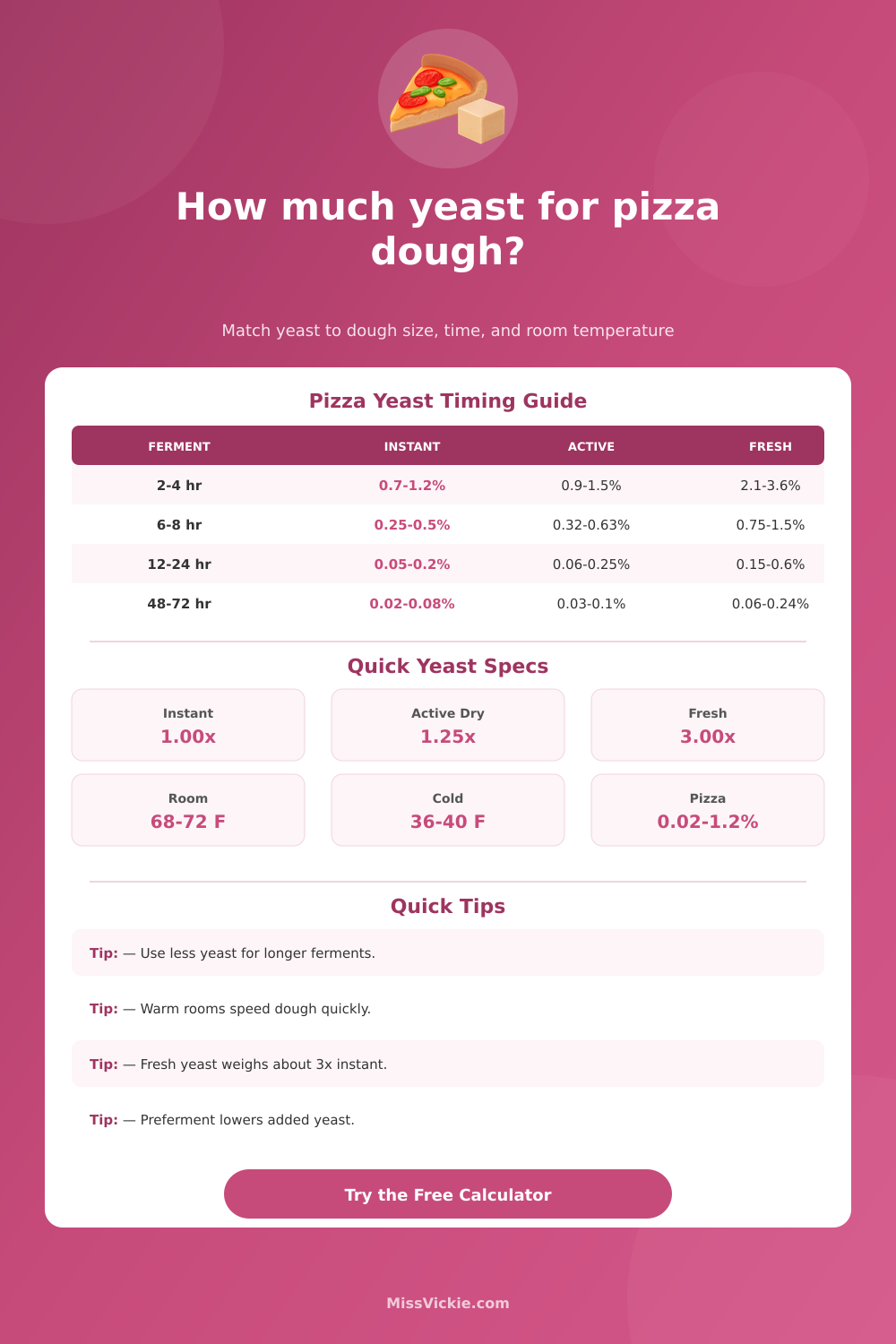
| Fermentation Plan | Instant Yeast % | Active Dry % | Fresh Yeast % | Best Use |
|---|---|---|---|---|
| Quick 2 to 4 hour dough | 0.70% to 1.20% | 0.88% to 1.50% | 2.10% to 3.60% | Fast weeknight pizza, warm proof, softer flavor |
| Same-day 6 to 8 hour dough | 0.25% to 0.50% | 0.31% to 0.63% | 0.75% to 1.50% | Balanced same-day dough with noticeable fermentation |
| Overnight 12 to 24 hour dough | 0.05% to 0.20% | 0.06% to 0.25% | 0.15% to 0.60% | NY, Neapolitan-style, and mixed room/cold schedules |
| Cold 48 to 72 hour dough | 0.02% to 0.08% | 0.03% to 0.10% | 0.06% to 0.24% | Slow refrigerator ferment with better flavor control |
| Pizza Style | Hydration Range | Salt Range | Oil / Sugar Range | Typical Dough Ball |
|---|---|---|---|---|
| Neapolitan / high heat | 58% to 64% | 2.5% to 3.0% | 0% to 1% | 240 to 280 g for 11 to 12 inch pies |
| New York style | 60% to 65% | 2.4% to 3.0% | 1% to 4% | 250 to 340 g for 12 to 14 inch pies |
| Pan, Detroit, or grandma | 65% to 75% | 2.0% to 2.8% | 2% to 6% | 550 to 900 g per oiled pan |
| Thin crispy crust | 50% to 58% | 2.0% to 2.6% | 1% to 4% | 180 to 240 g for a lean, crisp base |
| Gluten-free pizza dough | 75% to 95% | 1.8% to 2.5% | 2% to 7% | 300 to 450 g depending on starch blend |
| Condition | Typical Temperature | Yeast Direction | What It Means |
|---|---|---|---|
| Cool kitchen | 60°F to 65°F / 16°C to 18°C | Add 10% to 25% | Dough rises slowly and needs more activity or more time. |
| Moderate kitchen | 68°F to 72°F / 20°C to 22°C | Use baseline | Most recipe yeast percentages assume this range. |
| Warm kitchen | 75°F to 80°F / 24°C to 27°C | Reduce 15% to 30% | Yeast moves faster and dough can overproof early. |
| Cold ferment | 36°F to 40°F / 2°C to 4°C | Count as slow time | Refrigeration develops flavor while slowing gas production. |
| Pizza Plan | Dough Portions | Portion Weight | Approx. Flour | Use Case |
|---|---|---|---|---|
| Small dinner | 2 balls | 240 to 280 g | 290 to 340 g | Two personal or 11 inch pizzas |
| Family pizza night | 4 balls | 250 to 300 g | 610 to 730 g | Four medium round pizzas |
| Party batch | 8 to 12 balls | 260 to 320 g | 1.3 to 2.3 kg | Multiple bakes over a long evening |
| Sheet pan dinner | 1 to 2 trays | 650 to 900 g | 390 to 1,050 g | Pan, grandma, Detroit, or slab pizza |
Best when the dough must be baked within a few hours and flavor is less mature.
Good balance for room-temperature dough that starts in the morning and bakes at night.
Uses less yeast so the dough can ferment slowly without blowing past its peak.
Gives more flavor control for 48 to 72 hour pizza dough in the refrigerator.
Yeast are a living organism that consume sugar and releases gases and flavor compounds. The amount of yeast that you add to pizza dough will determine not only how fast the dough will rise but also an amount of flavor that develops in the dough. Adding too much yeast will cause the dough to rising too fast and result in a dough that dont contain enough flavor.
Adding too little yeast will result in dough that does not rise enough and contains no crumb structure. Because yeast is a living organism, the amount of time and the temperature in which the dough is allowed to rise affects the activity of the yeast. Time and temperature are two main factors that will change how the yeast act within the dough.
How Much Yeast to Add to Pizza Dough
If you would like dough that rises quick, you will have to add more yeast or use a warmer temperature. Conversely, if you would like dough that takes longer to rise, you can use less yeast or a colder temperature. For instance, dough that is left out at room temperature will rise faster then dough that is left in the refrigerator.
Dough left in the refrigerator will undergo a cold ferment. During a cold ferment, the activity of the yeast is slowed. By using fewer yeast than if the dough were to rise at room temperature, you can obtain the same results over a longer period of time.
Additionally, the longer the dough is allowed to ferment, the more acid and alcohols the yeast will release. These ingredients will contribute to a deeper, more complex flavor in the pizza dough. The type of yeast that you use will also change the amount of yeast that you has to add to the pizza dough.
For instance, instant yeast will allow the dough to rise quickly. Instant yeast does not require a proofing stage to become active. Active dry yeast will have a coating that will slow the start of the yeast activity.
Therefore, you will have to add more active dry yeast to pizza dough than instant yeast. Additionally, fresh compressed yeast contain moisture, like the dough itself. Therefore, the yeast will behave different than either instant or active dry yeast.
To achieve the desired amount of rise and flavor in the pizza dough, you must select the type of yeast to be used. Flour weight will be the primary measurement that is use to calculate the amount of yeast to be added to the pizza dough. The amount of yeast that you should use is a percentage of the weight of the flour.
If you change the total weight of the flour that is used in the pizza dough, you must also change the total weight of the yeast that is used in the pizza dough. The number of pizza dough ball that are to be cooked will change the total weight of the flour. Therefore, the total weight of the yeast will have to change, as well.
Other ingredients, such as salt, hydration, oil, and sugar, can also affect the activity of the yeast in the pizza dough. Salt will slow the fermentation process of the yeast but will strengthen the structure of the pizza dough. If the hydration level of the pizza dough is high, this will provide more water for the yeast to use.
More water will allow the yeast to move and develop the dough more fast. Oil and sugar will moderate the activity of the yeast but will also change the texture of the crust. The temperature in which the pizza dough is allowed to rise will also change the activity of the yeast.
The higher the temperature in the kitchen, the faster that the yeast will move within the dough. In some instances, the pizza dough may overproof if too much yeast activity occur. In contrast, if the kitchen is cool, the yeast will move slow in the dough.
Furthermore, the amount of time that the dough is allowed to rise will also be affected. You must consider both the room and refrigerator temperatures to allow the dough to rise to your desired timeframe. If a preferment is to be used in the pizza dough, such as a poolish or a biga, the preferment already contains the yeast and flavor compounds.
Therefore, you will have to add less fresh yeast to the pizza dough once the preferment is mixed in. A calculator can be used to determine the amount of yeast to be used in the pizza dough to remove the guesswork involved in adding too much or too little yeast. The calculator will ask for the weight of the flour to be used in the pizza dough and the type of yeast to be added to the pizza dough.
Additionally, the calculator will ask the temperature in which the pizza dough will rise so that it can determine the amount of yeast that will create the best results. Using a calculator will allow you to adjust the amount of yeast to be added to the pizza dough according to the timeframe in which you want the pizza dough to rise. For best results and flavor in your pizza dough, adjust the amount of yeast according to the temperature in your kitchen and how long you would like the pizza dough to rise.
Small adjustments to the amount of yeast will provide more better results in terms of the flavor and texture of you’re pizza dough.