Pizza Dough Weight Calculator
Estimate dough ball weight by pizza style, diameter, crust thickness, rim size, pie count, hydration, and baker percentage formula.
🍕 Pizza Dough Presets
Choose a style, then adjust diameter, crust edge, thickness, number of pies, hydration, salt, yeast, oil, and sugar.
⚖ Dough Sizing Details
Pizza dough result
Your dough weight and baker percentage formula will appear here.
Dough Sizing Breakdown
Baker Percent Formula
- Flour: 0 g
- Water: 0 g
- Salt: 0 g
- Yeast: 0 g
📊 Dough Ball Benchmarks
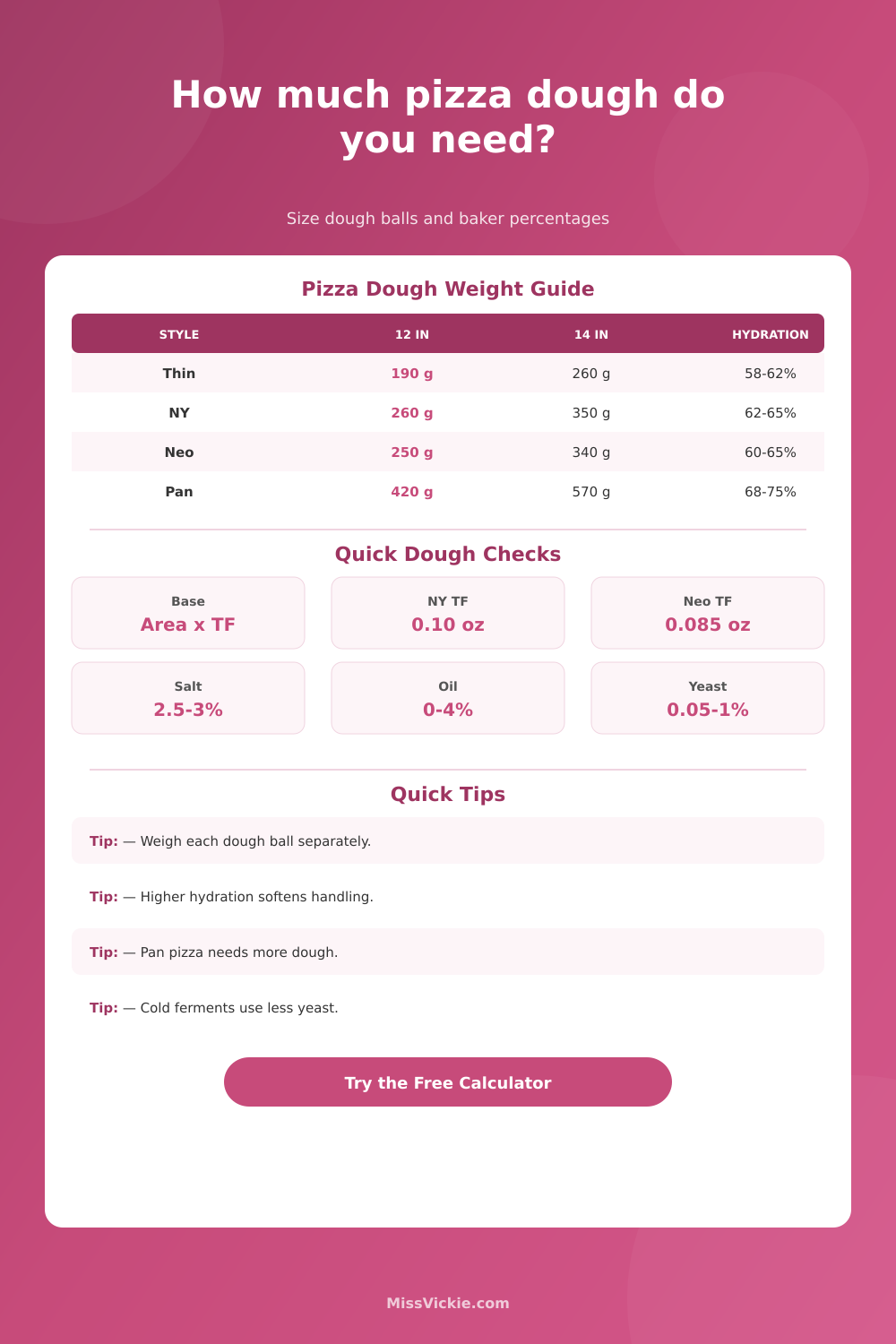
Dough loading is a practical pizza-shop shortcut: dough ball weight equals pizza area times a style thickness factor, then adjusted for rim and preference.
📘 Pizza Dough Weight Reference Tables
| Pizza Style | Dough Loading Factor | Typical Hydration | Typical Oil | Use This For |
|---|---|---|---|---|
| Thin crust round | 0.070 to 0.080 oz per sq in | 55% to 62% | 0% to 2% | Crisp tavern-style pies with a small edge and light chew. |
| Neapolitan round | 0.080 to 0.090 oz per sq in | 60% to 65% | 0% | High-heat pizza with an airy cornicione and tender center. |
| New York round | 0.095 to 0.105 oz per sq in | 62% to 65% | 1% to 3% | Foldable slices with moderate rim and home-oven browning. |
| Grandma pizza | 0.110 to 0.125 oz per sq in | 65% to 70% | 2% to 5% | Sheet pan pizza that is thinner than Sicilian but softer than NY. |
| Detroit or pan pizza | 0.130 to 0.155 oz per sq in | 68% to 75% | 3% to 6% | Oiled pans, crisp fried edges, and thicker airy crumb. |
| Sicilian thick crust | 0.155 to 0.180 oz per sq in | 68% to 78% | 3% to 7% | Very thick square slices with focaccia-like interior. |
| Round Pizza Diameter | Thin Crust Dough | Neapolitan Dough | New York Dough | Pan Style Dough |
|---|---|---|---|---|
| 10 inches | 165 g | 190 g | 225 g | 300 g |
| 12 inches | 240 g | 270 g | 320 g | 430 g |
| 14 inches | 325 g | 370 g | 435 g | 585 g |
| 16 inches | 425 g | 485 g | 570 g | 765 g |
| 18 inches | 540 g | 615 g | 720 g | 970 g |
| Baker Percentage | Lean Neapolitan | New York Style | Pan Pizza | How It Changes Dough |
|---|---|---|---|---|
| Flour | 100% | 100% | 100% | All other ingredients are measured against flour weight. |
| Water | 60% to 65% | 62% to 65% | 68% to 75% | Higher hydration gives softer dough and larger bubbles. |
| Salt | 2.5% to 3% | 2.5% to 3% | 2.2% to 2.8% | Salt controls flavor, gluten strength, and fermentation pace. |
| Instant yeast | 0.05% to 0.3% | 0.1% to 0.7% | 0.2% to 1% | Use less yeast for cold ferments and more for same-day dough. |
| Oil | 0% | 1% to 3% | 3% to 6% | Oil tenderizes dough and helps brown in lower-heat ovens. |
| Sugar | 0% | 0.5% to 2% | 1% to 3% | Sugar speeds browning, especially below wood-fired temperatures. |
| Total Dough Needed | 60% Hydration Lean | 65% Hydration NY | 70% Hydration Pan | Batch Planning Note |
|---|---|---|---|---|
| 500 g dough | 309 g flour, 185 g water | 297 g flour, 193 g water | 284 g flour, 199 g water | Small test batch or two personal pizzas. |
| 1000 g dough | 617 g flour, 370 g water | 594 g flour, 386 g water | 568 g flour, 398 g water | Enough for several 10 to 12 inch dough balls. |
| 1500 g dough | 926 g flour, 556 g water | 891 g flour, 579 g water | 852 g flour, 597 g water | Useful for family pizza night or mixed styles. |
| 2500 g dough | 1543 g flour, 926 g water | 1485 g flour, 965 g water | 1420 g flour, 994 g water | Large prep day; divide balls after bulk rest. |
🧪 Hydration And Yield Grid
Easy to handle, crispier, and good for very thin crusts.
Balanced for Neapolitan, New York, and general home pizza.
Looser dough with open crumb and tender pan-pizza texture.
Flour plus water, salt, yeast, oil, sugar, and any extras.
💡 Dough Calculation Notes
Most people don’t fail at making pizza in their homes out of laziness. They begin by failing to control the sticky nature of their flour, and before they know it, its all over the place. Crisp New York slice? It is more like a doughy mess. The problem is you didn’t calculate ratio between surface area and weight.
Enter the calculator. Input your desired style and diameter, and the calculator will take care of the math for you. You won’t have to guess conversions or coefficients; you will just get a specific recipe based off a vague desire for dinner.
Use a Calculator to Make Better Pizza
Dough weight remain something of a mystery to most home cooks. They add leftover bits. They double a recipe because it feels like they need more, that is what people get wrong. Dough is physics. A given surface area (say a twelve inch round) call for a certain amount of it, loaded out to reach the desired texture. Spread two hundred grams of dough across a square foot, and what do you have? Cracker. Six hundred grams in the same space make bread. The difference is loading.
This leads to style. A Neapolitan pizza require a very light hand, something more like zero point zero eight ounces per square inch. This allows the rim of the pizza to puff upward (in the intense heat) but leaves enough tenderness at core. New york style are thicker, about zero point one ounce per square inch. This added weight give it structural integrity, the ability to support itself and be folded over without collapsing. Pan pizza? It’s another beast, sometimes almost twice as much than thin crust. The calculator will adjust accordingly, but you have to know why. This isn’t about ingredient measurement, it’s about crust design.
The other thing that really changes the game are hydration. As the chart on the page indicates, moving up or down on that scale change the hydration levels of the dough from dry and crisp (fifty-five percent water) to a focaccia-light style with big air bubbles (seventy-five percent). A higher hydration produce a softer dough that is difficult to shape by hand, yet has an open crumb. A lower hydration rolls out well and is easy to work with even if it is not very complex. You can adjust that number in the calculator to suit your skills and oven conditions. For example, if you are baking at home in a conventional oven rather than in a wood-fire furnace, you may wish to go slightly lower on the number because a cooler oven could meant a soggy interior.
A couple of things is up to you: salt and oil. You don’t salt just for flavor, it also helps create a tighter gluten structure and slows fermentation. If you use too little or no salt, your dough will be slack and tear apart. Oil is divisive among purists. For purists, there is none because heat alone should makes the outside crispy. In America, we tend to toss in a tablespoon or two because our ovens aren’t as hot and the oil helps brown and tenderize the crumb. With this tool you can adjust those settings without disturbing the baker percentages.
The trickiest variable for a novice? Yeast. If you go heavy-handed and let the dough sit in the fridge for days, you’ll overproof it. The calculator contain a fermentation guide. According to its suggestions of how much yeast to use, the faster you want the dough, the more yeast you need; for example, a same-day dough rise more quickly with more yeast. The opposite is also true, as you use barely any yeast for a cold ferment up to 72 hours and let the wild microbes take care of it. You should of gotten this right, or you ruin the texture of the pie before shaping.
Consistency is where it’s at here. Lock in the right amount of water so your crust comes out just right every time and then never touch the scale again. No more staring into space trying to decide if you’ve got the right amount of water in there. No more guesswork. Just make a deliberate batch of dough and bake away. Now you know what kind of dough you’re working with and now you’ll make better pizza. Work on one dough ball at a time; being precise gives you freedom.