Pizza dough salt, baker percentage, spoon equivalents, and sodium
How Much Salt In Pizza Dough Calculator
Calculate salt for pizza dough from flour weight, dough balls, ball size, style, salt type, hydration, fermentation time, and your preferred sodium target.
Start with a common pizza dough scenario, then adjust flour, dough balls, salt type, style, and sodium preference.
Calculation Breakdown
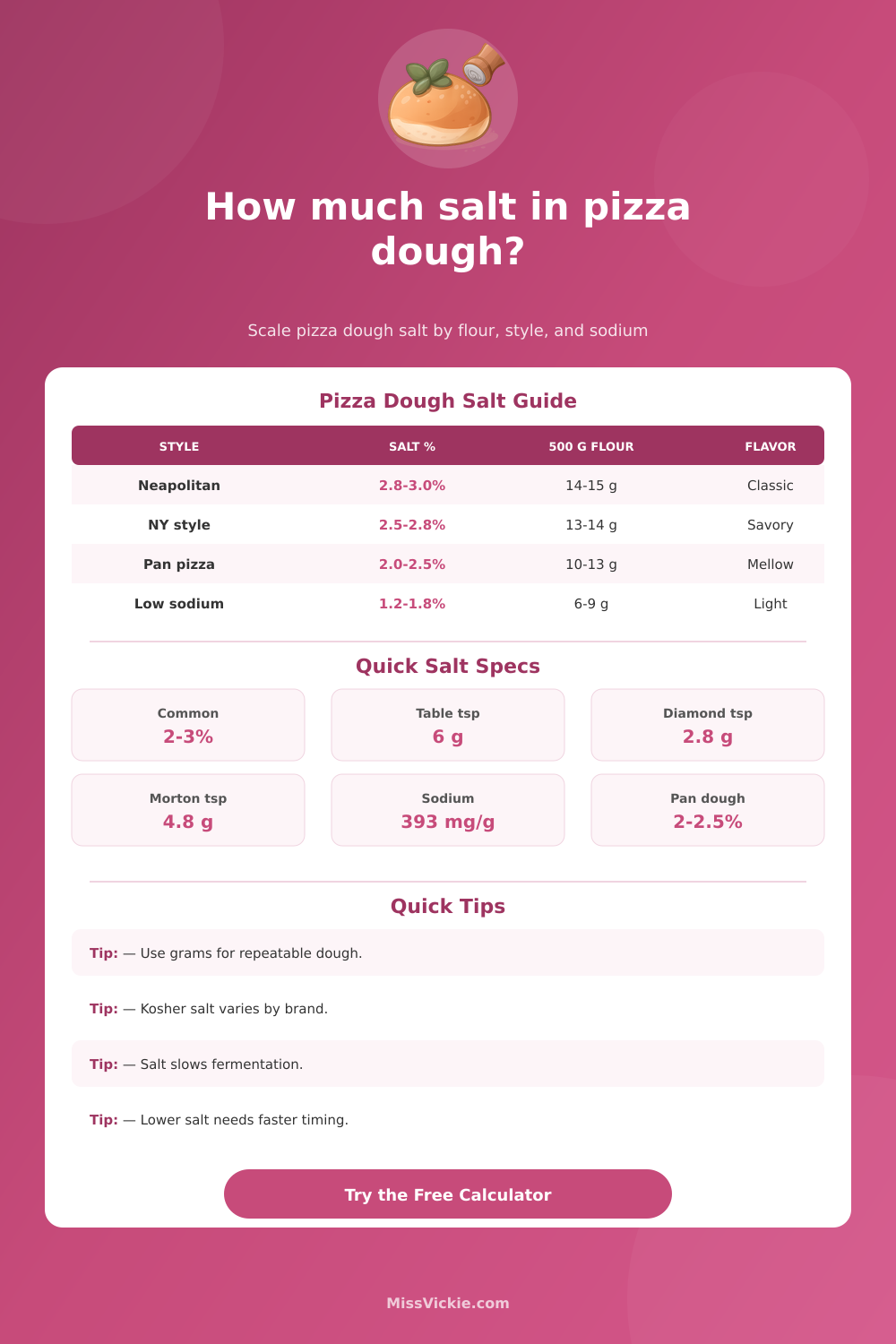
| Pizza Dough Style | Typical Salt % | Salt for 500 g Flour | Why It Works |
|---|---|---|---|
| Neapolitan / high heat | 2.7% to 3.0% | 13.5 to 15 g | Strong flavor in a lean dough with fast bake time and minimal toppings. |
| New York style | 2.5% to 2.8% | 12.5 to 14 g | Balances browning, chew, oil, sugar, sauce, and cheese. |
| Pan, grandma, Detroit | 2.0% to 2.6% | 10 to 13 g | Richer dough and toppings can make high salt taste heavy. |
| Thin crispy crust | 2.0% to 2.5% | 10 to 12.5 g | Thin dough tastes saltier because each bite has less interior crumb. |
| Lower-sodium pizza | 1.2% to 1.8% | 6 to 9 g | Needs careful fermentation and flavorful toppings to avoid a flat crust. |
| Salt Type | Approx. Grams per Tsp | 1 Tbsp Weight | Pizza Dough Note |
|---|---|---|---|
| Table salt | 6.0 g | 18.0 g | Dense and easy to overdo by volume; excellent by scale. |
| Fine sea salt | 5.7 g | 17.1 g | Close to table salt and dissolves well in dough water. |
| Diamond Crystal kosher | 2.8 g | 8.4 g | Very light by spoon, so volume swaps can under-salt dough. |
| Morton kosher | 4.8 g | 14.4 g | Heavier than Diamond but lighter than table salt. |
| Coarse sea salt | 4.0 g | 12.0 g | Best dissolved before mixing so crystals do not stay gritty. |
| Fine pink salt | 5.8 g | 17.4 g | Use like fine sea salt when weighed in grams. |
| Pizza Plan | Flour Estimate | Salt at 2.5% | Salt at 2.8% | Typical Portions |
|---|---|---|---|---|
| Two personal pizzas | 310 g | 7.8 g | 8.7 g | 2 dough balls |
| Family pizza night | 675 g | 16.9 g | 18.9 g | 4 medium pizzas |
| Two pan pizzas | 820 g | 20.5 g | 23.0 g | 2 trays |
| Party batch | 1,700 g | 42.5 g | 47.6 g | 10 round pizzas |
| Big event prep | 3,400 g | 85.0 g | 95.2 g | 20 round pizzas |
| Salt Level | Fermentation Effect | Yeast Planning | Flavor Result |
|---|---|---|---|
| Under 1.8% | Faster fermentation | Watch dough early or use less yeast | Can taste flat unless toppings are assertive. |
| 2.0% to 2.4% | Moderate control | Good for pan dough and soft crusts | Mellow saltiness with room for cheese and sauce. |
| 2.5% to 2.8% | Classic pizza control | Works with same-day and overnight dough | Balanced savory crust with good structure. |
| 2.9% to 3.2% | Slower proofing | Give dough time or avoid very low yeast | Pizzeria-like salt snap in lean dough. |
Best for sodium limits, but dough needs good fermentation and stronger toppings.
Soft, enriched, or oily doughs often taste balanced in this zone.
A reliable target for NY, home-oven pizza, and many cold ferments.
Works for lean high-heat dough, but can dominate rich toppings.
Salt is an essential ingredient in pizza dough, and the amount of salt that is use will affect both the flavor and the texture of the pizzas. If you use too little salt, the pizza dough will lack flavor. However, if you use too much salt, the texture of the dough will be tight, and it will brown too quick in the oven.
As such, it is essential to use a salt calculator to ensure that the amount of salt to be use in the pizza dough is the correct amount. The amount of salt that should be used is dependent on the weights of the flour that is to be use in the pizza dough. Bakers use a percentage to indicate the amount of salt that should be used in the pizza dough, based on the weight of the flour that is to be use.
How Much Salt to Use in Pizza Dough
Pizza dough requires salt percentage in the range of 2% to 3%. Using a percentage of 2% to 3% ensures that the dough has enough flavor while allowing the yeast to continue to work proper in making the dough. Using a salt calculator can make it easier for bakers to remember the mathematical computation of the amount of salt that is need in the pizza dough.
Pizza recipes of different styles use different percentages of salt. The baker can adjust the percentage of salt according to the type of pizza that is being made. For instance, Neapolitan pizza requires a higher percentage of salt because the dough needs to be baked quick at a high heat and has few toppings.
New York style pizza requires a medium percentage of salt because it contains alot of cheese and sauce. Pan pizza and Detroit style pizza, on the other hand, contain enriched ingredient that provide the necessary richness to the pizza, thus requiring a lower percentage of salt. The salt calculator allows bakers to adjust the percentage of salt according to the type of pizza that is being make.
The type of salt that is use will change both the weight and the volume of the salt that is measured. For instance, one teaspoon of table salt will weigh more than one teaspoon of kosher salt. Therefore, the weight of the salt is a more reliable measurement than the volume measurements of teaspoons or tablespoons.
A salt calculator will provide the baker with both the weight and the volume measurements of the salt. While it is best to use a scale to measure the salt for the pizza dough, the volume measurements provided by a salt calculator will be of help to bakers who are working quick. The total weight of the dough will change with the hydration of the dough and other ingredient.
The total weight of the dough will change with the amount of water, oil, and sugar that is added to the flour to make the dough. A salt calculator will account for these changes so that the percentage of salt to flour stays the same. The amount of salt will affect the fermentation of the dough.
As the salt slow the yeast activity, a percentage of salt that is too high will make the dough rise slowly. In instances when the dough is to be made on the same day that it will be baked, a lower percentage of salt is used to speed up the rising of the dough. For long fermentation periods, such as overnight fermentations, a higher percentage of salt can be used as the higher percentage will not significantly slow the fermentation process.
The salt calculator will assist the baker in understanding this relationship between the salt, the dough, and the fermentation period. The sodium content of the pizza dough is another aspect to consider when creating the pizza. Pizza is high in sodium content, and much of that sodium come from the salt content of the dough.
The salt calculator will allow you to calculate the total sodium content that will be in your batch of pizza dough. Furthermore, the salt calculator can calculate the sodium content per serving of pizza if you enter the number of slice that the pizza will be divided into. The sodium content in pizza dough allows bakers to make informed decisions regarding the amount of salt that they will add to the dough for flavoring.
Many people make mistakes in adding salt to there pizza dough. One of the most common mistake is that people make changes to the type of salt but do not change the amount of salt. Furthermore, some people use the same volume measurements for every batch of dough they prepare, even though using volume measurements for salt is not accurate when making halved or doubled recipes.
By using a salt calculator, people will be able to avoid these common mistake. Using the salt calculator will allow you to make small changes in the percentage of salt to suit the type of pizza you are making. For instance, if you are making a pan pizza, reducing the percentage of salt will make the flavor of the pizza less intense.
Increasing the percentage of salt in the pizza will make the flavor more intense when cooked into a Neapolitan style pizza. The salt calculator will allow you to prepare and test different percentages of salt in your pizza dough before you begin to make your pizzas. Using a salt calculator will help you to understand how the salt ingredient work in your pizza dough so that one day you can make your own pizzas with an understanding of how each ingredient in the dough work.