Pint jar capacity, canner diameter, rack layers, headspace, and batch planner
Pint Jars Per Canner Calculator
Estimate how many pint jars fit in a pressure canner or boiling-water canner from inside measurements, jar shape, rack layers, product type, headspace, and total jars to process.
📌Pint Canner Presets
Load a common pint-jar setup, then replace the measurements with your actual canner, rack, and jar dimensions. The result is a fit planner; the recipe still decides processing method, time, pressure, and altitude adjustment.
⚖Canner, Jar, Rack, Product, And Batch Inputs
Your pint jar capacity is ready.
Capacity is based on the entered footprint, jar shape, layer setting, and selected canning method.
Fit Breakdown
Batch And Safety Breakdown
Safety And Fit Flags
🧮Pint Jar And Canner Quick Cards
Measure your own jar if the shoulder is wider.
Wider jars reduce positions per rack layer.
Maintain brisk boiling water above the jars.
Follow the canner manual and tested recipe.
📊Pint Jar Fit Table
| Jar Shape | Typical Outside Diameter | Typical Filled Height | Fit Effect |
|---|---|---|---|
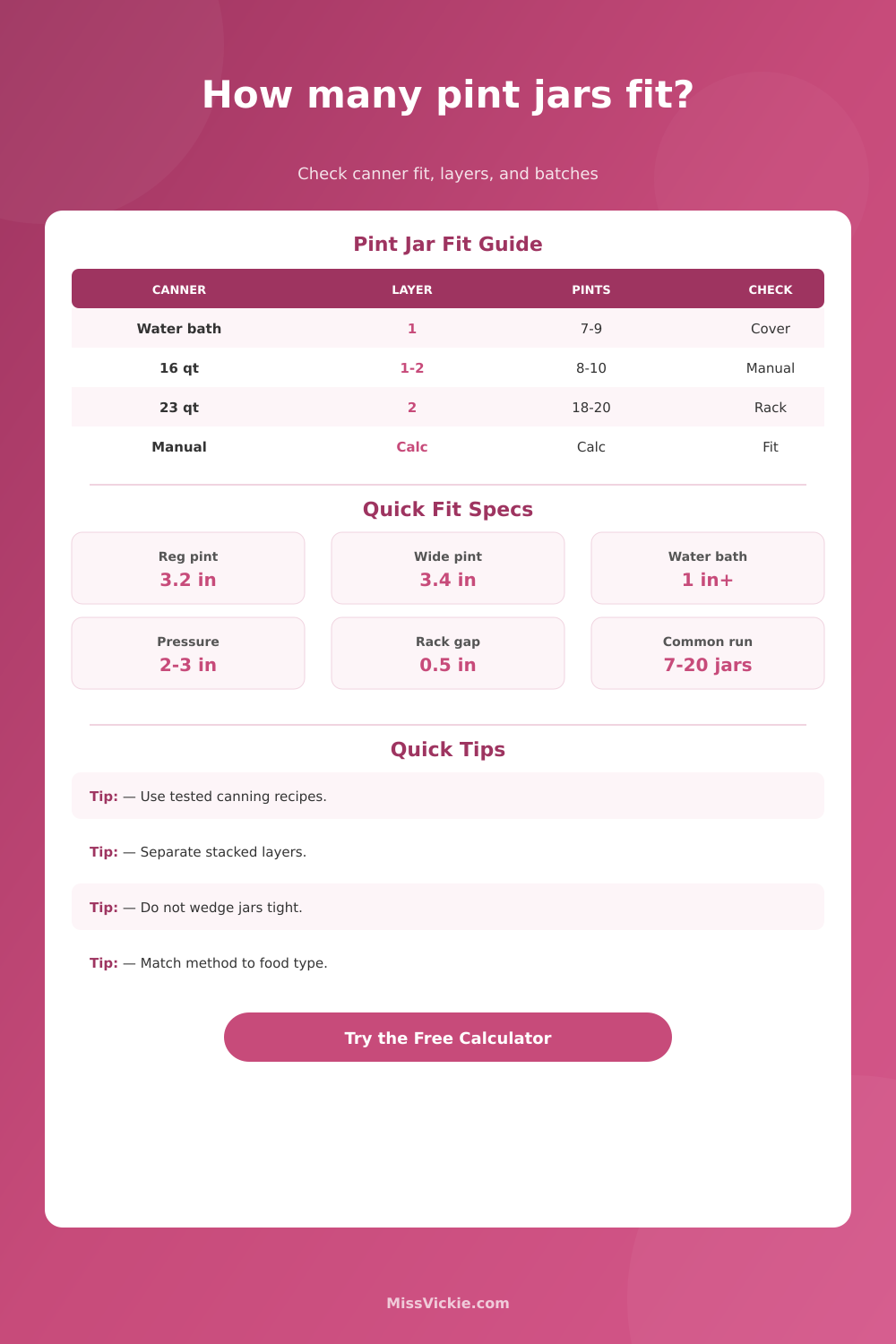
| Regular-mouth pint | About 3.2 in / 8.1 cm | About 5.2 in / 13.2 cm | Best common capacity for pint loads. |
| Wide-mouth pint | About 3.4 in / 8.6 cm | About 5.0 in / 12.7 cm | Usually fits fewer per layer but may stack easily. |
| Straight-sided pint | About 3.15 in / 8.0 cm | About 5.0 in / 12.7 cm | Predictable footprint for jams and spreads. |
| 500 ml preserving jar | About 3.15 in / 8.0 cm | About 5.35 in / 13.6 cm | Check exact height and tested jar-size directions. |
| Tall pint-style jar | About 3.25 in / 8.3 cm | About 6.1 in / 15.5 cm | May block a second pressure-canner layer. |
| Canner Type | Common Pint Load | Layer Rule | Safety Check |
|---|---|---|---|
| Boiling-water canner | Often 7 to 9 pints | Single upright layer | Keep at least 1 inch of boiling water over lids. |
| Atmospheric steam canner | Depends on base rack | Usually single layer | Use only with tested high-acid recipes approved for steam canning. |
| 16 qt pressure canner | Often 8 to 10 pints | Some models allow two layers | Confirm rack and manual before stacking. |
| 23 qt pressure canner | Often 18 to 20 pints | Two layers with separator rack | Low-acid foods require tested pressure process tables. |
| Manual measured pot | Calculator estimate | Based on entered height | Fit does not approve an untested recipe. |
🚦Safety And Product Table
| Product Type | Typical Headspace | Usual Method | Calculator Flag |
|---|---|---|---|
| Jam, jelly, fruit spread | 1/4 in | Water bath or approved steam | Checks water cover, single layer, and batch count. |
| Fruit, pickles, acidified tomatoes | 1/2 in | Water bath when tested | Flags low water cover or unknown recipe risk. |
| Broth, vegetables, beans | 1 in | Pressure canner | Warns if water bath or steam canner is selected. |
| Meat, poultry, fish | 1 in | Pressure canner | Requires pressure-canner planning and tested process tables. |
| Custom product | Recipe directed | Recipe directed | Shows fit only and asks for tested source confirmation. |
💡Pint Canner Planning Tips
This calculator estimates pint jar fit, load weight, and batch count. It does not create canning recipes, processing times, pressure settings, acidity adjustments, or altitude schedules.
Sterilized glass, sugar and fruit sit on the kitchen counter. Everything prepared over many hours is now ready to be sealed before it spoils. Grasp the large pot. And then stop. Should there be seven jars or eight? Do I really want to do this again? Will it require another hard trip through it all? Everyone hesitate for a moment. That is when it is as much about geometry as it is desire.
Enter our calculator… It performs that math for you. It converts your measured container into the exact amount it can hold so you can prepare for what will actualy happen, rather then guessing.
How to Fit Jars in Your Canner
It turns out most people think they should measure up to the top rim of their canner, which would be a no-no. What’s important is not what level the lid hits but how much water there is over the tops of the jar. Without all that water, the heat won’t reach into center of the jars as well. For a pressure canner, it’s also about having the right amount of water in the bottom to make the steam. If you measure up to the top, you will have too little water and will be stuck waiting for the pressure to rise because the tops of the jars are dry.
This is why the tool asks for water depth and the total usable inside height. It then subtracts the part used up by water. The space between jars is a factor too. It allows for boiling water circulation and room for your lifter tongs to grasp them safely. (And it accounts for jar clearance, so they don’t touch each other.) A snug fit sounds more efficient, but then when trying to lift a hot jar from a jam-packed pot, do you really want to end up scalded?
A second thing: The width of the jar makes a difference. A wide mouth pint is nice, since you don’t have to wrestle with a funnel when filling them, but they’re wider so they hog more space in the rack. Regular mouth jars fits a bit tighter (one or two fewer per row) but are narrower overall. It is easy to predict where the footprint of a straight-sided jar ends, but jars with a sharp shoulder won’t be counted by the calculator until they reach their widest point. So if you plan a whole load and then find out your jars is colliding at the shoulder level, it’s a bummer. That’s a tiny detail, but it means whether something fits all at once or requires another half-day of effort.
Physics also plays into stacking layers. For example, stacking two layers won’t give you double the amount. You must use a separator rack to keep one layer of jar from sitting right on the heating element or on the boiling water below. That rack take up space (it’s not zero thickness). There has to be water above AND below those jars so the heat can reach them all around. Push too many layers into a pot not designed for them, and you’ll have cold spots. Underprocessing creates a risk of botulism. Cold spots flag as an issue in the calculator by asking you how much gap there is in the racks. We are not just talking about glass volume here, but about the metal infrastructure required to carry heat safely through the process.
It’s also about safety (not just about math). Which kind of food? Pickles, jams, with their high acid content (can go into a boiling-water canner). Vegetables, meats, and low-acid foods like beans needs pressure canning. Without pressure, these foods don’t get hot enough to destroy harmful bacteria. And it will let you know if you’ve got the wrong combination: Beans, for example, won’t work if you only have a water-bath canner. It’ll warn you off. A key safety buffer. Reminds you that even if there’s plenty of room for twenty jars, it doesn’t matter if you’re doing it wrong.
It saves sanity, planning in batches. Do you have nine jars in your pot? That’s not enough for 50 pints of salsa. So you’ll of do six runs. This way, you can plan your day. Prep the fruit. Wash the jars. Figure out the timeline. Make it a series of manageable steps instead of a chaotic weekend project.
The reference table on the page will show you common loads for standard pot sizes. It is a baseline to compare with your own measurements. Precision. It requires patience. That’s what canning is all about. That’s what it’s about: respect for the glass, the heat, the acid.
Knowing how many jars you need and measuring your pot well helps you prepare. But still, knowing exactly how many jars are going in before you turn on the stove is a small victory. It keeps you ready, safe, and organized for the harvest.