Nitrite ppm and cure weight planning
Pink Curing Salt Per Pound of Meat Calculator
Calculate pink curing salt by meat weight, Cure #1 or Cure #2 strength, target ingoing nitrite ppm, retained pickup, scale rounding, teaspoon estimate, and how much plain salt remains in the recipe.
Each preset loads a real curing scenario with a cure type, meat weight, process style, target ppm, retained pickup, salt target, scale precision, and spoon density. Adjust the recipe details before weighing.
Calculated Pink Curing Salt
Results update after calculation.
Detailed Cure Breakdown
| Meat weight | Cure #1 at 156 ppm | Teaspoon estimate | Nitrite math |
|---|---|---|---|
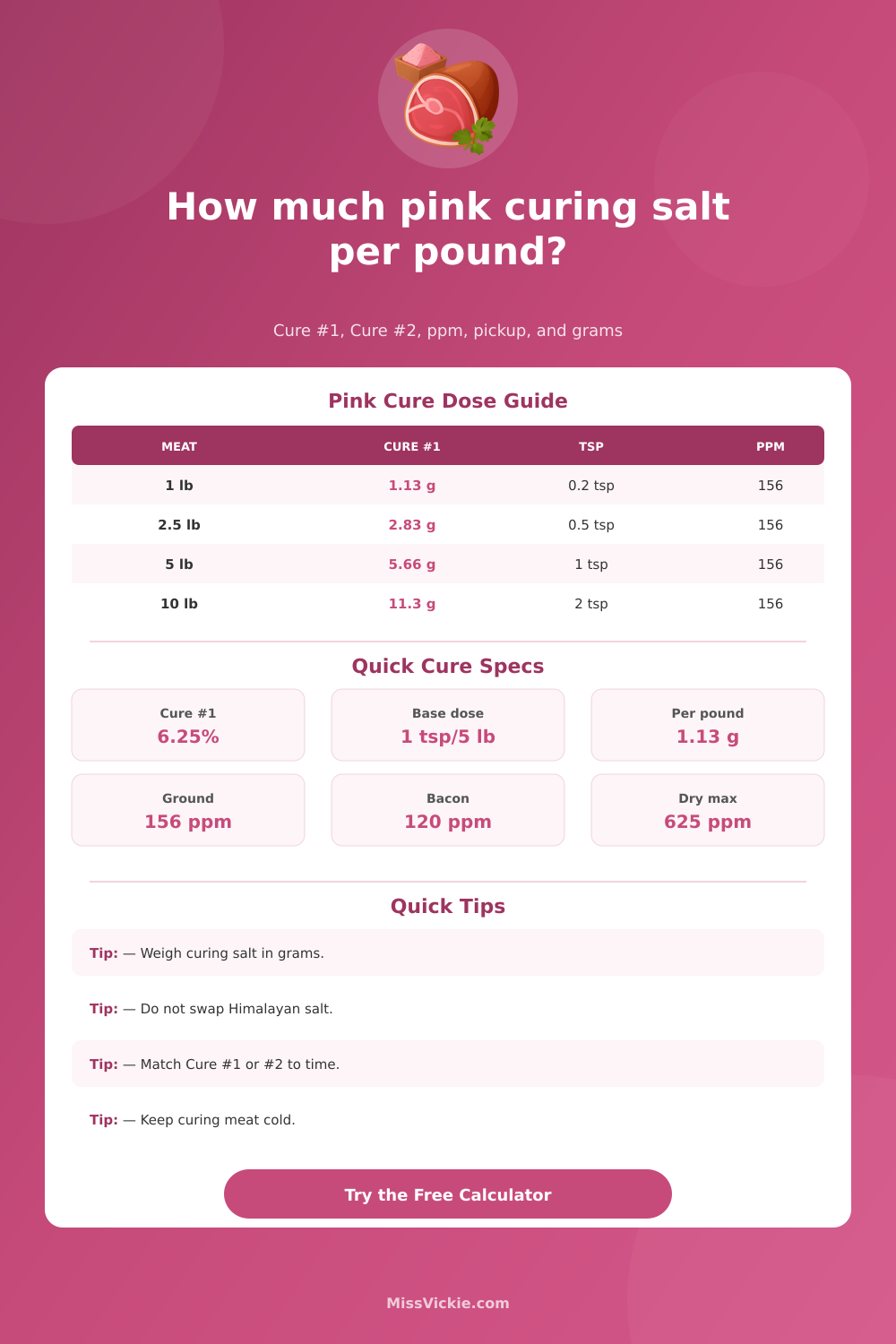
| 1 lb / 454 g | 1.13 g | 0.20 tsp | 70.8 mg nitrite in 0.454 kg meat |
| 2 lb / 907 g | 2.26 g | 0.40 tsp | 141.5 mg nitrite in 0.907 kg meat |
| 2.5 lb / 1.13 kg | 2.83 g | 0.50 tsp | 176.9 mg nitrite in 1.134 kg meat |
| 5 lb / 2.27 kg | 5.66 g | 1.00 tsp | 353.8 mg nitrite in 2.268 kg meat |
| 10 lb / 4.54 kg | 11.32 g | 2.00 tsp | 707.6 mg nitrite in 4.536 kg meat |
| Process style | Common target or limit | What the calculator does | Extra caution |
|---|---|---|---|
| Ground or comminuted meat | 156 ppm sodium nitrite | Uses meat block weight and cure nitrite percent | Mix evenly before stuffing or forming |
| Whole muscle dry rub or equilibrium cure | 156 ppm planning target | Assumes the cure is retained when pickup is 100% | Distribute rub across all surfaces and seams |
| Pumped or massaged bacon | 120 ppm sodium nitrite | Accounts for retained pickup when entered below 100% | Bacon has stricter nitrite practice because it is fried |
| Pumped or massaged whole muscle | 200 ppm maximum reference | Calculates required cure retained by meat | Injection plans require validated brine procedures |
| Dry-cured products | 625 ppm upper-limit reference | Flags a high target and shows rounded ppm | Use Cure #2 only when the recipe calls for nitrate |
| Curing salt | Typical composition | Use case | Do not confuse with |
|---|---|---|---|
| Cure #1 / Prague Powder #1 | 6.25% sodium nitrite, 93.75% salt | Short cures that will be cooked, smoked, or refrigerated | Table salt, kosher salt, or Himalayan pink salt |
| Cure #2 / Prague Powder #2 | 6.25% sodium nitrite plus nitrate and salt | Long dry cures where nitrate reduction is part of the process | Cure #1 in recipes that specifically need nitrate |
| Custom curing mix | Label-specific nitrite percentage | Only when the product label gives exact nitrite strength | Celery powder without a verified nitrite analysis |
| Plain pink salt | No standardized curing nitrite | Seasoning only, not curing | Any Cure #1 or Cure #2 calculation |
| Measurement issue | Why it matters | Calculator setting | Kitchen check |
|---|---|---|---|
| Teaspoon density varies | Crystal size changes grams per spoon | Set grams per teaspoon to your product | Prefer a scale over spoon volume |
| Scale rounds upward | Small batches can overshoot ppm | Choose 0.01 g, 0.1 g, 0.5 g, or 1 g | Use a jeweler-style scale for small batches |
| Brine pickup is not 100% | Only retained nitrite counts in meat | Enter retained pickup percentage | Weigh meat before and after pumping when needed |
| Cure adds salt | Cure #1 is mostly salt by weight | Enter total salt target to subtract cure salt | Add plain salt only after cure contribution |
Ground sausage and emulsified meats use full retention when the cure is mixed into the meat block.
Equilibrium rubs calculate against meat weight and assume the measured cure remains with the meat.
Pumped projects need a retained pickup estimate because not all mixed brine may stay in the meat.
Dry-cured salami or country ham may require nitrate, starter culture, humidity, time, and weight-loss controls.
Reference basis used in this calculator: ppm is mg sodium nitrite per kg meat block; standard U.S. Cure #1 is treated as 6.25% sodium nitrite; the familiar 1 teaspoon per 5 pounds estimate is represented as 5.66 g per teaspoon and 156 ppm.
When you’re first learning how to cure your own meat, the pile of pink powder in that canister doesn’t look like an ingredient; it just looks hazardous. And there’s a reason it’s dye-colored: If you don’t know what you’re doing, it’s something you should hesitate to guess at using your kitchen spoons. Sodium nitrite is far more powerful then most people realize on their first attempt at curing. They also tend to overestimate their skill with eyeballing that level teaspoon. A fraction of a gram make all the difference, the difference between success and failure with a batch of bacon. Whole ounces matter less than fractions of grams. You don’t have to be a chemist to work with it; you do, however, need to have respect for math. There is very little room for error.
You do the math: The calculator above takes care of that part; all you need to worry about is maintaining a cool, sanitary work environment. Depending on your desired nitrite level, it will convert your raw meat weight to exact number of grams of cure required. Simply input amount of beef or pork you’re preparing and it will tell you exactly how much to measure. Why? Different crystal sizes in each brand make volume measurement highly inaccurate. Heaping the spoon may deliver way more nitrite than lightly scooping it. When you weigh instead, there’s no guesswork involved.
Why You Must Weigh Your Curing Salt
Weighing is also important because curing salt is mostly regular salt. This calculator factors that in to help you adjust your total seasoning so the finished product isn’t swimming in brine water.
Do I use Cure #1? Or Cure #2? If you’re going to wait more than just a few days after making your meat until cooking or eating, then Cure #1 (just sodium nitrite) is best. It acts immediately to kill bacteria and preserve color in items you intend to cook shortly after production, such as fresh ham or breakfast sausage. On the other hand, if you’re doing something where you’ll want to preserve it longer, such as dry-cured meats (country ham, salami, etc.), then you should choose Cure #2, which combines both nitrates & nitrites. Because nitrate react more slowly by breaking down into nitrite over weeks or months, it helps preserve dried foods during long curing periods. Either way, you don’t want to use the incorrect cure; it’s either a waste of time by waiting for a result that isn’t coming, or a potential hazard by using up preservation before you need it. The calculator also has an option to toggle between them, note that switching will change total weight slightly due to the different amount of nitrites used.
Another source of confusion for first-time curers is target ppm levels. Ppm refers to parts per million (i.e., milligrams of active nitrite per kilogram of meat). Typically ground meats use a higher level at start-up, since they have greater surface exposure to bacteria; thus targets might be 156 ppm or so. For whole muscle cuts such as bacon, the dense tissue makes it harder for bacteria to get inside, so targets will generaly be lower; perhaps in the 120-ppm range, keeping in mind that it’ll still be cooked prior to consumption. Brined products pumped via validated injection techniques may be as high as 200 ppm. Selecting your treatment technique tells the calculator what kind of dose you want; it will then adjust accordingly so you don’t inadvertently overdose a fragile whole muscle with a ground-meat dose.
Wet cures do change the math dramatically, however, due to retention. When curing with brines, soaking your meat in them or pumping brine into something like a ham, some of that solution runs off. That means if you’re doing the math assuming that your brine solution was used entirely, you’ll probably wind up under-cured, as meat didn’t retain all of it. To adjust for this, there’s an option in the calculator to include a pickup percentage. You guess at what percent of cure remained in the meat, then the calculator tacks on more from the start to compensate. This is a tiny tweak in terms of the interface, yet it has a huge impact in both flavor balance and safety. Since dry rubs are rubbed onto the outside and then migrate inward (without washing away), they assume 100 percent retention.
Now: How precise does scale need to be? Turns out pretty darn precise. A single gram difference between 0.6 grams and 1 gram is huge. Take a look at what rounding up or down does to your ppm with the calculator. If you’re serious about curing meat, get one of these scales (and buy one that can weigh down to 0.01 grams). They’ll give you a sanity check before dumping everything together and save you a world of hassle.
Finally, always refer to these reference tables on the page when working through any common batch size, and don’t use Himalayan pink salt as a substitute; it’s missing some of those key preservation compounds. And whatever you do, don’t trust the spoon. Trust the weight.