🥧 Shortening for Pie Crust Calculator
Calculate shortening, optional butter, flour, cold water, dough yield, and trim allowance for single, double, lattice, blind-baked, and filled pie crusts.
Use auto-size when you want the pan and crust style to set the flour. Use locked flour when you already have a recipe weight and want shortening, butter, and water scaled from it.
Pie Crust Breakdown
Starting Flour Weights
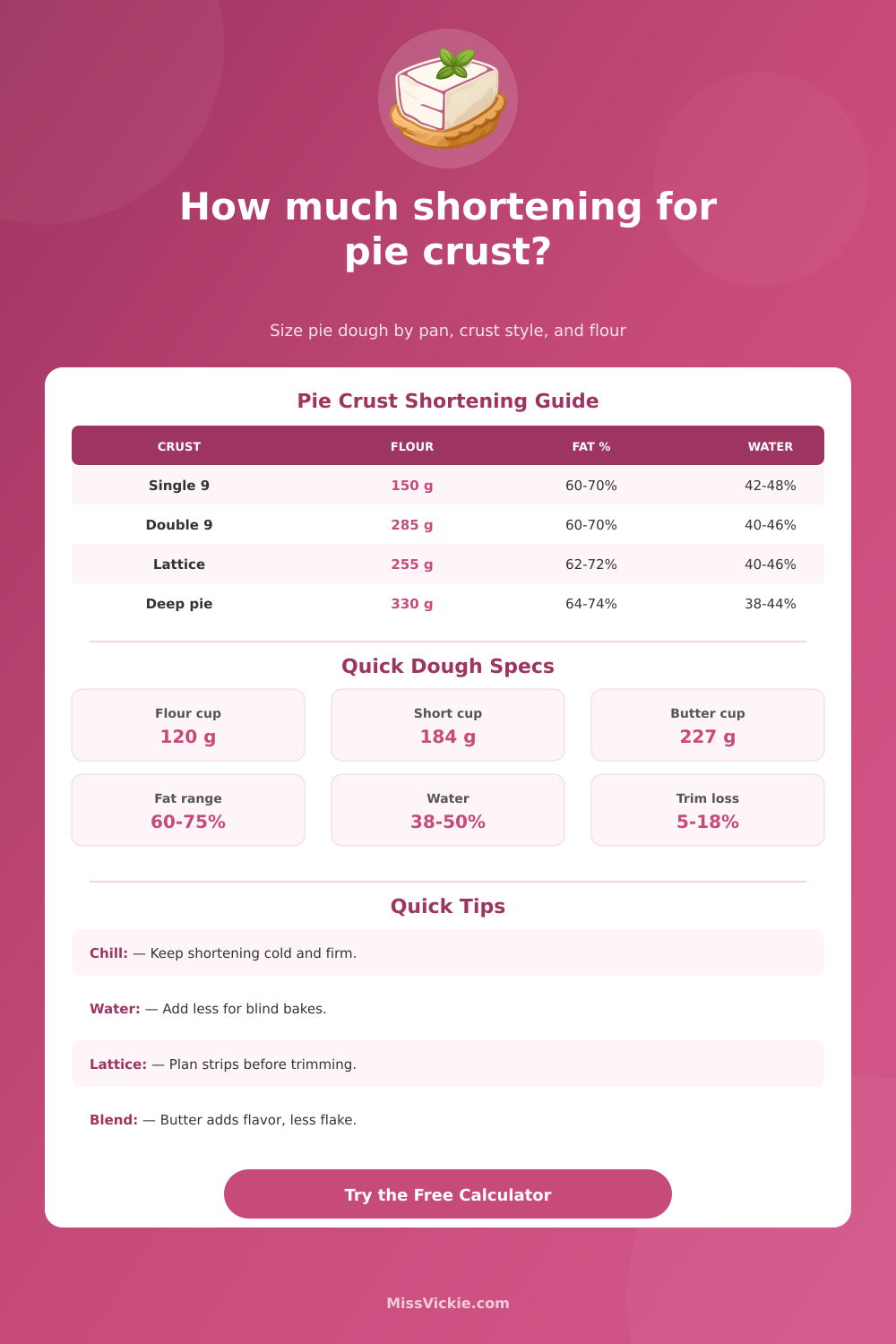
| Pie plan | Pan | Flour | Notes |
|---|---|---|---|
| Single shell | 8 to 9 in | 135 to 155 g | Bottom crust with standard crimp |
| Double crust | 9 in | 270 to 300 g | Top crust plus bottom crust |
| Lattice pie | 9 in | 245 to 275 g | Extra strips and weaving loss |
| Deep dish | 9.5 to 10 in | 315 to 360 g | Taller sides and wider rim |
| Quarter slab | 13 by 9 in | 430 to 520 g | Use slab mode with pan sides |
Shortening and Butter Blends
| Blend | Texture | Use | Handling |
|---|---|---|---|
| 100% shortening | Flakiest | Classic fruit pies | Forgiving and easy to roll |
| 75% shortening | Flaky with flavor | Everyday pies | Keep butter pieces chilled |
| 50% shortening | Tender, rich | Holiday pies | Chill before rolling |
| 25% shortening | More buttery | Tarts and quiche | Watch for smearing |
| 0% shortening | Firm and crisp | Butter crust | Needs colder handling |
Water by Bake Type
| Bake use | Water % | Feel | Why |
|---|---|---|---|
| Filled fruit pie | 42 to 48% | Flexible | Top crust must stretch |
| Blind bake | 36 to 43% | Firm | Reduces slump and shrinkage |
| Par-bake | 38 to 44% | Moderate | Holds edge shape |
| Hand pies | 44 to 52% | Sealable | Dough needs folding strength |
Useful Weight Conversions
| Ingredient | 1 cup | 1 oz | Kitchen note |
|---|---|---|---|
| All-purpose flour | 120 g | 28.35 g | Spoon and level if using cups |
| Shortening | 184 g | 28.35 g | Pack into measuring cup |
| Butter | 227 g | 28.35 g | 1 stick is about 113 g |
| Cold water | 237 g | 28.35 g | 1 tablespoon is about 15 g |
Pie dough absorbs water differently by flour brand, room temperature, and mixing style. Start with the calculated water, hold back a spoonful, and add only until the dough clumps when pressed.
Making a pie crust require an understanding of the ratio of ingredients to the pie crust recipe. The ratios of ingredient will determine whether or not the pie crust will hold together or if the pie crust will leak fats. Shortening is one of the main ingredient that must be used in the pie crust.
Shortening will provide the flake in the pie crust because shortening melts at a more higher temperature then butter. When shortening melts in the crust, the melted shortening will create pockets of steam, which will create the flakes in the crust. Additionally, another decision that must be made in creating a pie crust is the amount of fat that will be used.
Measuring Ingredients for a Pie Crust
The amount of fat that the baker uses in the crust will change depending on the size of the pan in which the crust is to be baked and the style of the crust that is to be created. The percentage of fat that is present in the pie crust will impact both the tenderness and the structure of the crust. If there is too little fat in the crust, it will be tough to roll.
However, if there is too much fat in the crust, the layer of the crust may collapse before it has a chance to set. To account for these different factor, a calculator may be used to determine the amount of fat that should of been used in the crust. For instance, a lattice top crust will require more dough than a standard crust for the lattice top.
The extra dough will prevent the dough from tearing as it is rolled. The second variable to consider when creating a pie crust is the amount of water to add to the crust. This is a variable that may surprise many individual who create pie crusts.
The amount of water to add will change according to the type of flour that are used for the crust and how the crust is to be baked. For instance, blind baked crusts require less water than hand pies and turnovers. The amount of water to add to the crust will depend upon the hydration level of the flour that is used to create the dough.
Thus, the amount of water will need to be adjusted according to the use of the crust. Many individuals will opt to use butter in they pie crusts. Butter will provide the crust with flavor and color.
However, the use of butter will change how the crust are prepared. Shortening creates the cleanest flake in the crust. Butter contains water and milk solid that are not contained in shortening.
Because of this, the use of butter may cause the pie crust to shrink. A tool may be used to determine the percentage of butter that is to be used in the total amount of fat. The use of this tool will determine the amount that the shortening weight must drop to allow for the amount of butter to be incorporated into the crust.
Another factor that must be accounted for in the creation of pie crusts is trim loss. Trim loss is lost when cutting the lattice crust strip. The crust is inevitably cut into scraps in the decorating of the crust.
The calculator for the crust will account for trim loss in the total amount of flour that is to be used. Otherwise, the dough may run out during the rolling of the crust. Decorative crusts require more dough than a non decorative crust.
The dough will need to be accounted for in the recipe to prevent the crust from tearing during decorative steps. Each of the variables in the pie crust will interact with each of the other variables. Thus, increasing the amount of each ingredient will not necessarily create a crust that can be baked in a larger pan.
The depth of the pan, the type of crust and the way in which the crust is decorated will all change the amount of each ingredient. It is best to begin the crust with a reference weight and scale the ingredients accordingly. Scales based off the reference weight will create more accurate results than memorizing several different crust recipes.
Finally, once the correct amount of each ingredient has been determined, the ingredients will need to be cold and minimally handle in the creation of the crust.