How Much Flour for Pie Crust?
Calculate flour for single crusts, double crusts, lattice pies, tart shells, slab pies, deep dish pans, galettes, and hand pies using pan size, depth, thickness, and dough ratios.
Pick a real baking setup to fill pan size, crust type, flour style, hydration, fat ratio, trim allowance, and batch overage.
Calculation Breakdown
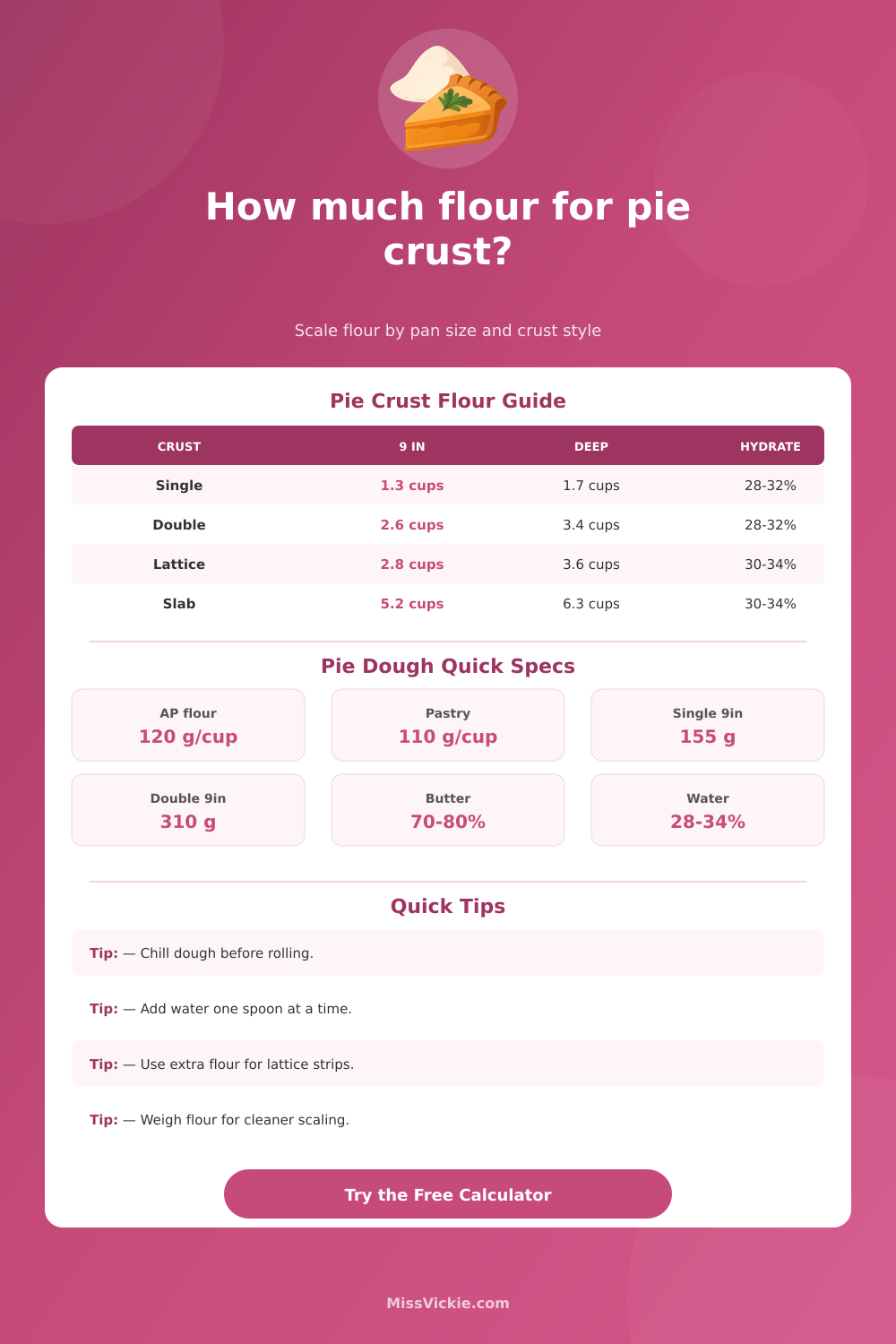
About 1.3 cups flour for a standard bottom crust.
About 2.6 cups before lattice or heavy trim.
Typical flour range for a deep double crust.
Half sheet pies often need five cups or more.
| Crust style | Best use | Flour factor | Water range |
|---|---|---|---|
| Single bottom crust | Pumpkin, custard, quiche, pecan | 1.00 x pan shell area | 26% to 32% |
| Double crust | Apple, peach, berry pies with full lid | 1.95 x single shell | 28% to 34% |
| Lattice top | Cherry, blueberry, juicy fruit pies | 2.10 x single shell | 30% to 34% |
| Deep dish double | High fruit fillings and tall crimped edges | 2.25 x single shell | 30% to 36% |
| Tart shell | Shallow pans with neat straight sides | 0.86 x standard shell | 24% to 30% |
| Galette | Free-form fruit pies with folded edge | 0.92 x round area | 28% to 34% |
| Slab pie | Rectangular pan pies for a crowd | 2.05 x slab bottom area | 30% to 35% |
| Hand pies | Turnovers, mini pies, sealed pockets | 2.35 x cutout area | 30% to 36% |
| Pan | Typical depth | Single crust flour | Double crust flour |
|---|---|---|---|
| 8 inch standard pie pan | 1.25 in | 125 to 145 g | 250 to 290 g |
| 9 inch standard pie pan | 1.25 in | 145 to 170 g | 290 to 340 g |
| 9.5 inch glass pie pan | 1.4 in | 165 to 190 g | 330 to 380 g |
| 10 inch deep dish pan | 1.8 to 2 in | 200 to 235 g | 400 to 470 g |
| 11 inch tart pan | 1 in | 150 to 180 g | Not typical |
| 13 x 18 inch slab pan | 1 in | 330 to 390 g | 600 to 720 g |
| Flour style | Grams per cup | Crust behavior | Adjustment cue |
|---|---|---|---|
| All-purpose flour | 120 g | Reliable flaky pie dough | Use as baseline |
| Pastry flour | 110 g | Tender, delicate crust | Chill well before rolling |
| Cake flour | 115 g | Very tender but less sturdy | Best for tart shells |
| Whole wheat blend | 120 g | Nutty, absorbs more water | Add 2% to 6% water |
| Gluten-free blend | 130 g | Needs binder and rest time | Use higher hydration |
| Sifted spooned flour | 105 g | Light cup measure | Weigh if possible |
| Scenario | Flour target | Fat target | Water target |
|---|---|---|---|
| One 9 inch single crust pie | 150 to 170 g | 105 to 125 g | 45 to 55 ml |
| One 9 inch double crust pie | 300 to 340 g | 215 to 270 g | 90 to 115 ml |
| Two holiday double crust pies | 650 to 730 g | 470 to 585 g | 200 to 250 ml |
| One deep dish apple pie | 390 to 470 g | 280 to 375 g | 125 to 160 ml |
| Six 5 inch mini pies | 420 to 500 g | 300 to 400 g | 135 to 170 ml |
| One half sheet slab pie | 600 to 720 g | 430 to 575 g | 190 to 245 ml |
Calculating the correct amount of flour is an necessary step in creating a pie crust. The amount of flour that you use will determine the texture of the crust, as well as it’s integrity. If the amount of flour that you use is too low, the dough will tear or shrink away from the edges of the pan.
If the amount of flour that you use is too high, the crust will be tough rather than tender. While it may seem like you should always use the same amount of flour each time that you prepare a crust, the amount of flour that you should use can change depending on the size of the pan in which you will cook your pie, the style of crust that you will use, and the type of flour that you use. The amount of flour that you will need will depend upon the area that the dough must cover.
How Much Flour to Use for a Pie Crust
A bottom crust will have to cover the bottom and sides of the pan in which the pie will be cooked. A top crust will have to contain twice as much flour as a bottom crust. If you make a lattice crust, it will require more flour than a full top crust, since it will leave gaps in the crust.
Decorative edges will require more flour as well. The calculator will calculate the amount of flour that you will need for your projects based off the size of your pan, the type of crust you will create, and your preference for the thickness of the crust; the calculator will make it unnecessary for you to guess at the amount of flour that will be required to successfully create your crust. Another factor that may impact the amount of flour that you need will be the type of flour that you use.
Different types of flour have different weights per cup of flour. All-purpose flour is the most common flour for making pie crusts. Pastry flour is lighter than all-purpose flour, and produces a more delicate crust.
Whole wheat flour and gluten-free flour mixes will change the weight of the flour as well as the amount of water that the flour will require in order to properly make your crust. These different types of flour can be accounted for in the calculator, which will calculate the amount of flour and water that you will need for your crust. The ratio of fat to flour and the percentage of water in the dough will impact the amount of flour that you must use to make your crust.
If you use a higher percentage of fat in your crust, your dough will be more tender. However, higher amounts of fat will make the dough softer to the touch, which is sometimes difficult when rolling the crust. The calculator can account for the percentage of fat and the amount of water in the dough.
The water is needed to allow the fat to create steam pockets as the crust cooks. Too much water added at once will create sticky dough. Too much sticky dough will require you to add more flour to the dough, which will make the crust become tough.
The thickness of the dough will impact the amount of flour that you will need to prepare your crust. Thicker crusts will be useful for deep-dish pies. Thin crusts are useful for hand pies.
The calculator can account for the thickness of your crust before you prepare your dough. It is also necessary to account for trim allowance and batch overage when preparing your dough. The trim allowance accounts for the dough that you will trim off of your crusts.
Some dough will remain on the counter. Batch overage provides for extra dough in case you make a mistake in the preparation of your crust. Accounting for both trim allowance and batch overage will ensure that you dont have to prepare a second batch of crust if you run out of dough.
The shape of the pan in which the pie will be prepared will impact the amount of flour that is needed for the crust. A slab pan will require a different amount of flour than a round pie pan. Mini pie pans will require more flour per unit of area than a round crust pan.
A galette will contain less total area than a fitted crust, but will require more flour to prepare the border of the pie. The calculator can account for the actual measurements of your pan, which will account for the precise amount of flour that will be required to prepare your crust. The reference tables provide information regarding the amount of flour that may be required based upon the type of pan in which the pie will be cooked.
These tables is useful if you are planning a number of pies. The batch planning table will allow you to determine the amount of flour, fat, and water if you plan on preparing more than one crust. These tables will allow you to understand the relationship between the size of the pan and the amount of crust that should be prepared.
Mistakes are often made in the step of measuring the flour for your pie crust. One of the most common is scooping the flour directly from the bag; this will compact the flour. Compacting the flour will add too much weight to your dough.
Using both cup and weight measurements for flour without accounting for the type of flour may result in errors. Adding all of the water at once will result in a sticky dough. Too much sticky dough will require you to add more flour, which will make the crust tough.
The calculator can account for these errors prior to mixing your ingredients. Once you have calculated the amount of flour that you will need, the remainder of your recipe will be based upon that measurement. If you calculated the flour correctly, you will know how much fat to add to the flour.
You will also know how much water to add. The dough will behave in the same way each time because you have accounted for the ratio of flour, fat, and water in your crust. This consistency ensures that you will never have to second-guess the ingredients for your pie crust.
Furthermore, calculating the amount of flour that you need will allow you to adjust the recipe according to any changes you may make to the pan or the type of flour you use.