🦃 How Much Pheasant Per Person
Estimate roast birds, breast portions, shredded pheasant, stew meat, and buffet pans with guest mix, edible yield, appetite, and extra buffer built into one planning calculator.
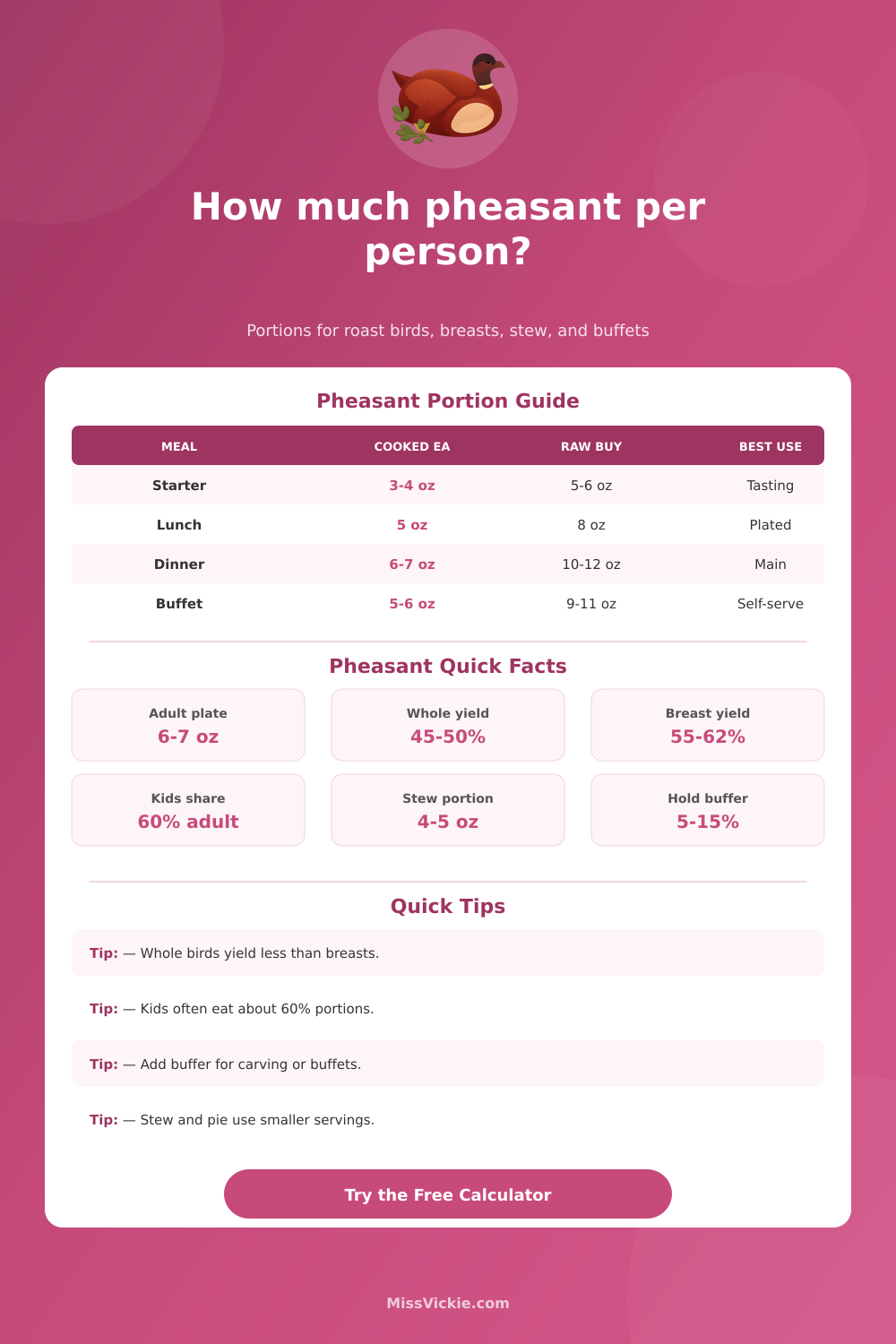
| Meal Format | Cooked Per Adult | Typical Raw Buy | Best Fit |
|---|---|---|---|
| Tasting Starter | 3.5 oz | 5 to 6 oz | Passed appetizers or first course pheasant bites |
| Plated Lunch | 5.0 oz | 8 to 9 oz | Sandwiches, salads, and light carved servings |
| Plated Dinner | 6.6 oz | 10 to 12 oz | Main-course breast or roast bird portions |
| Buffet Line | 5.8 oz | 9 to 11 oz | Self-serve chafers with several side dishes |
| Pheasant Format | Edible Yield | Default Unit | Planning Note |
|---|---|---|---|
| Whole Roasted Bird | 48% | 40 oz bird | Best for dramatic plating, but bone and carcass trim reduce usable meat. |
| Crown or Breast-On-Bone | 60% | 22 oz crown | Stronger yield than whole birds with a carved-table look. |
| Boneless Breast Packs | 92% | 12 oz pack | Most efficient choice for neat plated portions. |
| Trimmed Stew Meat | 78% | 16 oz pack | Works well for pies, chili, and sauced pans with smaller portions. |
| Guests | Whole Birds | Boneless Breasts | Stew or Pie Meat |
|---|---|---|---|
| 4 | 1 to 2 birds | 2 packs | 2 packs |
| 8 | 2 to 3 birds | 4 to 5 packs | 3 to 4 packs |
| 12 | 4 birds | 6 to 7 packs | 5 packs |
| 20 | 6 to 7 birds | 10 to 11 packs | 8 packs |
| Method | Cook Recovery | Buffer Range | When to Use It |
|---|---|---|---|
| Roast | 94% | 8 to 10% | Best all-purpose baseline for whole birds and crowns. |
| Braise | 98% | 5 to 8% | Moisture-friendly option for legs, thighs, and sauced service. |
| Smoke or Grill | 88 to 90% | 10 to 15% | Add extra when the meat will rest or sit in a buffet line. |
| Covered Stew | 100% | 5 to 8% | Least shrink for chili, pie filling, and casseroles. |
When planning to use pheasant for eight people, you must calculate the amounts of pheasant required. This is because pheasant meat contains less meat than other meat. Pheasant meat contains many bones that will reduce the amount of pheasant meat that an individual can eat.
In calculating the amount of pheasant to purchase, you must account for the weight of the bones in the pheasant. Additionally, you must also account for the weight of the pheasant that will be lost during the cooking process. If these variable are not accounted for, there will not be enough pheasant for each person sitting at teh table for the meal.
How Much Pheasant to Buy for Eight People
A whole pheasant will have a low yield. The whole dressed pheasant will weigh 40 ounces when uncooked. However, the yield of meat will be 45 to 50 percent of the weight of the whole pheasant.
If pheasant breasts is used instead of whole pheasants, the percentage of yield will be more higher. If the pheasant breasts are on the bone, the yield will be 60 percent of the weight of the pheasant breast. If the pheasant breast is boneless, the yield will be 90 percent of the weight of the pheasant breast.
Therefore, using pheasant breast instead of whole pheasants will allow for more meat to be provided for the number of individual eating the meal. The number of people that will eat the pheasant and the age of those individuals will change the amount of pheasant that you need to purchase. Children will eat less pheasant than adults.
The amount of pheasant that children eat will only be about 60 percent of the amount of pheasant that an adult eat. If there are many children eating the pheasant, the amount of pheasant that is required to be purchased will be less than if there is only adults eating the pheasant. The side that will be served will also change the amount of pheasant that each individual eats.
If heavy side dishes are served, the amount of pheasant that each individual eats will be less. If sparse side dish are served, the amount of pheasant that each individual eats will be more. The method for cooking the pheasant will also change the amount of meat that can be obtained after the pheasant is cooked.
If the pheasant is roasted, the amount of moisture that will be lost will retain about 94 percent of the moisture of the whole pheasant. If the pheasant is smoked or grilled, the pheasant will lose more moisture and the cooked weight will be 88 percent of the weight of the whole pheasant. Because smoking and grilling will result in the loss of more moisture than roasting, if pheasant is to be smoked or grilled, you must purchase more pheasant.
If the pheasant is braised or stewed, the weight of the pheasant will remain the same after cooking. Additionally, the sauce that will be used will stretch the amount of pheasant meat. By cooking the pheasant in this manner, the recipe will include a buffer of 5 to 15 percent of the total weight of the pheasant to allow for waste when carving the pheasant.
Pheasant is a lean meat and contains a specific nutritional profile. One hundred grams of pheasant contains 133 calories. One hundred grams of pheasant contains 28 grams of protein.
One hundred grams of pheasant contains 3 grams of fat. One hundred grams of pheasant contains 1.6 milligrams of iron. Additionally, because pheasant is lean, if cooked incorrectly, the pheasant will be dry.
To avoid having dry pheasant, it can be confit or braised prior to cooking. There are some mistake that should be avoided when purchasing pheasant for a meal. One mistake that could be made is underestimating the amount of pheasant that children will eat.
Another mistake is forgetting that people will eat more pheasant at a buffet than they would at a formal meal. People will eat more pheasant at a buffet if it is served because they can come back for seconds. For buffet meals, five to six ounces of pheasant should be provided per person instead of the seven ounces that may be provided for a formal meal.
Additionally, the pheasant may be wild or farm-raised. If the pheasant is wild, it will be leaner than farm-raised pheasant. Therefore, you will require more pheasant if the pheasant is to be wild instead of farm-raised.
Finally, the amount of pheasant to be purchased should be rounded up. By rounding up the amount of pheasant to purchase, there will be an extra amount of pheasant that can be used for leftovers or a pâté. If the pheasant is not rounded up, there may not be enough pheasant for each individual at the meal. By considering the yield of the pheasant, the appetite of the guests, and the method for cooking the pheasant, you can calculate the amount of pheasant that will be required to be purchased for the meal.