How Much Cornstarch to Thicken Peach Cobbler Calculator
Estimate the right cornstarch slurry for fresh, frozen, or canned peach cobbler using peach weight, added juice, sugar, bake time, pan size, and your target filling texture.
Choose a starting point, then adjust the fruit and juice you actually have in the bowl.
Full Cobbler Thickening Breakdown
| Peach Type | Expected Juice | How To Count It | Cornstarch Note |
|---|---|---|---|
| Fresh ripe peaches | About 0.15 cup per pound | Add lemon juice and macerated juice | Classic rate usually works |
| Very juicy summer peaches | About 0.22 cup per pound | Include all bowl juices | Add a small margin for runniness |
| Frozen thawed peaches | About 0.28 cup per pound | Measure thawed liquid if drained | Needs more starch than fresh |
| Canned peaches in syrup | Often 0.3 cup per pound or more | Count reserved syrup as liquid | Drain or increase starch |
| Cornstarch | Cold Liquid | Metric Starch | Best Use |
|---|---|---|---|
| 1 tablespoon | 1 to 1.5 tablespoons | About 8 grams | Small skillet or juicy topping |
| 2 tablespoons | 2 to 3 tablespoons | About 16 grams | Fresh peach 8 inch cobbler |
| 3 tablespoons | 3 to 4.5 tablespoons | About 24 grams | Standard frozen peach cobbler |
| 4 tablespoons | 4 to 6 tablespoons | About 32 grams | Large pan or thick filling |
| Filling State | Visual Cue | What It Means | Adjustment |
|---|---|---|---|
| Edges only bubble | Thin center | Starch may be undercooked | Add bake time, not more starch |
| Full slow bubbling | Glossy syrup | Cornstarch has activated | Rest before judging texture |
| Very thick before bake | Cloudy paste | Slurry may be too concentrated | Thin with peach juice |
| Watery after cooling | Loose puddle | Too much liquid for starch | Cook juices next time |
Soft cobbler sauce that flows around biscuit topping.
Balanced spoonable filling with glossy peach syrup.
Thicker scoop with less syrup pooling in the pan.
Useful when cobbler must hold neater portions.
| Batch | Peaches | Liquid To Thicken | Typical Cornstarch |
|---|---|---|---|
| Mini skillet | 1 to 1.5 pounds | 1/4 to 1/2 cup | 1 to 1.5 tablespoons |
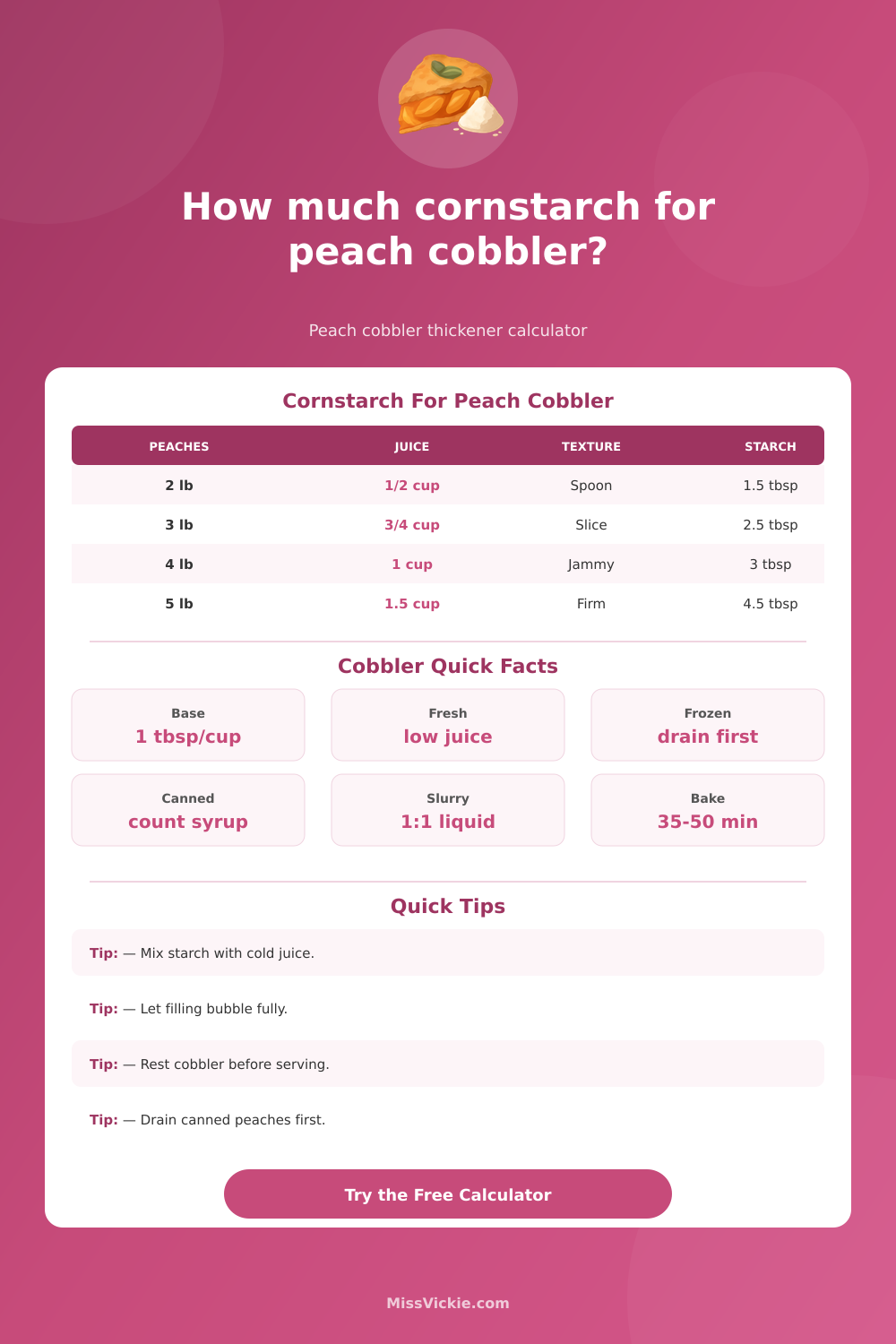
| 8 inch cobbler | 2 to 3 pounds | 1/2 to 3/4 cup | 1.5 to 2.5 tablespoons |
| 9 x 13 pan | 4 to 5 pounds | 1 to 1.5 cups | 3 to 4.5 tablespoons |
| Potluck tray | 6 to 8 pounds | 1.5 to 2.5 cups | 4.5 to 7 tablespoons |
Peach cobbler require a filling that holds a consistant shape, and a peach cobbler require a filling that doesnt become too liquidly. When baking peach, the peaches will release juice, and that juice can make the filling too liquid. Cornstarch can be used to thicken the liquid in the filling, and the amount of cornstarch that should be used in the recipe depend on the type of peaches that are used in the recipe, the amount of sugar that will be used, and the type of pan in which the cook will bake the peach cobbler.
The peach cobbler calculator will calculate the amount of cornstarch that should be used in the peach cobbler recipe if the following variable are entered into the calculator: the weight of the peaches that will be used in the recipe, the amount of juice that is contained within the peaches. The type of peach that is to be used in the recipe will impact the amount of juice that the peaches release when they are baked; ripe peaches will release more juice then firm peaches. Additionally, if the peaches that are used in the cobbler recipe are frozen, the amount of liquid in which the cobbler will be baked can change due to the peaches releasing there liquid as they thaw.
How much cornstarch to use in a peach cobbler
The calculator can account for the liquid that frozen peaches will release when they are baking to ensure the cobbler does not become too thin. The amount of sugar that will be used in the peach cobbler will impact the thickness of the cobbler filling. Sugar will draw the liquid out of the peaches, but it will also decrease the ability of the cornstarch to thicken the liquid in the peaches when they are baked.
Therefore, if more sugar is used in the peach cobbler filling than another recipe, more cornstarch should be used in the recipe to account for the liquid that the sugar draws out; the calculator account for the amount of sugar that will be used in the peach cobbler. The time that it takes for the peach cobbler to bake will also impact the amount of cornstarch that is used in the filling. If the bake time is too short, the cornstarch will not have had time to thicken the liquid in the peaches; if the time for baking is too long, the cornstarch can potentially thicken the filling beyond the desired thickness.
The type of pan in which the peach cobbler is baked will also impact the amount of cornstarch that is baked. If the pan in which the peach cobbler is baked is relatively shallow, the liquid will have the potential to evaporate more rapidly during the baking process; baking in a shallow pan will require less cornstarch to thicken the liquid in the baking pan. Baking in a deep pan will trap the liquid in the pan, preventing it from evaporating; baking in a deep pan will require more cornstarch to thicken the liquid in the peaches.
The calculator includes a variable in which the depth of the pan can be accounted for. Additionally, the cook should mix the cornstarch with a cold liquid to create a slurry; this slurry can then be mixed into the peach cobbler to prevent the cornstarch from creating lumps in the filling. When baking peach cobblers, many people make the mistake of determining the thickness of the filling while the peach cobbler is still hot.
When hot, the filling will appear thinner than if it were allowed to rest. As the peach cobbler rests, the cornstarch will continue to thicken the liquid in the cobbler; allowing the cobbler to rest will lead to a thicker filling. Therefore, if a thicker filling is desired, the cook should allow the cobblers rest once it is removed from the oven.
If a thinner filling is preferred, the cobbler should be served while it is warm. The calculator will suggest a resting time for the cobbler to reach the desired thickness of the filling. All of the liquid that will be in the cobbler should be accounted for when baking the cobbler.
If the sugar is mixed with the peaches prior to baking them, that will add to the amount of liquid in the baking pan. If canned peaches are to be used in the recipe, the amount of liquid in the canned syrup will have to be accounted for. Finally, if the peaches are to be frozen, the amount of liquid that those peaches will release as they thaw will have to be accounted for.
These variables will be accounted for in the calculator to allow for the thickening of the filling to include all of the liquid that will be present in the cobbler. The texture to which the peach cobbler filling will be baked can also be accounted for in the calculator. For those who prefer a baking recipe in which the filling has a relatively loose texture, the calculator will account for that texture in the amount of cornstarch that is required to be baked into the peaches.
For those who would like the texture of the filling to be firmer such that the squares of cobbler can be baked into the dessert, the cornstarch can again be accounted for in the recipe that is created using the calculator. Therefore, the calculator is useful in accounting for these variables of the baking recipe. Once the type of peaches, amount of sugar, amount of juice, type of pan, and amount of time to bake have been accounted for, the recipe will allow for the baking of a peach cobbler that will have a texture that is exactly to which the cooks wish to bake their peach cobblers.