Pastrami Cure Calculator
Plan brisket brine strength, Cure #1 ppm, salt, sugar, pickling spice, injection, cure days, desalination soak, smoke and cook loss, and finished slice yield.
🥩Pastrami cure presets
Choose a brisket style, then tune the weight, thickness, brine, injection, salt, sugar, cure target, soak, and finished slicing plan.
⚖Units
🔪Brisket and cure method
🧂Cure, spice, injection, and soak
🔥Smoke, cook, and slice yield
Pastrami cure plan
Ingredient and yield breakdown
Enter brisket and cure details to check the plan.
📊Pastrami planning benchmarks
Common equilibrium cure range before soaking.
Typical ingoing nitrite target for cured beef.
Useful for thick flats and whole briskets.
Typical smoke plus cook loss for slices.
📘Reference tables
| Brisket style | Typical thickness | Injection | Cure days | Yield note |
|---|---|---|---|---|
| Trimmed flat | 4-6 cm / 1.5-2.5 in | Optional at 8-10% | 5-7 days | Lean slices, moderate loss |
| Thick flat | 6-8 cm / 2.5-3.25 in | Recommended at 10-12% | 7-10 days | Longer soak may taste cleaner |
| Point | 6-9 cm / 2.5-3.5 in | Recommended | 8-11 days | Fattier, softer sandwich slices |
| Whole packer | 7-10 cm / 2.75-4 in | Strongly recommended | 10-14 days | Separate flat and point for even slices |
| Cure component | Typical range | Calculator role | Practical note |
|---|---|---|---|
| Salt percentage | 2.0-3.5% | Main cure salinity | Higher salt often needs a longer soak. |
| Sugar percentage | 0.3-1.5% | Balances cure flavor | Brown sugar gives a rounder deli flavor. |
| Pickling spice | 0.8-2.0% | Brine aromatics | Toast coriander and pepper before crushing. |
| Rub percentage | 1.5-3.0% | Exterior bark | Apply after rinsing and desalination soak. |
| Finished use | Cooked portion | Slice target | Serving estimate |
|---|---|---|---|
| Deli sandwich | 150-190 g / 5-7 oz | 20-35 g | 4-7 slices per sandwich |
| Stacked rye | 200-250 g / 7-9 oz | 25-40 g | 6-9 slices per sandwich |
| Platter slices | 100-140 g / 3.5-5 oz | 18-28 g | 4-6 lighter portions per lb |
| Hash or cubes | 80-120 g / 3-4 oz | Not sliced | Use yield weight, not slice count |
💡Pastrami cure tips
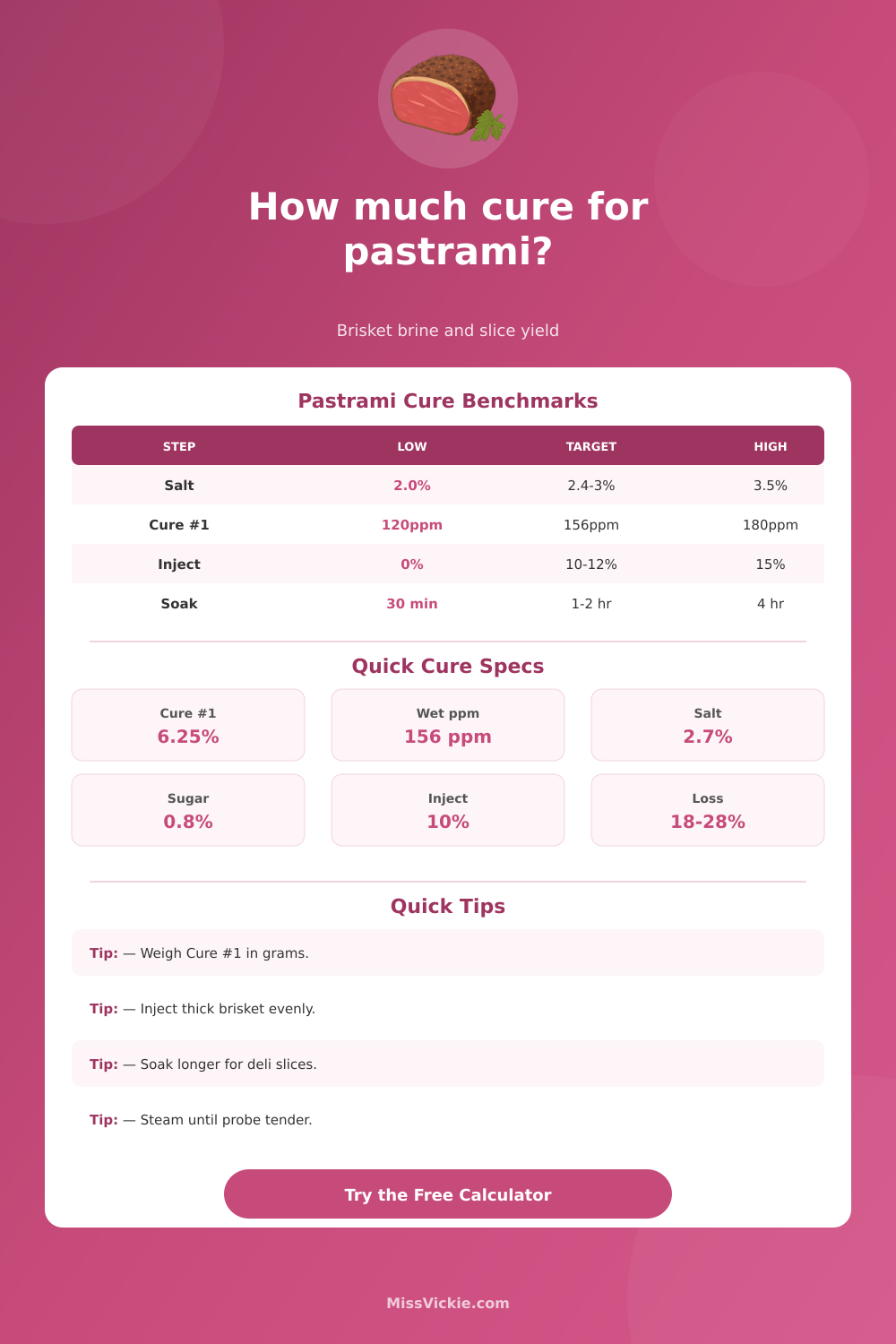
Inject for thickness: A thick flat or whole brisket cures more evenly when 10-12% of the brine is injected in a grid before submerging.
Soak after curing: Rinse the cured brisket, soak in cold water, and fry a small test slice if you need to judge salt before adding the pepper-coriander rub.
Separate large cuts: Whole packers cure and slice better when the flat and point are trimmed consistently, even if they stay in the same brine batch.
Plan final tenderness: Pastrami is usually smoked for bark and color, then steamed or held moist until the probe slides in easily.
Here’s the thing about homemade pastrami: It all begins with one basic question: How much salt and nitrite do I need to get to the center of my brisket? The number will be different depending on whether you use an injection, how thick it is, or if it is trimmed with more or less fat. So you choose your brine strength, your target cure time. You punch those numbers into a calculator and it figures out the math for you.
But first, know what each variable mean in the real world of curing meat. “Brisket is an uneven cut. Point can sit another three days easily, while the flat will be cured in five or six days if left in the fridge. That’s where the calculator want you to enter thickest part, because it uses that as the basis for calculating the rest. When you enter widest section, it will adjust your recommended cure time according to thickness.
Understanding the Variables for Homemade Pastrami
You don’t want a short cure on a thick brisket; the middle get under-cured. Likewise, too long a cure on a thin flat can create a salty band on top side of your meat. This saltiness can never be completely soaked out.
The other timing variable that’s harder to predict and less discussed is what I call “injection percentage.” To illustrate, if you inject 10 percent of your brine solution, it will move the nitrite/salt further into the meat faster. This can help when you have a thick flat or a whole packer, where you’d like everything ready in under ten days. Without the injection, the same cut might take two days longer, and then require more turns as well. Although the calculator estimates total cure time, it doesn’t factor in whether you actualy distributed those needles evenly throughout. If they’re spotty, there are still slow-curing pockets remaining.
The desalination soak and its salt percentage. Generally speaking, if you are going for a nice deli-style slice with some salt still remaining (a 1- to 2-hour soak in cold water) you want 2.7 percent as your balance goal. Go up to 3.2 percent and that might require longer than a single water change or soak. It’ll alert you to the higher value and recommend adding more soaking time or an extra water change.
You can also look at the page’s reference table. It shows typical values for injection, nitrite, and salt to give you a sense of where you’re starting from when entering your own numbers into the calculator.
But not really about how many days: the actual day number is less important than temperature while curing. Diffusion at 34-38 degrees Fahrenheit is predictable. If it warms up, the surface will cure before the interior. If it cools down, it just takes longer but it isn’t safer. The calculator’s readiness score adjusts for the temp that you input, but assumes stable refrigeration. Add a safety day if your fridge cycle or if the brisket will hang out by the door.
But yield is calculated last, since it depends on all that came before. How much smoke do you lose? How much steam? What size slices are you aiming for at the end of the day? A fatty point will make fewer sandwiches than a lean flat, but the point retain more juice during steaming. Input your desired serving and slice size, and the tool calculates those numbers to give you a realistic yield number, not an optimistic one.
But what the actual numbers do for you, especially when paired with a good calculator, is they free you from thinking of pastrami as just a recipe; instead, they teach you to think of it in terms of adjustable variables, like thickness, soak time, salt target, and injection level. Adjust one and the others changes too. When you understand these relationships, the calculator’s job becomes only to ensure that you’re staying honest with the math; it lets you determine how you want your final product to look, slice, or taste.
You should of looked at all variables first.