Pastrami Brine Calculator
Build a pastrami cure plan from brisket cut, meat weight, water ratio, Cure #1 target, salt, sugar, pickling spice, garlic, thickness, injection choice, rinse loss, cook yield, and slicing size.
🥩Choose a pastrami scenario
Each preset fills a realistic cure starting point for brisket. Edit the weights, brine ratio, seasoning strength, cure target, and timing assumptions for your own tested pastrami process.
⚖Brisket and brine inputs
Metric inputs use kilograms, liters, and centimeters.
Affects water ratio, yield, and timing hints.
Equilibrium wet uses meat plus water as the cure basis.
Trimmed meat weight in kg.
Water as percent of meat weight; use 0 for dry cure.
Ingoing ppm on the selected cure basis.
Total salt percent, including Cure #1 carrier salt.
Percent of curing basis for balance and bark color.
Percent for coriander, pepper, bay, mustard, clove.
Fresh crushed garlic or equivalent paste percent.
Centimeters at the thickest point.
Percent brine retained from injecting, if used.
Estimated surface salt reduction before rub.
Finished weight after smoke, steam, or braise.
Finished grams per serving or sandwich.
Use the precision your scale can repeat.
Your Pastrami Brine Plan
Enter brisket details and calculate.
Ingredient breakdown
Timing and serving notes
📊Pastrami batch checkpoints
These are planning ranges, not legal processing instructions. Local rules and validated commercial formulas can differ by product, pickup, heat process, and labeling method.
🔪Cut and brine style reference
Brisket flat
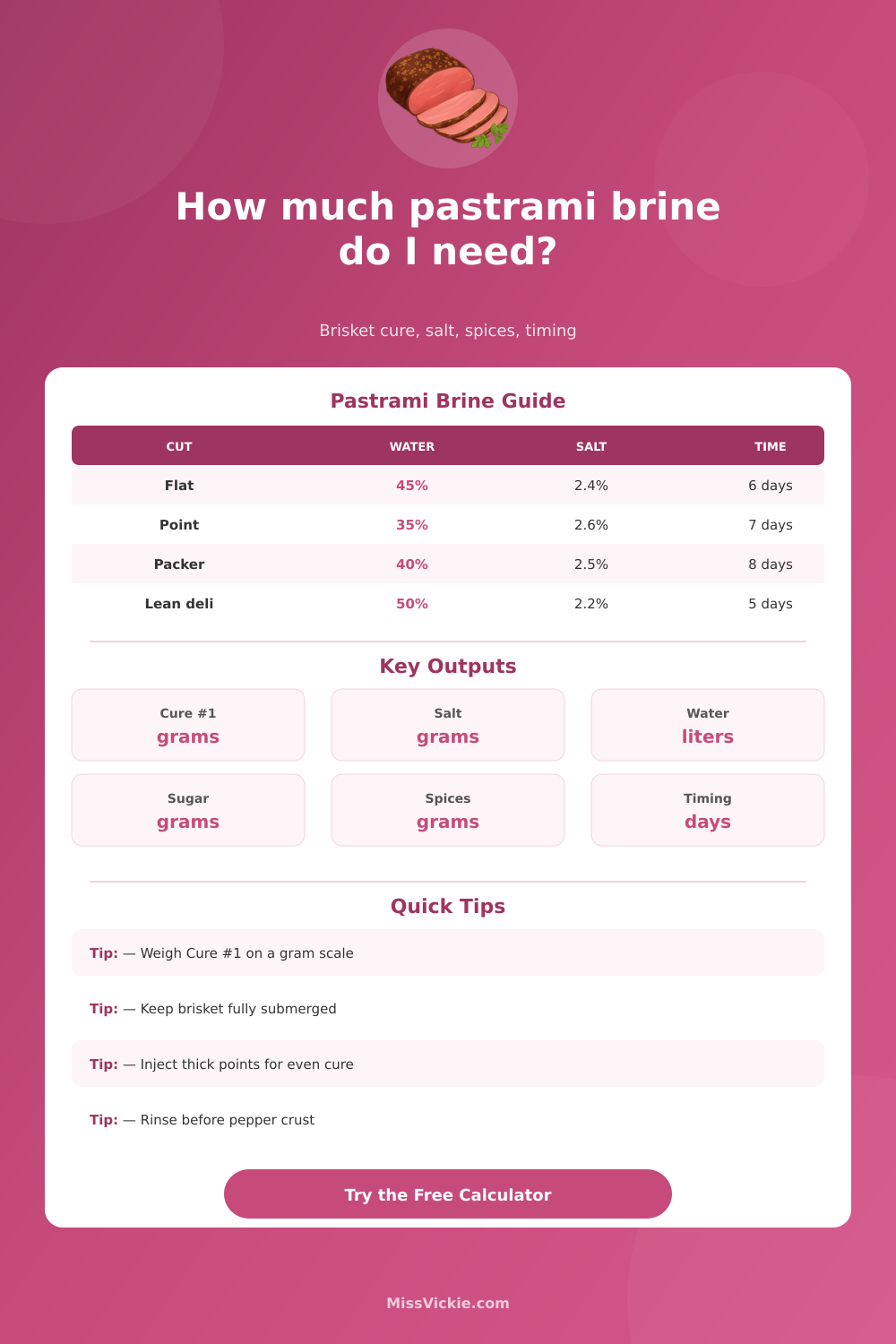
Best for neat deli-style slices. It cures evenly, dries less aggressively than lean round, and usually benefits from 40% to 50% water by meat weight.
Brisket point
Richer, fattier, and thicker. It can take a stronger spice profile and often needs either more time or injection for a balanced cure.
Whole packer
Plan around the thickest point. Many cooks split flat and point after curing so smoke, steam, slicing, and pepper crust can be managed separately.
Lean alternatives
Round, turkey breast, and trimmed flats can taste salty faster because they have less fat. Lower salt targets and shorter holding times often make sense.
🧪Brine method comparison
📘Reference brine ratios
| Pastrami Style | Water Ratio | Salt Target | Sugar Target | Best Use |
|---|---|---|---|---|
| Deli flat, balanced | 45% of meat weight | 2.3% to 2.5% | 1.0% to 1.3% | Classic sliced brisket flat with moderate salt. |
| Smoky point cut | 30% to 40% | 2.5% to 2.7% | 0.8% to 1.2% | Fattier meat that can handle stronger seasoning. |
| Lean round or turkey | 50% to 60% | 1.8% to 2.2% | 0.8% to 1.0% | Less fat, so gentler salt and sugar are useful. |
| Whole packer | 35% to 45% | 2.4% to 2.6% | 1.0% to 1.4% | Large batches where cure time follows thickness. |
| Dry cure pastrami | 0% added water | 2.2% to 2.6% | 0.8% to 1.2% | Vacuum bag or nonreactive pan cure. |
🫙Spice and aromatics grid
| Seasoning | Calculator Basis | Typical Range | Pastrami Role |
|---|---|---|---|
| Pickling spice blend | Percent of curing basis | 0.7% to 1.5% | Brine aroma from coriander, mustard, bay, allspice, clove, and pepper. |
| Garlic | Percent of curing basis | 0.2% to 0.7% | Background savoriness, especially helpful for lean flats and turkey pastrami. |
| Black pepper crust | Finished surface rub | 1.5% to 3% of raw meat | Applied after rinsing and drying, not counted as brine salt. |
| Coriander crust | Finished surface rub | 1% to 2.5% of raw meat | Classic pastrami aroma that blooms during smoke and steam. |
| Brown sugar | Percent of curing basis | 0.5% to 1.8% | Rounds salt and helps bark color; too much can burn during hot smoking. |
⏱Thickness timing reference
| Thickest Point | Wet Brine Estimate | Injected Estimate | Handling Note |
|---|---|---|---|
| Under 1.5 in / 4 cm | 4 to 5 days | 2 to 3 days | Thin flats cure quickly; avoid oversalting lean edges. |
| 1.5 to 2.25 in / 4 to 6 cm | 5 to 7 days | 3 to 5 days | Turn daily and keep fully submerged. |
| 2.25 to 3 in / 6 to 8 cm | 7 to 9 days | 5 to 6 days | Injection improves the center of thick points. |
| Over 3 in / 8 cm | 9 to 12 days | 6 to 8 days | Split very thick packers or inject with measured pickup. |
🔢Formula reference
| Formula | What It Solves | Calculator Detail | Why It Matters |
|---|---|---|---|
| Water kg = meat kg x water ratio | Brine volume before dissolved solids | 1 L water is treated as about 1 kg | Prevents tiny brines that cannot cover brisket. |
| Cure #1 g = ppm x basis kg / 0.0625 / 1000 | 6.25% nitrite curing salt | Basis changes by wet, injected, or dry method | Keeps cure math tied to the chosen pastrami method. |
| Plain salt g = salt target - cure carrier salt | Additional salt to add | Cure #1 is treated as mostly carrier salt | Avoids double-counting salt in the curing mix. |
| Brine strength = solids / water | How concentrated the liquid is | Includes cure, plain salt, sugar, spice, and garlic | Useful for comparing cover brines and injected brines. |
| Cooked slices = cooked weight / serving grams | Estimated servings or sandwiches | Yield reflects smoke, steam, braise, and trimming | Connects cure planning to sliced pastrami portions. |
💡Practical pastrami brine tips
Making pastrami requires a person to manage many different variable because each of those variables has an impact upon the final taste of the pastrami. A person wants the seasoning to be deep throughout the pastrami, the color of the pastrami to be stable, and for the salt level of the pastrami to be within a range that does not overpower the flavor of the meat. For instance, changing the cut of meat will change the water ratio of the meat, and changing the thickness of the cut will change the numbers of days that the meat needs to cure.
Individuals who may make pastrami understand these variables, but many attempt to guess at the proper measurements for these variables. If an individual guesses at any of the measurements, however, they may introduce mistakes into the plan due to the fact that the math behind these variables may change with any alteration of one of the variable. The cure for pastrami includes ingredients like Cure #1, salt, sugar, pickling spice, and garlic.
How to Use the Pastrami Cure Calculator
Cure #1 provides the nitrite for stabilizing the color of the meat and the bacteria in the cure; salt provides the flavor and textures of the meat; sugar softens the salt and aids in browning the meat during cooking; pickling spice and garlic provide the aroma of the cured pastrami. Furthermore, an individual must decide how much of each ingredient to use in the cure. For example, the weight of the cut of meat, the water ratio, and the type of cure that are to be used determine the amount of Cure #1, salt, sugar and spice.
The calculator help an individual to manage the measurements necessary to make the pastrami. An individual must input the weight of the brisket that will be used, the water ratio, the target amount of Cure #1, the percentage of salt, sugar, spice, garlic, the thickness of the cuts of meat, the percentage of injection of the brine, the loss of weight that may result from rinsing the brined brisket, the yield of cooked brisket, and the number of servings that are to be made with the batch of pastrami. The calculator will transform these inputs into the individual measurements that are necessary for the preparation of the pastrami, rather than performing the calculations by hand.
Additionally, there are reference tables included that provide common settings for water ratios and salt targets for pastrami. An individual must make a decision of which cut of meat will be used in the preparation of the pastrami. For instance, beef flats will cure even and will lose less of their moisture during the curing process; beef points have more fat and flavor to them, allowing for more salt and spice to be used when curing these cuts; whole packers include both flat and point cuts of beef, but the thick center of the cut will take longer to cure than the thin edges of the cut.
Furthermore, lean cuts of meat, such as lean rounds or turkey breasts, will cure faster than cuts that contain more fat; these cuts will have a longer time to cure than beef or turkey cuts with less fat. The calculator will adjust these times according to the cut of meat that is selected. In addition to the cut of meat that will be cured, individuals will also have to decide the type of cure that is to be used for the meat.
For instance, equilibrium wet brines will treat the cut of meat and the water as the total weight of the preparation; cover brines will submerge the meat in liquid; however, some of the liquid may drain from the cut of meat, making the salt level less exact; injection will push the brine into the thickest parts of the cut of meat; dry cures will not use a bucket of the brine to treat the cut; however, the cook must turn the cut more frequently while curing to ensure even treatment of the meat. Each of these methods will change the amount of meat that is cured, allowing the calculator to provide the proper recalculation of the amount of salt, spice, and other ingredient that will be used for that particular method of curing. Another of the variables of pastrami is thickness of the cut of meat.
For instance, thicker cuts of meat will require more days to cure than thinner cuts of meat. Furthermore, if the thickness of the cuts of meat is more than 2.5 inches, it is recommended to use injection or to split the cut to ensure that the curing process will even for all portions of the meat. These times will be provided for different methods to allow for more evenly accuracy in determining how long it will take for the meat to cure.
After the meat is cured, it may be rinsed or soaked in water to remove some of the salt from the meat. For instance, if an individual rinses the meat after curing it will lose some of its salt; too much rinsing may lead to the loss of the seasoning that was developed during the curing process. The calculator will account for the amount of salt, allowing the individual to determine whether or not the amount of salt is correct for there individual preference.
The final two variables to discuss are the variable of yield and the variable of servings. For instance, the yield will determine how much meat will be left after the pastrami curing process. If the yield is low, it means that there will be the loss of some of the raw meat during the smoking or steaming of the meat.
If an individual would like the recipe to yield a specific number of sandwich, they will have to start with more raw meat; otherwise, the low yield will result in less pastrami being prepared than is desired. Furthermore, the calculator will also account for these variables. The individual master chef can all review these variables in advance of the preparation of the pastrami.
For instance, if the water ratio is high, the salt and cure will be diluted; therefore, more Cure #1 will be necessary. Furthermore, if the percentage of spice is high, the size of the containers will have to be large enough to handle the additional spice. Finally, if an individual chooses to inject the meat, the weight of the meat will increase; therefore, the pickup of the injection will have to be measured to ensure accuracy of the percentage of salt.
These three variables will impact the taste of the pastrami. The reference tables will allow for an individual to quickly review the variables of pastrami without having to refer to the calculations that the calculator may perform. These reference tables include information about common water ratios, salt targets, and other variables according to the different types of pastrami that are prepared.
For instance, if an individual is using lean rounds or thick packers of beef, the reference tables may indicate how many days to cure the meat, the water ratio to use, and the target salt to prepare the seasoning for the meat. While the calculator cannot provide the same feel of the meat after curing, the calculations will provide an individual with the best possible start in the preparation of the pastrami. Furthermore, some individuals may find that their brisket products become tighter during the curing process.
Additionally, the spice blends may taste differently after being smoked. The best way to evaluate the salt level of the cure is to taste the brine before adding the brisket to the smoker. Using these calculations will allow an individual to have a plan in place that accounts for all of the variables.
The goal with these calculations is to ensure that the pastrami has an even color, the right amount of salt, and the spice and pepper crust balance with the cure.