Salt Per Quart of Water for Pasta Calculator
Size pasta water salt from quarts or liters, pasta weight, salt crystal density, target salinity, shape, fresh or dried pasta, sauce saltiness, evaporation, reserved water, sodium estimate, and servings.
🍝Pasta salting presets
Choose a real pasta-water setup, then adjust the water, pasta pounds, salt type, target salinity, sauce saltiness, evaporation, and serving count.
⚖Units
🍲Pot, pasta, and sauce plan
Pasta water salt result
Detailed breakdown
The calculator will compare your target with the pasta, sauce, and cooking setup.
🧂Salt density quick reference
Large flakes; biggest teaspoon volume for the same grams.
Denser kosher crystals; use fewer spoons than Diamond.
Close to many fine-grain sea salts used at the stove.
Dense fine crystals; easy to oversalt by volume.
📊Pasta water salinity table
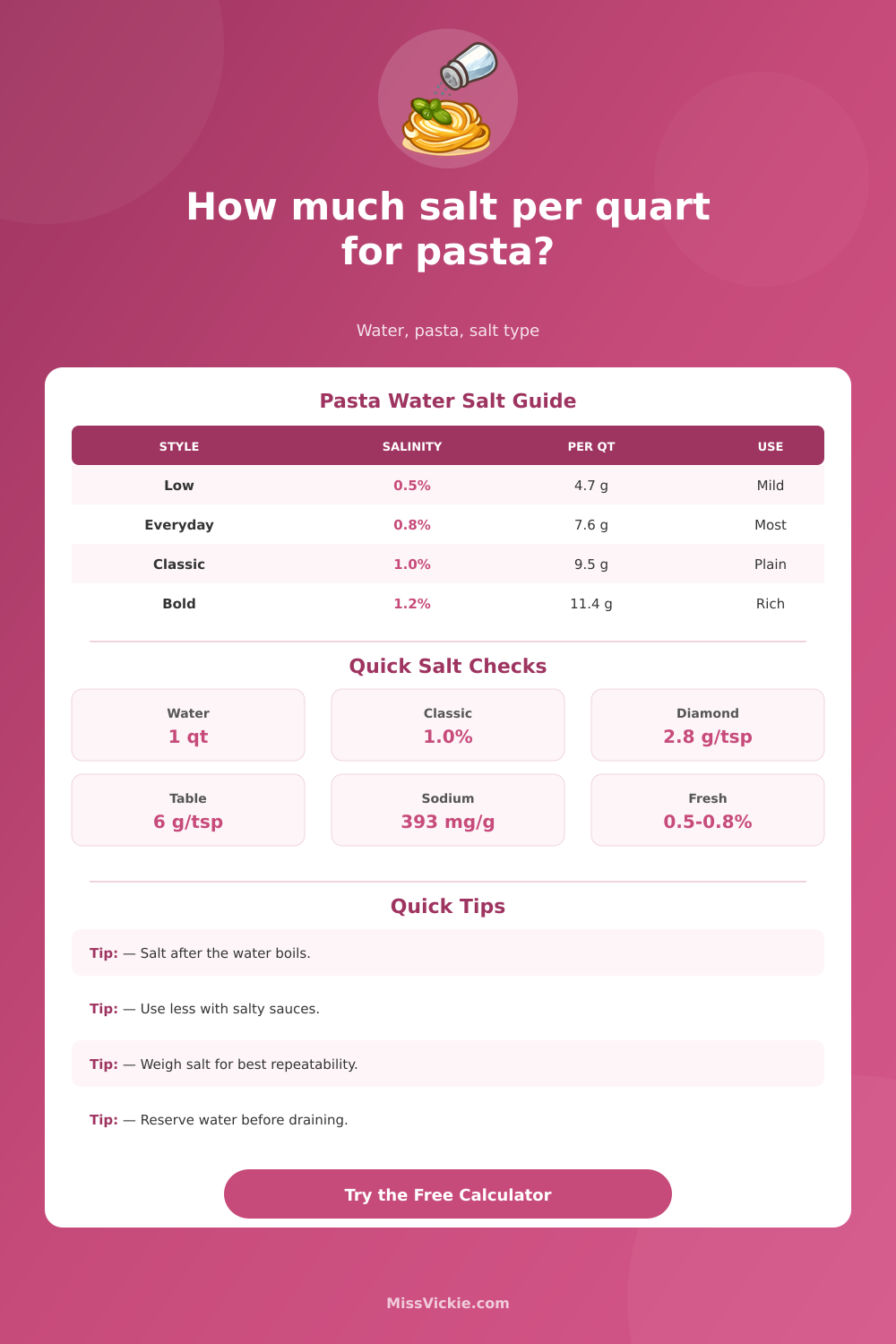
| Target | Salt per quart | Salt per liter | Best for |
|---|---|---|---|
| 0.4% to 0.6% | 3.8 to 5.7 g | 4 to 6 g | Fresh pasta, filled pasta, soup pasta, salty sauces, lower sodium meals. |
| 0.7% to 0.9% | 6.6 to 8.5 g | 7 to 9 g | Everyday dried spaghetti, penne, rigatoni, and balanced tomato sauces. |
| 1.0% to 1.1% | 9.5 to 10.4 g | 10 to 11 g | Classic restaurant-style water for simple sauces, oil sauces, or plain buttered pasta. |
| 1.2% to 1.4% | 11.4 to 13.3 g | 12 to 14 g | Short cook times, very unsalted sauce, or a bold result; taste sauce before using this range. |
🍝Shape and fresh pasta adjustments
| Pasta type | Typical water target | Absorption behavior | Salting note |
|---|---|---|---|
| Dried long pasta | 0.8% to 1.1% | Moderate absorption, low surface carry. | Good benchmark for spaghetti, linguine, bucatini, and angel hair. |
| Short tubes and ridges | 0.8% to 1.0% | More surface water clings after draining. | Reduce slightly when the sauce is salty or cheese-heavy. |
| Fresh egg pasta | 0.5% to 0.8% | Short cook, less water uptake. | Use milder water so delicate noodles do not taste sharp. |
| Filled pasta | 0.4% to 0.7% | Filling already carries salt and cheese. | Keep the water gentle, especially with ricotta, prosciutto, or aged cheese fillings. |
| Whole wheat pasta | 0.8% to 1.0% | Firm texture can need full seasoning. | Balanced salinity helps grain flavor without making sauce salty. |
| Gluten-free pasta | 0.6% to 0.9% | Fragile texture and starchy cooking water. | Season carefully and avoid very salty finishing water. |
🫙Sauce saltiness guide
| Sauce style | Target shift | Examples | How to finish |
|---|---|---|---|
| Unsalted or barely salted | Add 0.05% to 0.10% | Plain butter, olive oil, fresh tomato, low-salt cream. | Let pasta water carry most of the seasoning. |
| Balanced homemade | No major shift | Seasoned marinara, pesto adjusted to taste, vegetable sauces. | Reserve water and taste before adding extra salt. |
| Jarred or reduced sauce | Subtract 0.10% to 0.20% | Prepared tomato sauce, simmered meat sauce, concentrated pan sauce. | Use a smaller splash of pasta water first. |
| Cheese, anchovy, cured pork | Subtract 0.20% to 0.35% | Carbonara, cacio e pepe, puttanesca, amatriciana. | Keep the water milder because the sauce adds sodium fast. |
💡Practical pasta salting tips
Weigh when it matters. A teaspoon of table salt can contain more than twice the salt of a teaspoon of Diamond Crystal kosher salt, so volume-only rules are easy to misread.
Salt after boiling. Adding salt once the water is hot helps it dissolve quickly, gives a clean reading of pot volume, and avoids undissolved crystals sitting on cookware.
Reserve before draining. Pasta water used in the sauce carries salt into the finished dish; this calculator includes the amount you actually stir back in.
Match the sauce. Fresh pasta, filled pasta, salty cheese sauces, and cured-pork sauces usually need less salted water than plain dried pasta with a gentle tomato sauce.
Controlling the level of salt in your pasta water controls what will ultimately end up on your plate. Is it too little? After adding sauce, your noodles lack any flavor; they are flat. Is it too much? Before taking that first bite, this dish is sharp on your tongue.
It’s not about settling on an exact quantity of salt. It’s about figuring out how much you need depending on the kind of pasta, size of your pot, and which other ingredients you’re cooking in the same pan. Most cooks will tell you to make it taste like seawater. This is great if you are making the same thing in the same pot under the same conditions every time.
A Better Way to Salt Your Pasta Water
But then you try adjusting the conditions. A wide pot of uncovered water lose more water as steam compared to a narrower, covered one. Fresh egg pasta soaks up less liquid than dried semolina pasta. A tomato-y sauce with meaty cured pork product requires less starting saltiness than one finished only with herbs and butter. You get the idea.
These variables are accounted for by the calculator above. So instead of a vaguely useful guideline like “make it taste like seawater,” it provide an exact value suitable for whatever you have on the table for dinner.
How does this affect the final salinity? The input has different effects on the output. Check water level based off how big your pan is. The type and size of pasta determine how much water it will soak up. Salt kind: Is it coarse or fine? Sauce saltiness: Does it have enough salt, or do you need to use less? How do you drain it: do you use a colander or a strainer?
Evaporation and drain style: How much salty water follows the pasta to the sauce. Some of that salty water follow the pasta to the sauce. The output is not just a magic number, but a real-life pinch-to-add plus a guess at per-portion sodium.
Pasta: When you cook pasta, you tend to think about the “seasoning” (salt) as a separate pre-sauce step one which occurs before adding any ingredients. But really, your pasta water is inseparable from the rest of the process. Once you’ve finished cooking the pasta in the pot, some of the water becomes part of whatever sauce (or nothing) you’re pairing it with. We track all that salt transfer across boundaries so there is no need to guess how many grains end up in the dish.
The calculator displays the total amount of salt added to the bowl and it shows the difference between the salt added initially and the salt in the drained water. That gap increases over time (and in bigger pots). This explains why a recipe might taste more differently on Saturday then it does on Tuesday.
Most “rules” say you can ignore this stuff: the type of pasta matters, as does its freshness. Long thin noodles retain less water from their surfaces than short ridged ones. Filled pastas contains salt within the fillings and therefore need less in the cooking liquid. Fresh pasta is cooked quickly and take up minimal water, so the water lacks time to flavor it. Rather than forcing all shapes into same percentage, the device accounts for those facts when setting the target salinity.
Taste your water before adding the pasta (and again at the end of the cooking time). Your pasta water might be fine but feel under-seasoned when you eat it. Chances are it’s not the pot, it’s most likely the sauce. On the flipside: If your water tasted balanced but the cooked pasta was sharp, then you accidently carried too much of your saltwater bath with you into the pan.
Regardless of what’s happening in the pot, the calculator will get you started by taking both the sauce and the water into account. From there, you’ll be able to adjust to match in one spot rather than two. From there, you could of expected consistent results without having to put any more thought or effort into it.
Stop treating pasta water as a rigid rule and treat it like something that changes depending on everything else happening on the stovetop.