
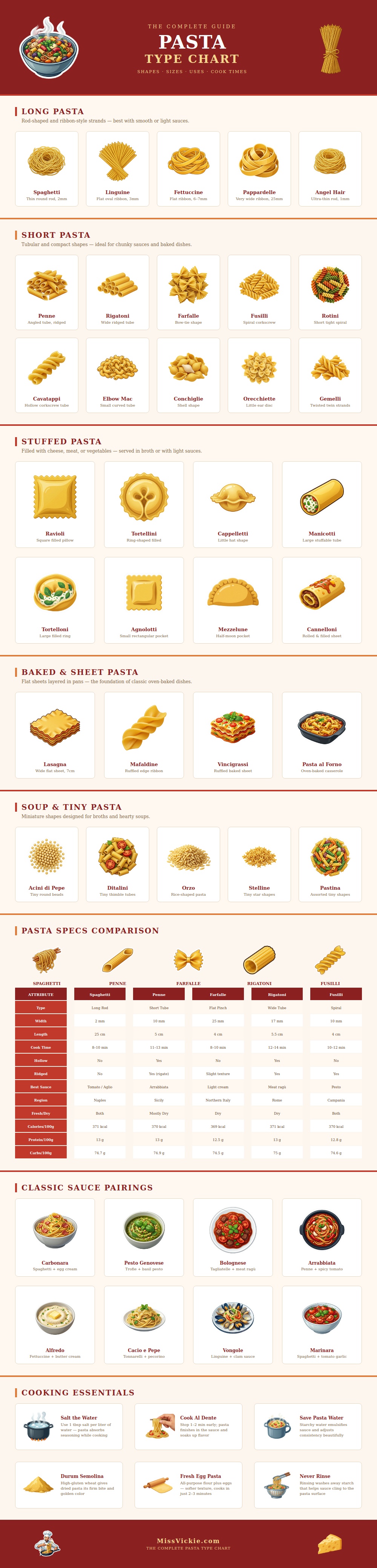
Walk into any Italian supermarket and you’ll be face-to-face with hundreds of different kinds of pastas. There’s a huge variety, and at first glance it might seem like nonsense: Why so many? Flavor aside, shape matter greatly. To make your dinner more delicious, you don’t have to memorize hundreds of names; just learn how one kind of pasta differ from another.
Why is ribbon pasta different than tube-shaped pasta? It comes down to sauce retention and surface area. Spaghetti, linguine: Long pasta shapes designed for smooth sauces that coat rather then cling. These would be great for light dressings such as a creamy egg mixture or a light tomato basil. Fettuccine has a wider shape that can supports the weight of heavier dressings, such as a ragù, better than thin angel hair pasta can. Its flat surface also help hold a heavy ragù nicely compared to thin strands.
How Pasta Shape Matches Sauce
Even wider pappardelle is ideal for pairing with slow-cooked braised meats where something substantial is needed to rest against. You don’t want to waste any of those chunks by serving them on a delicate strand of pasta, they’ll just fall through. This is why chefs pair width with viscosity. The change from a thin rod to a broad ribbon shows the way texture build with thickness.
Another way short shapes do their thing is through their shape. Because they’re tubular (think rigatoni and penne), they have a hollow center and ridges around it. This allows them to capture sauce within the noodle itself, which is perfect for a thick vegetable sauce or something baked. Rotini and fusilli depend more on the spiraling shape to grab cheese and other blend combinations that might otherwise slip off flat plate. The twists naturaly form little pockets to hold ingredients.
Conchiglie, those shell-shaped ones, even act as mini-scoops; they collect some of the filling, too, so you get sauce plus starch in each bite. Use a light hand with stuffed versions because these items is already loaded. Tortellini, ravioli, etc., tend to be served in broth (or little-to-no-butter) in order to allow contents to stand out without overpowering the taste buds. No one dumps a bucket of hefty marinara over delicate pockets of cheese.
Instead, the pasta itself becomes the star of the dish; it’s the dough that conveys most of the flavors. Lasagna-type baked sheets offer structure in layers, standing firm under heat, forming separate stripes of flavor instead of an even combination. That tells you how to plan your dinner: before even turning on the stove.
These variations increase during cooking. Pasta soaks up flavor as it cooks, so you must use plenty of salt when boiling. If you don’t, there’s not much point in sprinkling on extra after, since you’ll end up with a dull-tasting dish regardless. Before straining, reserve a cupful of starchy cooking water; it will contribute a bit of sheen and thickness to whatever sauce you use, helping it stick to the pasta instead of pooling in the bottom of your bowl. (Never run hot pasta under cold tap water, unless you’re dressing it to be eaten as a salad, because washing off the starch prevents it from sticking.)
Dried varieties take a bit longer to reconstitute and set up; fresh pastas made with egg cook fast, as the protein molecules is quick to change. Dried versions obtain their characteristic golden color and chew from being milled from durum wheat. Where many home cooks falter: knowing how long to cook them.
To achieve al dente, cooked pasta should of be firm but tender to the tooth, retaining some spring so it can continue cooking off the stove in the still-hot sauce. The last toss brings flavor into the pasta better than just pouring sauce over already-drained noodles. When you understand these categories, you feel less confused and more sure of yourself. It stops being random shapes and starts looking like patterns.
Linguine makes for a nice clam sauce because it coats smoothly. Rigatoni stands up to a good baked ziti. Half of the job is done for you by using the proper shape. Consider next time you’re standing in that aisle looking beyond the packaging at what your sauce should be clinging to. A little geometry will get you to a better meal.