
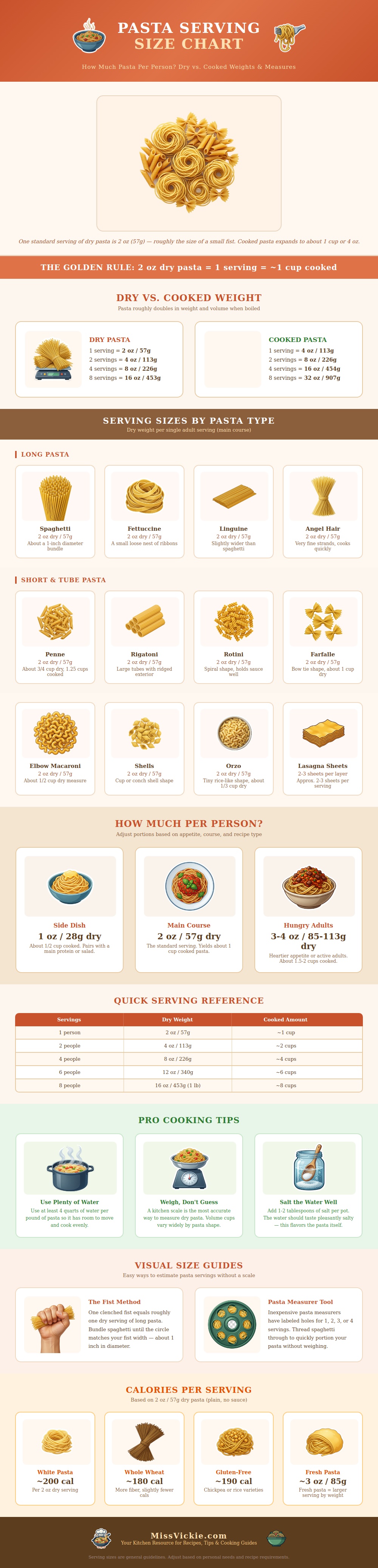
Here’s the thing: When you have more people over than anticipated, the last thing you want to do is freak out. So you open your pantry and discover that there’s just enough pasta. Can it feed all these peoples? It’s something every home cook can relate to: Pasta looks like an easy food to make, but how much should you measure out? Turns out, the math involved in serving up portions isn’t as complicated than you think. All you really need is a way to eyeball things without guessing every single time.
Cooked pasta is larger than uncooked pasta. Why? Because pasta is simply a combination of water and dehydrated flour. When you boil water to cook it, the pasta absorbs the liquid and gets bigger. That’s why a lot of people is surprised by how much their pasta increases in volume. For example, a cup of dry penne seems tiny on the countertop, but it almost doubles once it’s boiled.
How to Measure Pasta Portions Easily
Dry noodles double in size (give or take). So if you’re not sure how much 2 ounces of dry pasta will be as a serving, just remember that 1 cup = about 2 ounces of dried pasta. And that’s the number you need for measuring. Once you’ve got that concept down, that most pasta doubles in size, you’ll be able to make educated guesses.
Longer pastas such as spaghetti lend themselves nicely to visual estimation: Grab a handful of raw spaghetti and hold it up next to the box. Try to create a circle roughly one-inch across with your hand. That’s roughly two ounces. Don’t be tempted to double that! It doesn’t seem like much, but let the expanding pasta take care of the rest.
Short forms like rotini benefit from volume estimates. One serving of dried pasta are roughly three-fourths of a cup. It is messy, but it is home-cooking-friendly and consistent.
So what about portions? Portions are guidelines based off your appetite, not a hard and fast rule. Lighter eaters can adjust, while hungry adults will thank you. Avoid having leftovers by adjusting portions up or down depending on whether you have more or fewer people eating. No one has to go hungry either. As for pasta, it’s a flexible dish that can be balanced out with other dishes to account for calories. A plate of just pasta require more than a side order served alongside some meatloaf. And a bowl of noodles served with another protein can be cut in half. The numbers matter, but context matter too.
The other side of satisfaction is technique. If your pasta tastes bland, you think you must eat more of it. More often than not, though, the problem’s in the water (specifically), the lack of seasoning on the water. Salt it when it’s boiling and the noodle soaks up flavor even before you toss it with the sauce. A good dose of salt (think: a tablespoon) for every pot will transform the taste profile. And the pasta will hold its own against robust sauces. Suddenly, it’s no longer just edible but enjoyable.
Since fresh pasta has more moisture, you want to use just a little more by weight than you would for dried pasta so you get the same amount once it is cooked. But, fresh also cooks in just minutes and yields a tender noodle. There’s no way for dried to match that characteristic. Just remember this difference if you’re making substitutions. Whether you begin with dried or fresh, we’re going for the same result, a consistent bite.
Trusting the process is key to mastering portions. There’s no need for a digital scale. Your hands and eyes will get you there as practice aligns your instincts with reality. Open the box in the pantry, recall the three-quarters cup measure (or the inch-wide bundle). Let the noodles stretch in the water. Confidence turns what was once a stressful rush into a smooth meal for all.