🍝 Pasta Dough Calculator
Calculate exact flour, eggs, salt, and oil for any number of servings
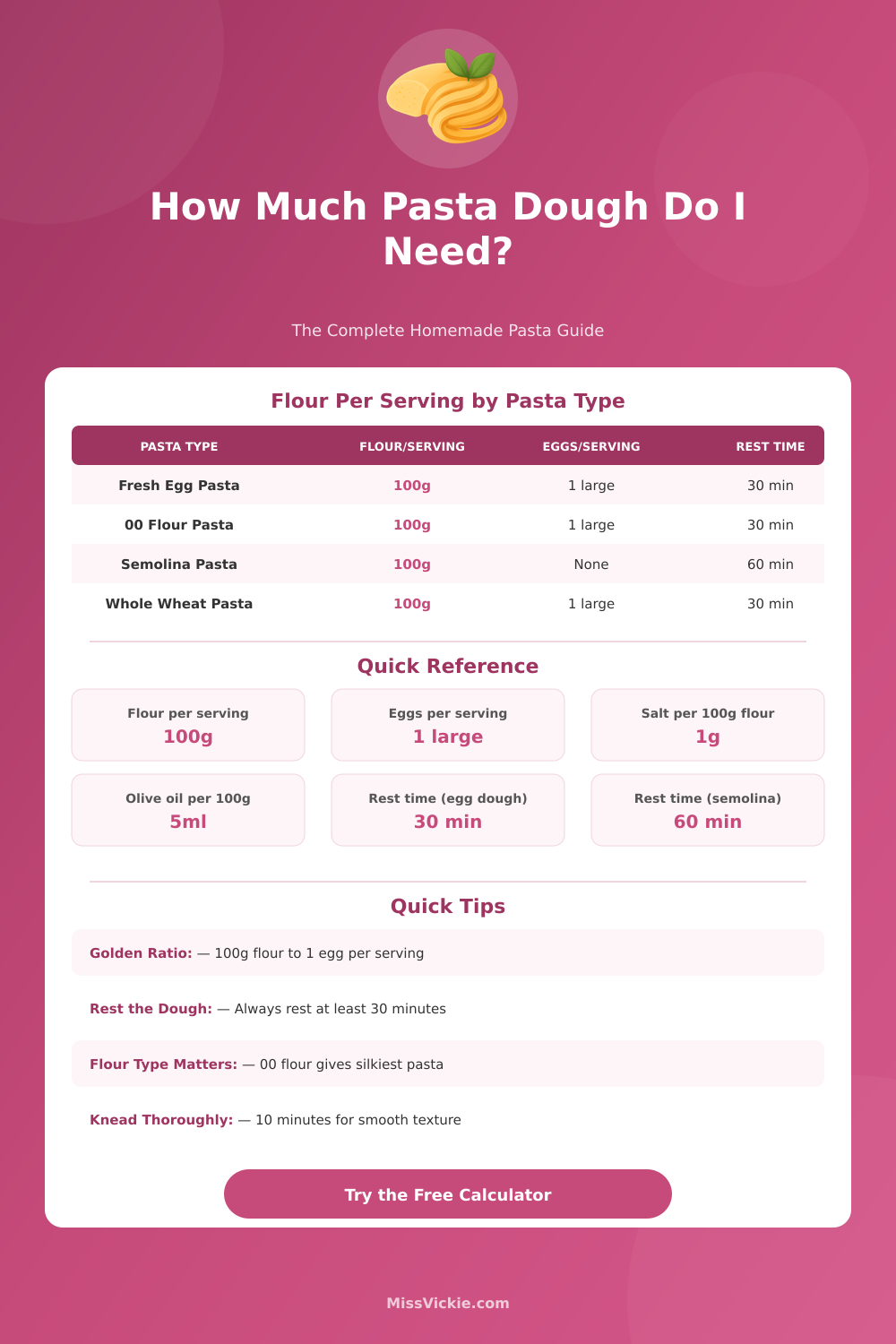
| Servings | Flour (g) | Eggs | Salt (g) | Olive Oil (ml) |
|---|---|---|---|---|
| 1 serving | 100g | 1 | 1g | 5ml |
| 2 servings | 200g | 2 | 2g | 10ml |
| 4 servings | 400g | 4 | 4g | 20ml |
| 6 servings | 600g | 6 | 6g | 30ml |
| 8 servings | 800g | 8 | 8g | 40ml |
| 10 servings | 1000g | 10 | 10g | 50ml |
| 12 servings | 1200g | 12 | 12g | 60ml |
| Type | Flour per Serving | Liquid | Rest Time | Best For |
|---|---|---|---|---|
| Classic Egg | 100g all-purpose | 1 large egg | 30 min | Tagliatelle, lasagne |
| 00 Flour | 100g 00 flour | 1 large egg | 30 min | Silky ravioli, fettuccine |
| Semolina | 100g semolina | ~60ml water | 60 min | Orecchiette, cavatelli |
| Whole Wheat | 110g whole wheat | 1 large egg | 30 min | Pappardelle, ribbons |
| Spinach | 90g + 30g spinach | 1 large egg | 30 min | Filled pasta, tagliatelle |
| Squid Ink | 100g 00 flour | 1 egg + 4g ink | 30 min | Seafood pasta |
| Shape | Thickness | Roll Setting | Cook Time (fresh) |
|---|---|---|---|
| Angel Hair / Tagliolini | Very thin | Setting 6-7 | 1-2 min |
| Tagliatelle / Fettuccine | Thin | Setting 5-6 | 2-3 min |
| Linguine / Pappardelle | Medium | Setting 4-5 | 2-4 min |
| Lasagne Sheets | Thick | Setting 3-4 | 3-5 min |
| Ravioli / Tortellini | Thin (filled) | Setting 5-6 | 3-4 min |
| Gnocchi | N/A (hand-shaped) | N/A | 2-3 min |
Pasta dough is one of those things that seems more complicated than they are. It is made of unleavened dough from wheat flour mixed with water or eggs, later formed into sheets or various shapes. The taste and texture of fresh pasta surpasses anything from the store in a box.
Although it requires some time, do not rush the process
How to Make Fresh Pasta Dough
Ingredients stay very simple. Basic ratio is one egg in 100 grams of flour. Some recipes use two cups of all-purpose flour, three big eggs, half a spoon of salt and some olive oil.
Olive oil is not necessary. Water can fully replace the eggs for pasta dough. Semolina flour also works with same ratio.
Italian 00 flour is perfect because of its fine grind. Do not bother with extra yoks, unless you want yellower color.
Pour the flour on a clean table and form a hole in the center. Crack the eggs in this hole, mix with salt and olive oil, if you use it. Stir with a fork until it thickens, then help with a scraper to combine the whole dough.
The volcano method gives better control of the moisture, which guarantees even texture. A food processor also works, pulse in short pauses until the mix looks like couscous and easily meets during pressure. If too dry, add a spoon of water.
If sticky, add more flour.
Pasta was made during centuries, before you cared about precise amounts. There is a lot of freedom. Too wet?
Add flour. Too dry? Mix water.
You must leave the dough to rest, do not skip that. During rest it absorbs more moisture, so a bit of stickiness before is fine. Fresh pasta dough must be quite firm.
It should mean you can knead it without extra flour, without residues on hands. Compared to bread dough, it will seem very dense.
After rest, share it in four parts, flatten one to an oval disk and pass through the widest setting of a pasta machine. Start on thick settings and go down slowly. Dough must feel elastic but smooth.
One serving, around 100 grams, gives a sheet of 30 to 38 cm long after passing through thinnest setting. Later cut it in shapes like fettuccine, linguine or pappardelle… They work best for newcomers.
Fresh pasta almost does not change shape or size during cooking and boils only two to three minutes.
Fresh pasta dough can stay in the refrigerator, so that it relaxes beforeusage.