Panettone Dough Calculator
Scale a rich panettone formula by pirottino size, loaf count, lievito madre, eggs, yolks, butter, sugar, fruit, hydration, salt, aroma, and final dough yield.
Each preset fills a complete formula. You can still adjust any field before calculating.
Formula breakdown
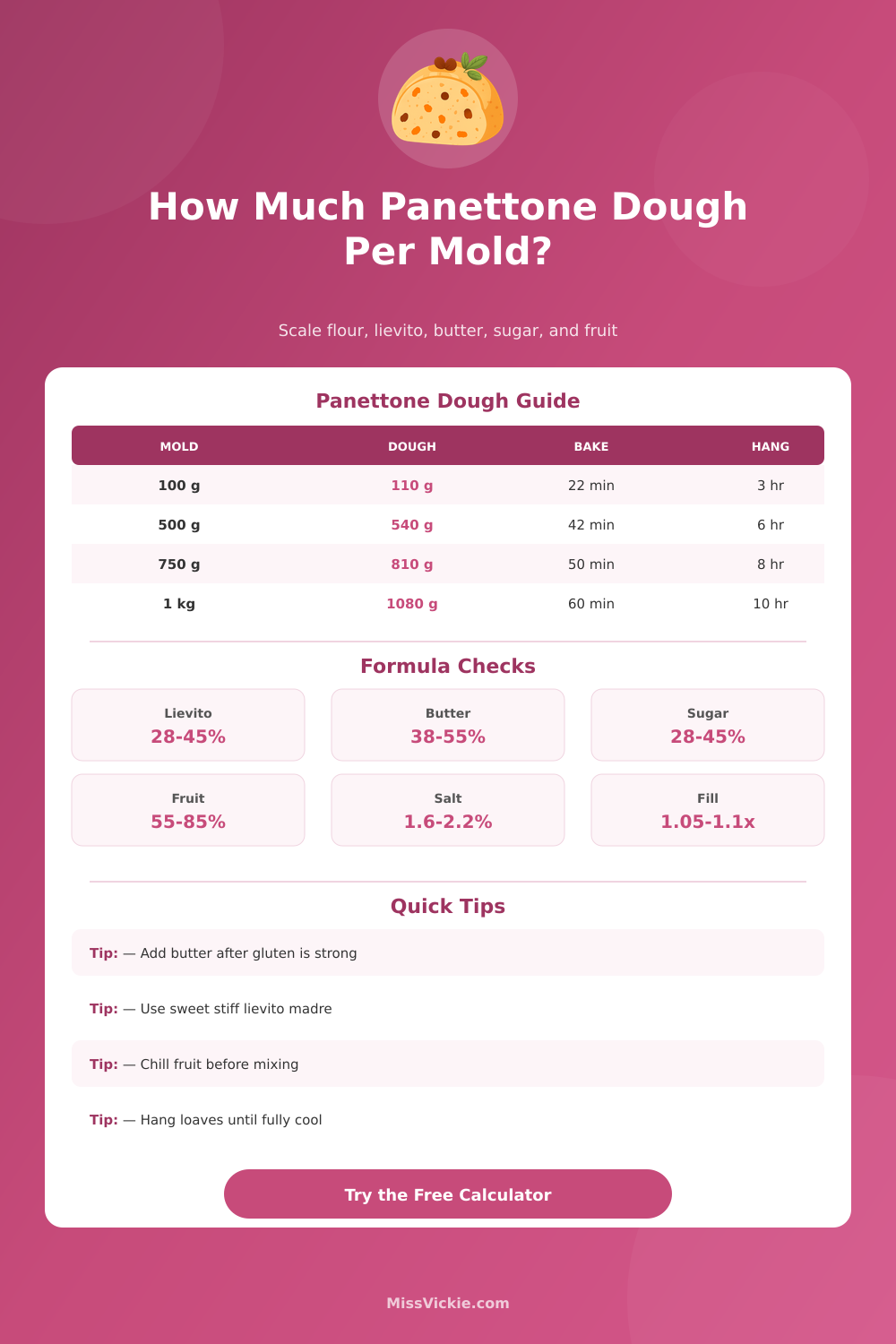
| Pirottino size | Dough to scale | Typical baked weight | Bake cue | Cooling hold |
|---|---|---|---|---|
| 100 g mini | 105-112 g | 96-103 g | 93 C center, about 20-25 min | Skewer and hang 2-3 hours |
| 300 g small | 318-330 g | 292-304 g | 93 C center, about 32-38 min | Hang at least 4 hours |
| 500 g standard | 530-545 g | 488-501 g | 93 C center, about 40-46 min | Hang 6 hours or overnight |
| 750 g tall | 795-820 g | 731-754 g | 93 C center, about 48-55 min | Hang 8 hours if very rich |
| 1 kg grande | 1060-1100 g | 975-1012 g | 93 C center, about 56-65 min | Hang 10-12 hours |
| 1.5 kg feast | 1590-1650 g | 1460-1518 g | 93 C center, often 70-82 min | Hang overnight before bagging |
The calculator uses the selected fill factor to target raw dough, then estimates baked weight from your bake-loss setting.
| Ingredient | Classic range | What it changes | Watch point |
|---|---|---|---|
| Strong flour | 100% | Structure for butter, sugar, yolks, and fruit | Use strong panettone flour when butter exceeds 40% |
| Lievito madre | 28-45% | Leavening, aroma, acidity control, keeping quality | Refresh until it triples cleanly before mixing |
| Whole eggs | 10-28% | Water, protein, color, and tenderness | Too much whole egg can loosen dough early |
| Yolks | 18-38% | Emulsification, golden crumb, rich shred | Add slowly after gluten begins to form |
| Butter | 35-55% | Soft crumb, aroma, pull-apart strands | Mix in after dough is elastic and glossy |
| Sugar or honey | 28-45% | Sweetness, browning, shelf life, fermentation drag | High sugar slows rise and needs stronger leaven |
| Fruit or chips | 0-85% | Flavor, weight, moisture pockets, slice identity | Fold in cold and dry to avoid tearing dough |
| Liquid source | Water estimate | Calculator use | Practical note |
|---|---|---|---|
| Lievito madre at 45% | 31% of starter weight | Counts as starter water | Stiffer lievito gives more strength and slower acidity |
| Whole egg | About 74% water | Counts toward effective hydration | Egg size varies, so weighing matters more than counting |
| Egg yolk | About 48% water | Counts toward effective hydration | Yolk brings lecithin and fat as well as water |
| Butter | About 16% water | Included in hydration estimate | Cool pliable butter mixes cleaner than melted butter |
| Added water or milk | 100% liquid basis | Direct hydration adjustment | Hold back a little if flour absorbs slowly |
| Candied peel or soaked raisins | Variable | Not counted automatically | Drain and blot fruit so dough does not smear |
| Stage | Target look | Typical ingredients | Why it matters |
|---|---|---|---|
| First dough | Elastic, smooth, warm but not hot | Flour, lievito, water, some sugar, yolk, butter | Builds fermentation strength and flavor overnight |
| Second dough base | Strong gluten before enrichment | First dough, flour, sugar, yolks, salt, aroma | Gluten must carry the heavy sugar and fat load |
| Butter addition | Glossy dough that clears bowl | Soft butter added in several portions | Adding too early coats flour and weakens structure |
| Fruit fold | Even distribution with minimal tearing | Raisins, peel, chocolate, nuts, or inclusions | Late gentle folding keeps the crumb long and feathery |
| Final proof | Dough reaches mold rim or slightly below | Panned dough in paper molds | Underproofing splits hard; overproofing collapses |
- Lievito35%
- Butter45%
- Sugar38%
- Fruit72%
- UseHoliday loaf
- Lievito40%
- Butter54%
- Sugar44%
- Fruit78%
- UseSoft slices
- Lievito34%
- Butter48%
- Sugar40%
- Chips60%
- UseNo peel
- Lievito30%
- Butter50%
- Sugar36%
- Fruit0%
- UsePlain crumb
Making panettone requires careful planning because panettone contains high amount of fat, sugar, and fruit. Because these ingredients creates tension within the dough, it is essential to balance the ingredients correctly. If you balance the ingredients correctly, the panettone will rise and have a soft texture.
However, if you fail to balance the ingredients correctly, the panettone may have a center that cave in the oven or the crumb texture may be dense. Calculating the amount of each ingredient before you start mixing the dough will ensure that your panettone rises correctly. The amount of dough that you place in each paper mold is another crucial factor in the making of panettone.
Plan and balance panettone ingredients
If you place the dough too lightly into each mold, it will not fully fill the mold. However, if you place too much dough into each mold, the panettone will burst when it is bake. You must take into account that panettone will lose some of its weight during the baking and cooling stages.
Thus, the weight of the raw dough must be higher than the weight of the finished panettone. The lievito madre is another crucial ingredient in the dough. The lievito madre provides the leavening and acidity needed for the dough.
The acidity will help keep the dough alive during the fermentation stage. The percentages of lievito madre will dictate how much flour and water will be contained in the dough. If you use a stiff lievito madre, the dough will have more strength.
However, if you use a loose lievito madre, the lievito madre will become active more quickly. The type of lievito madre you use will dictate the type of flour you use and the temperature of the area in which you cook the panettone. Using eggs and egg yolks adds moisture, protein, and fat to the panettone dough.
Using whole eggs will add more structure to the panettone than using only egg yolks. However, the egg yolks will add more color and texture to the panettone. Using more eggs or egg yolks will affect the amount of water and milk needed for the panettone.
Many bakers often find that the dough feels wetter than they would of liked because they have not accounted for the water content of the eggs and egg yolks. Thus, it is best to calculate the amount of egg yolks and whole eggs first. Another ingredient that contains tension within the panettone is butter and sugar.
These ingredients make it difficult to bake panettone. Using butter coats the gluten strands in the dough. This will slow the fermentation process.
Using sugar will draw the water content out of the dough and make the crust brown. However, sugar acts as food for the lievito madre. Because you use high amounts of butter and sugar, you will need a flour that has more strength and a lively lievito madre starter.
Additionally, you will have to slowly add the butter and sugar so that the gluten structure absorbs them. Fruit contains another variable to panettone because candied peel and raisins contain moisture. This moisture can move into the dough if you do not chill the fruit and blot it of the excess liquid before adding it to the panettone dough.
Additionally, adding fruit will add to the load of the gluten web in the panettone. Using more fruit will require you to use less butter and sugar. A calculator can be used to change the amount of fruit in the panettone and calculate how this will change the other ingredients.
The hydration for panettone is the total amount of liquid that will be used in the recipe. The total hydration will include the amount of water from the lievito madre, the water from the eggs, the amount of water from the egg yolks, the water content in the butter, and the amount of liquid that you will add to the dough. Using panettone will allow the baker to determine the effective hydration so that they can decide whether the dough will be supple or tight.
If the hydration is high, you will have to hold back the amount of water that you will add to the dough. However, if it is low, you will have to add more liquid to the dough or let the dough proof for a longer period of time. Another crucial factor in the baking of panettone is the fill factor.
This will determine how the dough will climb the sides of the paper mold in which you will bake the panettone. Using a light fill factor will result in the dough forming a gentle dome. High amounts of the dough will create a mushroom cap.
The fill factor will determine the final height of the panettone. Furthermore, you must calculate the bake loss of the panettone. This will tell you how much weight the panettone will lose while it bakes and cools.
Knowing the bake loss will allow you to calculate the raw weight of the dough to obtain your desired finished weight for each panettone. Many people make mistakes when making panettone. For example, they may add butter too early into the dough.
If they do, the gluten will weaken. Others may forget that sugar will slow the activity of the lievito madre starter. Thus, they will find that the dough will not rise enough.
Furthermore, they may fold in cold fruit into warm panettone dough. This will create streaks within the finished panettone. However, if you lay out all of the percentages of the ingredient that you will use, you will be able to avoid these mistakes.
When making large batches of panettone, there are some constraint that you must work within the recipe. Because the dough will warm up quickly when using a mixer to mix the panettone, you must pay closer attention to the temperature of the dough. The temperature will affect the fermentation process of the lievito madre.
When you make large batches of panettone, you will be more concerned with the temperature of the final dough than with the temperature of each ingredient. The formulas will remain the same when making a large batch of panettone. However, the mixing schedule will be longer, and the rest periods for the dough will be even more importantly.
A calculation tool will allow you to calculate all of the ingredients that will be used to make panettone. However, you should not use this as the final tool for making panettone. The numbers will allow you to determine the amount of each ingredient.
However, you can also adjust each ingredient one at a time to see how it will change the panettone. Over time, you will be able to remember how adding more egg yolks will change the color of the panettone and how changing the amount of sugar will change the rise of the panettone. Thus, the panettone recipe has the same arithmetic to each ingredient.
However, your intention for the panettone will change as a result of your use of the calculation tool. Furthermore, once the panettone is baked, the shape and crumb will be the result of your planning to create that specific outcome for the finished product.