Pan area, dough loading, hydration, and baker percentages
Pan Pizza Dough Calculator
Calculate dough weight and ingredient amounts for round pans, Detroit pans, Sicilian trays, deep-dish skillets, and sheet pans using flour type, thickness, fermentation, hydration, oil, salt, yeast, and servings.
Load a realistic pan pizza starting point, then adjust the pan dimensions, thickness, flour, hydration, and baker percentages to match your kitchen.
Dough Formula Breakdown
| Thickness | Dough Loading | Best For | Texture Target |
|---|---|---|---|
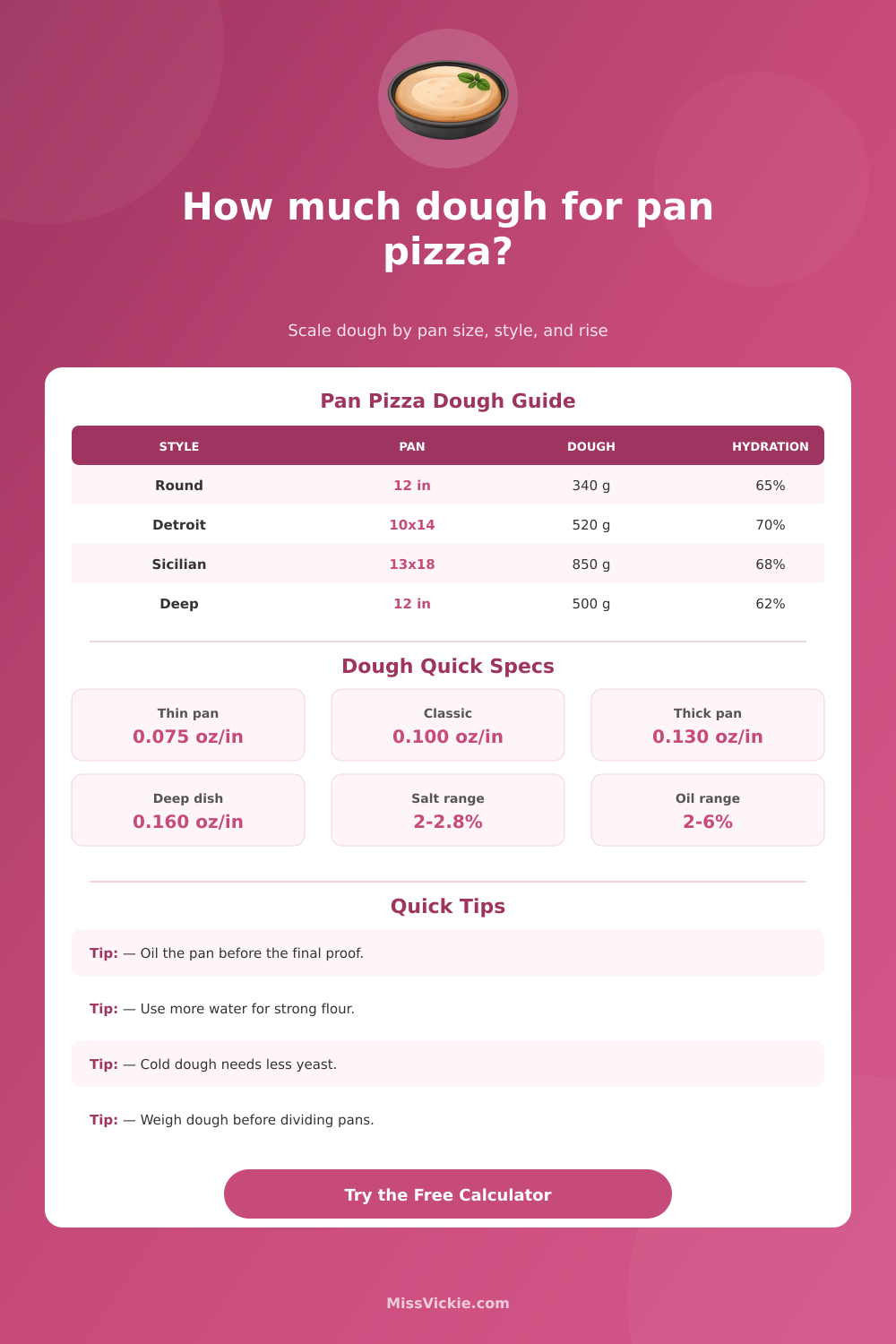
| Thin pan | 0.075 oz/sq in or 2.13 g/sq in | Bar pizza, crisp cast iron, small skillets | Crunchy base, low rim |
| Classic pan | 0.100 oz/sq in or 2.83 g/sq in | Weeknight round pan pizza | Balanced chew with browned bottom |
| Thick pan | 0.130 oz/sq in or 3.69 g/sq in | Detroit, Sicilian, square pan | Open crumb and tall edges |
| Deep dish | 0.160 oz/sq in or 4.54 g/sq in | Chicago-style deep dish, heavy skillet | Tall, sturdy, buttery crust |
| Focaccia slab | 0.145 oz/sq in or 4.11 g/sq in | Oil-rich tray pizza | Airy, dimpled, tender interior |
| Flour Type | Typical Hydration | Protein Feel | Pan Pizza Note |
|---|---|---|---|
| All-purpose flour | 62% to 68% | Moderate strength | Easy handling for thin and classic pans |
| Bread flour | 66% to 72% | Strong enough for long proofing | Reliable for Detroit and Sicilian dough |
| High-gluten flour | 68% to 75% | Very elastic | Good for thick pans and chewy edges |
| Tipo 00 flour | 60% to 68% | Fine and extensible | Use a little less water for soft pan dough |
| Whole wheat blend | 70% to 78% | Bran absorbs more water | Give the dough a rest before kneading |
| Gluten-free blend | 78% to 90% | Depends on starch and binder | Often presses into the pan better than it stretches |
| Fermentation Plan | Instant Yeast | Suggested Temp | Use When |
|---|---|---|---|
| Fast warm proof | 0.80% to 1.20% | 78 to 82 F | You need dough in about 2 to 4 hours |
| Same-day room temp | 0.45% to 0.70% | 70 to 74 F | Dough is mixed after breakfast for dinner |
| Overnight room temp | 0.18% to 0.35% | 65 to 70 F | Flavorful dough without fridge space |
| 24 hour cold proof | 0.15% to 0.30% | 38 to 42 F | Good balance of flavor and schedule |
| 48 hour cold proof | 0.08% to 0.18% | 38 to 42 F | Better flavor and browning control |
| 72 hour cold proof | 0.04% to 0.12% | 36 to 40 F | Use strong flour and careful salt level |
| Pan Size | Area | Classic Dough | Thick Dough |
|---|---|---|---|
| 10 inch round skillet | 79 sq in | 224 g | 292 g |
| 12 inch round skillet | 113 sq in | 321 g | 417 g |
| 14 inch round pan | 154 sq in | 436 g | 567 g |
| 8 x 10 inch pan | 80 sq in | 227 g | 295 g |
| 10 x 14 inch Detroit pan | 140 sq in | 397 g | 517 g |
| 13 x 18 inch half sheet | 234 sq in | 663 g | 864 g |
Rectangular pan, 68% to 75% hydration, generous oil, long proof, crisp cheesy edges.
Large tray, 65% to 72% hydration, sturdy airy crumb, usually cut into squares.
Lower dough loading, oiled sheet pan, thinner square crust with a crisp bottom.
Lower hydration, more oil, taller dough wall, enough structure for sauce and cheese.
To make a successful pan pizza, you must focus on the dough that you will use to prepare your pan pizza. The thickness of the crust will determine the type of pan pizza that you will create. The type of dough that you use will determine the thickness of the crust and the texture of the crust.
To determine the proper amount of dough that you should use for your pan pizzas, you will have to determine the size of the pan in which you will cook your pan pizzas, and the style of pan pizza that you wish to create. Pan pizza styles are different from one another due to the different ingredients that is required for each type of pan pizza. For instance, Detroit square pizzas contain alot of air in the crust so that it can support the cheese that will melt down the sides of the pan.
How to Make Pan Pizza Dough
Thin cast iron bar pizzas need to have a low rim on the pizza so that the toppings will not overwhelm the thin crust. Focaccia style tray pizzas require a higher amount of hydration to set the crust properly, and will contain oil in the corners of the pan. Thus, each of these different types of pan pizzas will have the same variables for there dough recipes, but the dough weight per square inch, the percentage of water that is contained in the dough, and the amount of oil that is added to the dough will be different from each other.
The calculator that is provided in this project will include the math that calculates the amount of dough that you will need based off the dimensions of the pan in which you will cook the pan pizza, the thickness that you would like the crust of your pan pizza to be, the type of flour that will be used to prepare the dough, and how you would like to ferment the dough. The thickness of the crust will impact the type of pizza that is created, and whether it will have a crisp crust or a crust that can hold deep-dish fillings. The loading numbers for the dough will ensure that the dough has the appropriate structure to rise within the corners of the pan.
The type of flour that is used will impact the dough that is created. Using stronger types of flour can allow for higher hydration and proofing periods for the dough without creating slackness in the dough. All-purpose flour is often used for dough that will be prepared that same day.
Whole wheat flour contains more fiber than other types of flour, which requires more hydration to soften the fiber. Thus, the calculator allows individuals to change the type of flour that will be used in the recipe. The amount of time that the dough ferments will impact the amount of yeast that should be used in the dough.
If the dough ferments quick, then more yeast will be required to allow for the dough to proof in the warm kitchen. If the dough ferments for seventy-two hours in the fridge, less yeast will be required to allow for the dough to proof at a slower rate. Additionally, allowing the dough to proof for an extended period of time allows the enzymes within the flour to develop flavor in the dough.
Cold-proofed dough will also brown differently within the pan due to the breakdown of the sugars in the dough over time. The amount of oil that is used in the dough will change according to the style of pan pizza that is being prepared. Detroit and focaccia pizzas will contain more oil than classic pan pizzas.
The amount of salt that is included in the dough will change according to the type of pizza that is prepared. However, the amount of salt will remain within a narrow range, as too little will create a flat-tasting pizza, and too much will slow the proofing of the dough by the salt. Within the recipe, there are reference tables that contain the typical loading rates for the different flours that will be used in making pan pizza.
These tables are helpful for individuals who are creating there recipes, but the settings in the kitchen can vary from the settings in the tables. Thus, while the calculator will provide the measurements for the recipe, the bakers will have to use their hands and the properties of the ingredients to determine how much more water to add to the dough or for how long to allow the dough to rest. Many individuals make mistake when attempting to create pan pizza.
For instance, many individuals under-hydrate the dough, as they are familiar with the low hydration rates for Neapolitan-style pizza. Additionally, some individuals may load the pan with too much dough, which will create a gummy center to the pan pizza. Thus, the thickness setting within the calculator will help to eliminate these mistakes.
In addition to the thickness of each pan pizza, the number of pizzas that will be prepared will impact the amount of dough that is required for each pizza. If two pans of pizza are to be made, the total weight of the dough will change, and the schedule for fermenting the dough will change according to the amount of yeast that should be used for that total weight of pizza dough. Additionally, the number of servings that will be prepared can impact how many people portions of pizza will be made by each pan pizza.
Thus, the number of servings that are set within the calculator will provide an idea of how many people can be fed by each pan of pizza. The temperature at which the dough is proofed will be more important than the percentage of yeast that is used in the recipe. Dough that proofs well at 70 degrees may collapse at higher temperatures in the kitchen.
Additionally, dough that is cold-proofed may not have time to proof in the pan if it is placed in a warm oven immediately after removing it from the refrigerator. Thus, it is more important to watch the dough proof than to keep strict time with the clock to monitor the dough. By running the numbers prior to beginning the recipe, many of the variables will be eliminated.
Thus, the total weight of the dough that will be prepared and the baker percentages will be known prior to adding flour to the bowl. Once the weight of the dough is set and the pan that will be used is selected, the recipe can be repeated. Any number of the variables can be altered, such as the type of flour that is used or the amount of time during which the dough is fermented.
Thus, the ability to prove the recipe allows for the bakers to prepare pan pizza without second-guessing the dough recipe. Youll find that the dough should of been ready if you follow this. Its moddern approach is naturaly better.