Oyster sauce, water, broth, slurry, marinade, and stir-fry ratio planner
Oyster Sauce Ratio Calculator
Calculate oyster sauce tablespoons and milliliters for stir-fries, marinades, glazes, gravies, noodles, vegetables, servings, protein weight, sweet-salty balance, broth dilution, and sauce thickness.
📌Oyster Sauce Presets
Choose a common dish, then adjust servings, protein or vegetable weight, salt-sweet balance, thickness, and broth or water dilution.
⚖Dish, Weight, Balance, And Thickness Inputs
Balanced stir-fry sauce
Your oyster sauce ratio will appear here.
Sauce Ratio Breakdown
Flavor And Texture Breakdown
Cooking Guidance
🍴Serving Size And Ratio Cards
Light marinade or background savory note.
Classic beef and broccoli style sauce.
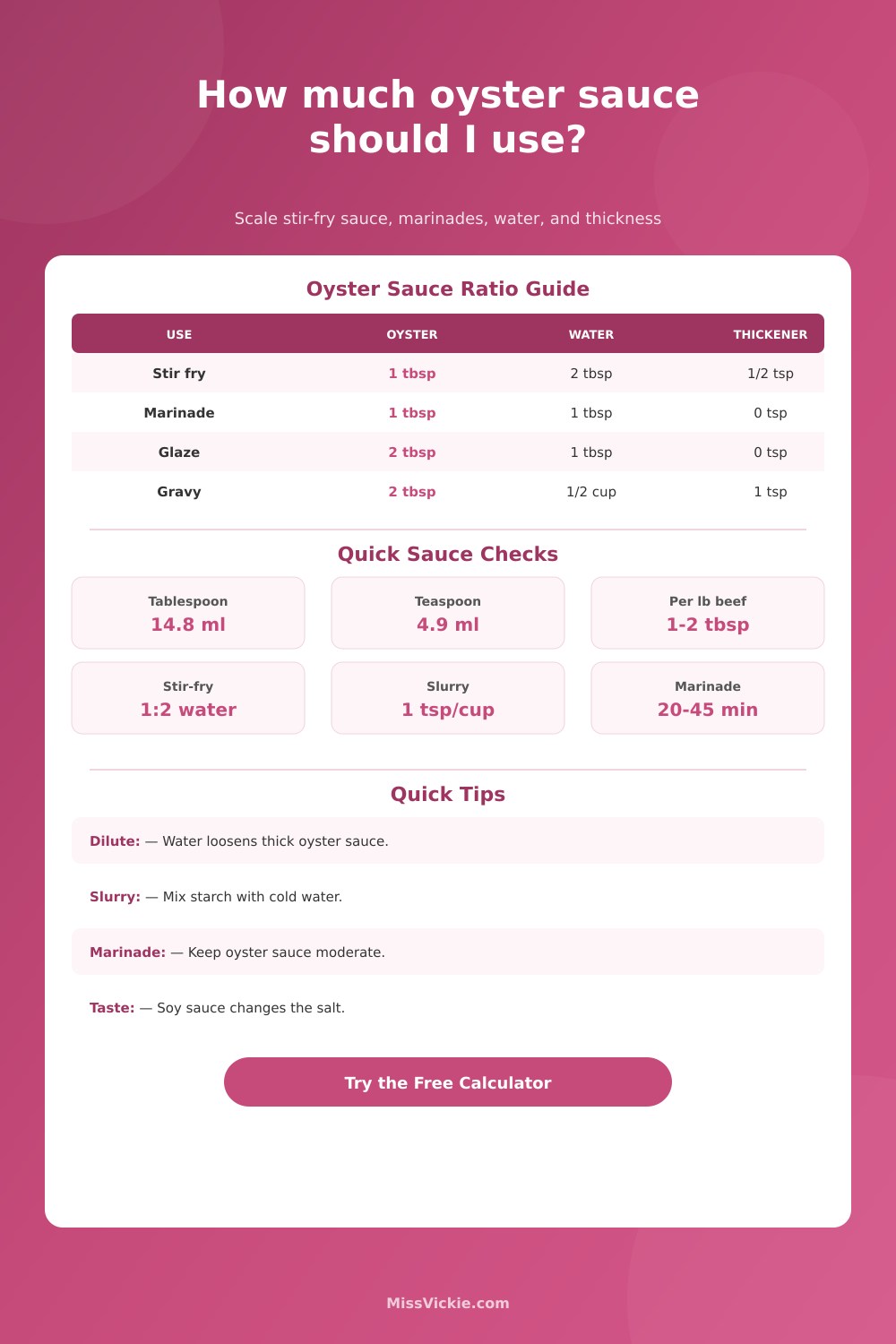
One part oyster sauce to two parts water or broth.
Medium glossy coating after simmering.
Kitchen tablespoon rounded from 14.8 ml.
Useful for sugar, sesame oil, and slurry starch.
Good range for sliced meat, shrimp, or tofu.
Common amount for a large family stir-fry.
📊Tablespoons, Milliliters, And Sauce Tables
Oyster Sauce Ratio By Dish
| Dish | Oyster Sauce | Water/Broth | Thickener |
|---|---|---|---|
| Quick vegetable stir-fry | 1 tbsp per 2 servings | 1 to 2 tbsp | 1/4 tsp starch |
| Beef and broccoli | 1.5 to 2 tbsp per lb | 3 to 4 tbsp | 1/2 to 1 tsp starch |
| Chicken or tofu stir-fry | 1 to 1.5 tbsp per lb | 2 to 3 tbsp | 1/2 tsp starch |
| Lo mein noodles | 1 tbsp per 2 servings | 2 tbsp noodle water | Optional starch |
| Marinade | 1 tbsp per lb | 1 tbsp water | No starch before cooking |
| Sticky glaze | 2 tbsp per lb | 1 tbsp water | Reduce in pan |
Tablespoons To Milliliters
| Tablespoons | Milliliters | Cup Equivalent | Best Use |
|---|---|---|---|
| 1 tbsp | 14.8 ml | 1/16 cup | Small stir-fry |
| 2 tbsp | 29.6 ml | 1/8 cup | One-pound protein |
| 3 tbsp | 44.4 ml | 3/16 cup | Saucy noodles |
| 4 tbsp | 59.1 ml | 1/4 cup | Family pan |
| 6 tbsp | 88.7 ml | 3/8 cup | Party batch |
| 8 tbsp | 118.3 ml | 1/2 cup | Large gravy |
Common Batch Amounts
| Servings | Light Sauce | Balanced Sauce | Extra Saucy |
|---|---|---|---|
| 2 servings | 1 tbsp oyster | 1.5 tbsp oyster | 2 tbsp oyster |
| 4 servings | 2 tbsp oyster | 3 tbsp oyster | 4 tbsp oyster |
| 6 servings | 3 tbsp oyster | 4.5 tbsp oyster | 6 tbsp oyster |
| 8 servings | 4 tbsp oyster | 6 tbsp oyster | 8 tbsp oyster |
| 12 servings | 6 tbsp oyster | 9 tbsp oyster | 12 tbsp oyster |
| 16 servings | 1/2 cup oyster | 3/4 cup oyster | 1 cup oyster |
Thickness And Slurry Guide
| Texture | Starch Rate | Liquid Needed | Cooking Note |
|---|---|---|---|
| Thin sauce | 0 to 1/4 tsp per cup | More broth | Good for rice bowls |
| Glossy coating | 1 tsp per cup | Balanced water | Simmer 30 seconds |
| Thick stir-fry | 1.5 tsp per cup | Moderate water | Add slurry last |
| Sticky glaze | 0 to 1 tsp per cup | Low water | Reduce instead of flooding |
| Gravy style | 1 to 1.25 tsp per cup | Broth base | Whisk until glossy |
| Marinade | 0 tsp | Small splash | Do not starch raw marinade |
Oyster sauce sodium and sweetness vary by brand. The calculator uses practical kitchen ratios and estimated sodium for planning, then expects final tasting in the pan.
💡Practical Oyster Sauce Notes
Oyster sauce is salty, thick, and prone to burning if dribbled straight from its bottle into a piping-hot pan. Too much of this can lead to uneven coating, this results in intense flavor pockets amid dry vegetable areas. More sauce isn’t the answer; try better dilution instead.
Enter the weight of your protein and your desired texture, and the calculator above do the rest for you. No more guessing about conversions. Since marinades, stir fries, and glossy glazes is all different, the tool asks what you’re preparing because oyster sauce reacts to heat differently depending on how it is used.
How to Use Oyster Sauce Right
For a marinade, you’ll want to maintain the concentrated flavor within the sauce to get into meat’s fibers while you don’t use a thickener at all. In a stir fry, you’ll want to dilute the sauce with some broth or water to coat each vegetable. These decisions affect base amount of sauce used, so you can make sure the dish isn’t overwhelmed by flavor or tastes bland.
Another error is not taking into account the saltiness of other ingredients. Certain components are already salty. Brined oysters, of course, but also oyster sauce, and if you cook that alongside any fermented bean pastes, soy sauces, salty stocks and so on, then forget about eating it.
There’s an option for other salty items in the calculator. When you choose a heavily salty dish, it will suggest less oyster sauce, reducing the likelihood that your dish will be overwhelmed by a bitter aftertaste. It requires thinking not only about how much oyster sauce is going in, but the overall sodium content.
The other issue is thickness: Many home cooks just dump oyster sauce directly into their wok, and it will separate between the oil and water in the pan. To get a smooth sauce, they has to make a slurry (i.e., mix some cornstarch with cold water). Depending on how thick you want your sauce, it tells you exactly how much starch to add. If you’re making a thin sauce that can be eaten with a spoon over rice bowls, use less. If you want something thicker, like a clingy glaze to hold onto chicken wings, use more. That tweak turns a watery mess into a smooth finish.
Other factors play into it too: Different brands will produce different results (expensive versions tend to be sweeter and thicker then cheaper ones, for example). Vegetarian varieties may include ingredients like mushroom extracts which aren’t as dense. You can choose exactly what kind of product you’re using in the calculator, and it’ll adjust accordingly to fit your bottle. That way, you won’t get angry after following some basic recipe written for an imaginary version of the sauce you bought.
Finally, there is the timing. Adding raw oyster sauce to a hot pan at any time is a bad idea. Before you begin to cook, whisk together your thin sauce, slurry, and sweetener in a small bowl. When the protein has been seared and the aromatics are fragrant, pour in your mix. As soon as it touches the heat, it will thicken right up. Doing this will not only protect the flavors from getting scorched, but it also helps them spread evenly across the dish.
Once you understand the ratios, though, mastering oyster sauce become a solid way to achieve balance of flavors, sweetness, saltiness and savoriness. Suddenly, instead of winging it, you’re cooking on purpose. No more guessing. Each ingredient pulls its weight in the final product. This makes each bite taste consistent and balanced, without getting too bitter.
You should of used better dilution for a more luxuruis feel. If your sauce dissapears, it means you need to add more starch based off the texture.