Oven math for everyday baking
Oven Temperature Converter Calculator
Convert Fahrenheit, Celsius, and gas mark, then layer in convection, pan material, altitude, oven offset, and recipe-specific guidance for more reliable baking and roasting temperatures.
Use direct conversion for simple swaps or recipe guidance mode when you want convection, pan, altitude, and oven-offset adjustments based on a real food category.
Low Oven
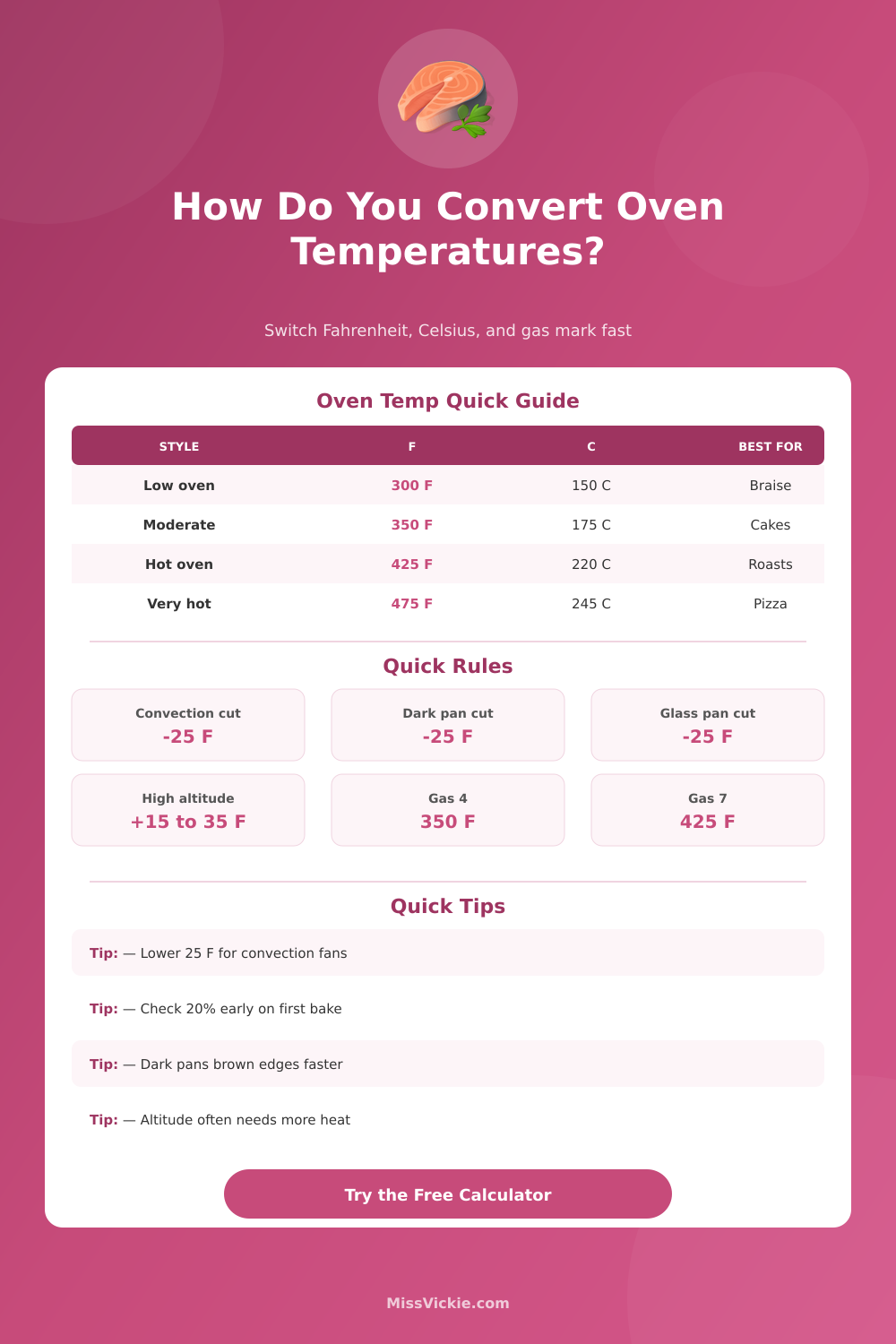
300 F
Best for braises, custards, and slow bakes.
Moderate
350 F
Classic setting for cakes, bars, and cookies.
Hot Oven
425 F
Useful for roasting vegetables and chicken pieces.
Very Hot
475 F
Helps pizza and flatbreads brown quickly.
| Heat Level | Fahrenheit | Celsius | Best Use |
|---|---|---|---|
| Very Low | 250 F | 120 C | Warming, drying, meringue |
| Low | 300 F | 150 C | Slow roasting, braises |
| Moderate | 350 F | 175 C | Cakes, cookies, casseroles |
| Moderately Hot | 375 F | 190 C | Bread, baked pasta |
| Hot | 425 F | 220 C | Roasts, pies, vegetables |
| Very Hot | 475 F | 245 C | Pizza, crisp flatbread |
| Gas Mark | Fahrenheit | Celsius | Typical Use |
|---|---|---|---|
| Gas 2 | 300 F | 150 C | Slow casseroles |
| Gas 4 | 350 F | 180 C | Standard baking |
| Gas 5 | 375 F | 190 C | Loaf bread |
| Gas 6 | 400 F | 200 C | Roast vegetables |
| Gas 7 | 425 F | 220 C | Chicken, pies |
| Gas 9 | 475 F | 245 C | Pizza, fast browning |
| Category | Typical Temp | Convection Note | Start Check |
|---|---|---|---|
| Cookies and Bars | 350 F / 175 C | Often 25 F lower | 20% early |
| Layer Cake | 350 F / 175 C | Use gentle fan only | 15% early |
| Cheesecake | 325 F / 160 C | Skip strong fan | 10% early |
| Bread Loaf | 375 F / 190 C | Reduce only if crust darkens | 15% early |
| Pizza and Flatbread | 475 F / 245 C | Convection can help browning | 20% early |
| Whole Roast Chicken | 425 F / 220 C | Fan speeds browning | 25% early |
| Roasted Vegetables | 425 F / 220 C | Fan improves caramelization | 20% early |
| Baked Casserole | 375 F / 190 C | Glass dish may need less heat | 15% early |
Ovens come with differently temperature scales, and it can be difficult for individuals to understand those scales. Many recipes uses Fahrenheit as the temperature scale to use in the oven to bake the foods described in those recipes. However, other recipes use Celsius or gas mark as the temperature scale that the recipe requires for baking the food.
In some cases, the recipe may use gas marks, but the oven that is being used may only use Fahrenheit as its temperature scale. Additionally, the recipe may use Celsius as its temperature scale, but the oven may only use Fahrenheit as its temperature scale. In these cases, individuals will have to convert the temperature scale of the recipe to the temperature scale that their oven use in order to correctly bake the food.
How to Set and Adjust Oven Temperatures
Each of the temperature scales was created for specific purpose. The Fahrenheit scale was created in 1724 and used a brine mixture to determine the zero point for the scale. The Celsius scale was created for the purpose of scientific use and used the freezing and boiling point of water to determine the points for the scale.
The United Kingdom created gas marks for use and represented the heating levels from the size of the flame in the coal oven. Even though it is possible to convert between each of these scales, each of the scales is not the same. The type of oven that is used will impact the cooking of the food placed into the oven.
If convection ovens are used, food will cook different than it will in still-air ovens. Convection ovens use a fan to circulate the hot air within the oven. Because of this, food cook faster in convection ovens.
As a result, the cook should lower the temperature of the food by 25 degrees Fahrenheit. If it is not lowered, the food may burn on the outside while it is still raw on the inside. Additionally, the material of the pan in which the food is cooked will impact the cooking of the food.
Dark pans will absorb heat more faster than light pans. Additionally, pans made of glass will hold heat better than metal pans. As a result, if dark pans are used, the dark pans will absorb the heat and cook the food faster.
The altitude at which individuals live can also impact the cooking of the food. The altitude can have an impact on the boiling point of the liquid in the food. At higher altitude, the air pressure is lower.
At lower air pressures, the boiling point of water is lower. Because the boiling point of water is lower in areas of high altitude, products that contain baked goods may cook incorrectly. As a result, the temperature of the oven and the ingredients listed in the recipe may have to be adjusted.
This particular temperature converter considers the type of oven that will be used to bake the food. Additionally, the recipe considers the altitude where the food will be cooked. The recipe will provide information regarding the final temperature to which the oven should be set.
Additionally, the temperature converter will indicate at what point the food should be cooked to check for doneness. Because convection ovens cook the food faster, cooking should of begun earlier. Additionally, recipe modes allow for adjustments to the heat for different type of food.
For instance, the setting for cheesecakes may be set to a gentler heat level so that the cheesecakes do not crack. Additionally, the setting for foods like pizza may be set to a higher heat so that the crust of the pizza become crisp. Ovens can be inaccurate.
Using an oven thermometer will tell individuals if the oven is inaccurate. The accuracy of the oven will have to be taken into account when baking food. For instance, if the oven is significantly inaccurate, individuals may need to account for that in their baking.
Additionally, the material of the pan in which the food is cooked will impact the evenness with which the food cooks. For instance, pans made of aluminum will cook the food more evenly than black steel pans. Different types of food require different temperatures within the oven to cook correctly.
For instance, recipes for cookies may require temperatures of 350 degrees Fahrenheit. However, bread recipes may require temperatures of 375 degrees Fahrenheit. Additionally, recipes for roasts and vegetables may require temperatures of 425 degrees Fahrenheit as higher temperatures improve the browning of the food.
The temperature converter will match the type of food to these different temperatures and provide individuals with suggestions regarding adjustments to the oven temperature for the food to cook correctly. Finally, there are a few other factor that can impact the cooking of food within the oven. Humidity within the air can make it so that food does not crisp as quick, so food will have to be monitored in high humidity settings.
Additionally, the rack on the oven in which the food is cooked will impact the amount of heat that is applied to the food. Placing the food on the middle rack will allow for the food to be cooked with even heat. However, placing food on the lower rack will add more heat to the bottom of the food.
Performing test batches of food will allow individuals to understand how their oven works and if any adjustment is necessary. For instance, if food is tested in a batch, individuals will understand if more or less heat is needed in their oven to cook the food correctly. Common mistake can be made in the kitchen when baking food.
One common mistake could be to forget to adjust for convection ovens. By forgetting to adjust for convection ovens, the edges of food may cook more than the bottoms of the foods. Another mistake could be to use a glass casserole dish.
Glass dishes hold heat well and will continue to cook the food even after the food is removed from the oven. Additionally, another mistake could be to use gas mark. Gas marks do not provide the same level of precision in heat levels as Fahrenheit scales.
However, a temperature converter will help individuals map the different heat levels to the tasks that they perform in the kitchen. Presets can be set for different types of food. For instance, a preset for cookies can be created.
Additionally, another preset can be used for high-altitude baking. Pans that are dark in color will require less heat to be cooked because the dark pans will absorb the heat more aggressive. Additionally, pans made of stone or steel will increase the heat applied to the bottoms of the foods cooked in these pans.
These types of pans are useful for baking bread with crisp crust. By adjusting the food for each of these variables, individuals will be able to reliably use their oven to cook their food correctly.