🔥 Oven Temperature Adjustment Calculator
Convert temperatures between Fahrenheit, Celsius & Gas Mark — with convection, altitude, and pan adjustments
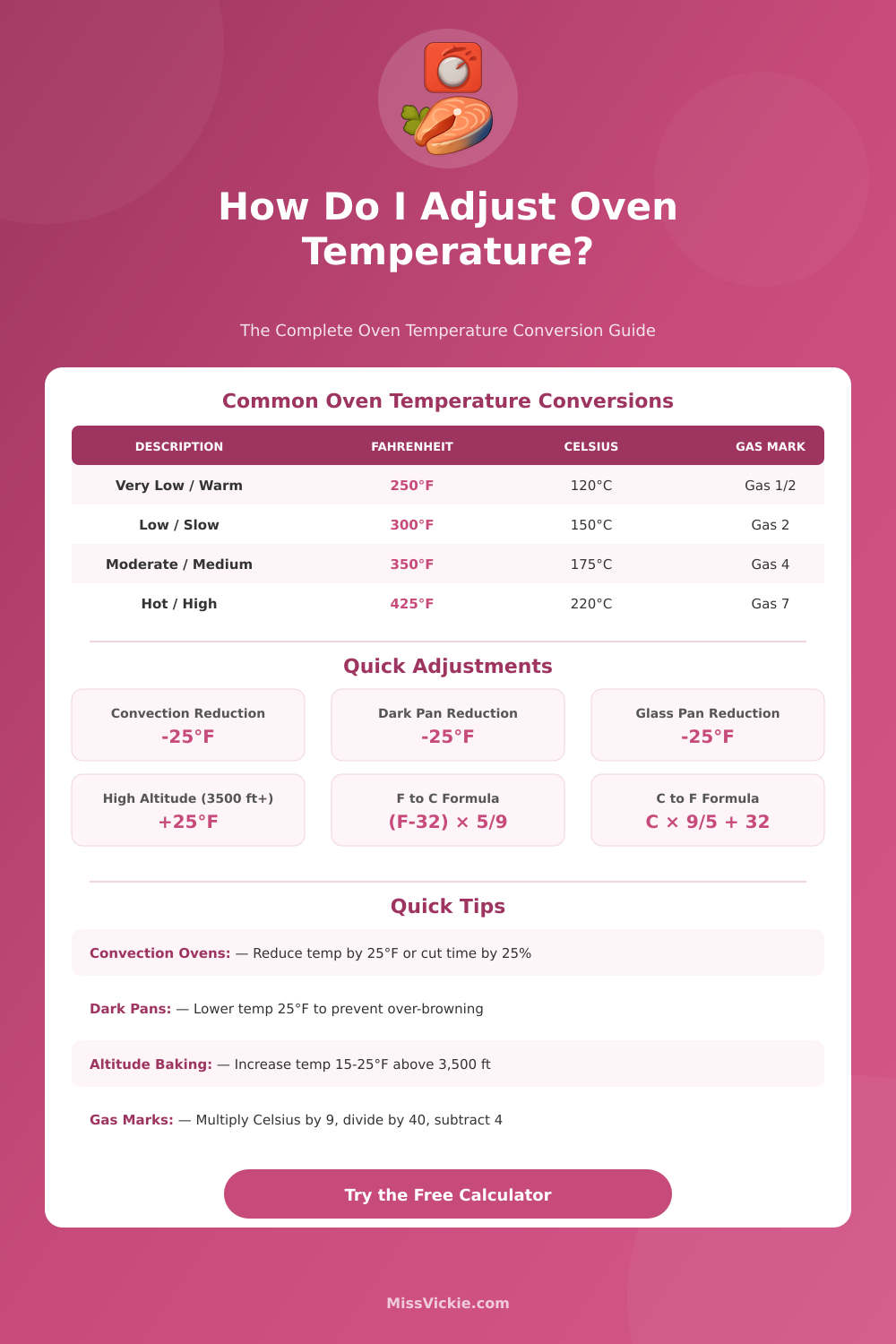
| Description | Fahrenheit | Celsius | Gas Mark | Best For |
|---|---|---|---|---|
| Very Low / Warm | 225°F | 107°C | Gas 1/4 | Keeping food warm, meringue drying |
| Very Low | 250°F | 121°C | Gas 1/2 | Slow-drying, dehydrating |
| Low | 275°F | 135°C | Gas 1 | Slow roasting, braising |
| Low / Slow | 300°F | 149°C | Gas 2 | Slow cook, tough cuts of meat |
| Low-Moderate | 325°F | 163°C | Gas 3 | Pound cake, cheesecake, custard |
| Moderate | 350°F | 177°C | Gas 4 | Most cakes, cookies, muffins |
| Moderate-Hot | 375°F | 190°C | Gas 5 | Bread, quick breads, chicken |
| Moderately Hot | 400°F | 204°C | Gas 6 | Roasted vegetables, fish |
| Hot | 425°F | 218°C | Gas 7 | Pies, tarts, roast beef |
| Very Hot | 450°F | 232°C | Gas 8 | Pizza, crusty breads, searing |
| Extremely Hot | 475°F | 246°C | Gas 9 | Thin crust pizza, flatbreads |
| Max / Broil | 500°F | 260°C | Gas 10 | Broiling, Neapolitan pizza |
| Situation | F Adjustment | C Adjustment | Notes |
|---|---|---|---|
| Convection / Fan Oven | -25°F | -15°C | Or reduce cook time by 25% |
| Dark / Non-Stick Pan | -25°F | -15°C | Absorbs more heat |
| Glass / Ceramic Dish | -25°F | -15°C | Retains heat longer |
| Altitude 3,500–6,500 ft | +15°F | +8°C | Lower boiling point |
| Altitude 6,500–8,500 ft | +25°F | +14°C | Increase leavening too |
| Altitude above 8,500 ft | +35°F | +19°C | Consult high-altitude guide |
Oven temperatures do not need to be secrets. Low oven stands at 200°F, while slow oven stays between 300, 325°F. If you move to medium level, then you find 350, 375°F. Ovens with high heat reach the range of 400. 425°F, and very hot models go up to 450 (475°F). If you turn it to maximum you reach the very hot values between 450, 525°F. Those old cooking words, “fresh”, “slow”, “medium”, “warm”, simply point to these temperature levels, all in Fahrenheit.
Switching between Fahrenheit and Celsius needs a bit of math: take 32 from the Fahrenheit number, multiply by 5, then divide by 9. Otherwise, converters for gas marks, Celsius, Fahrenheit and fan settings desreve to be beside you for fast lookup.
Easy Oven Temperatures and Tips
Most home ovens range from around 170°F at the bottom limit up to 550°F. Do you have a warm broiler? It can sink even to 120°F. American ovens usually reach higher values than European, new types sometimes reach 550°F, while old or cheap models max out between 500, 525°F. In the Celsius range, ovens start at almost 30°C and climb up too around 250°C.
Here is where things get interesting. Ovens hardly keep stable heat. Most stray from their set values by around 25, 50°F, more or less.
A nice oven can stay within 20 degrees of your setting, but a cheap one swings by 40 to 50 degrees around. Open the door to put in the food? That alone can drop the heat by 30…
50 degrees right away. That really affects the cooking.
Every electric oven usually starts at 350°F when you first turn it on. Quite funny, 350°F is also the most used temperature, especially for savory foods. There is a reason for that, it comes from times when ovens lacked automatic controls, and it simply stayed popular because it works well as a base for many recipes.
If your oven runs too hot, a temperature adjustment of around 15 (25°F will commonly fix the problem). An easy test is to lay a thermometer in the center, set to 350°F and check after 20 minutes. If the reading differs, either calibrate the oven or simply adapt the setting to make up for it.
When one wants to keep food warm without any more cooking it, the “keep warm” setting usually stays between 170 and 200°F. Warm food must pass 140°F to stop bacteria growth. That setting does not cook fresh food or reheat leftovers, it only keeps ready dishes at a safe level to serve.
Cooking stuffings at 170°C instead of 200°C mainly only extends the time, not the result. They do not need accuracy like a tender cake. With fan cooking, a temperature adjustment of around 20°C works well.
For pizza, professional pizza ovens reach 800°F or more, whileyour home standard pizza setting stays around 500°F.