🍊 Vitamin C in Orange Juice Calculator
Calculate vitamin C content by juice type, serving size, and number of servings
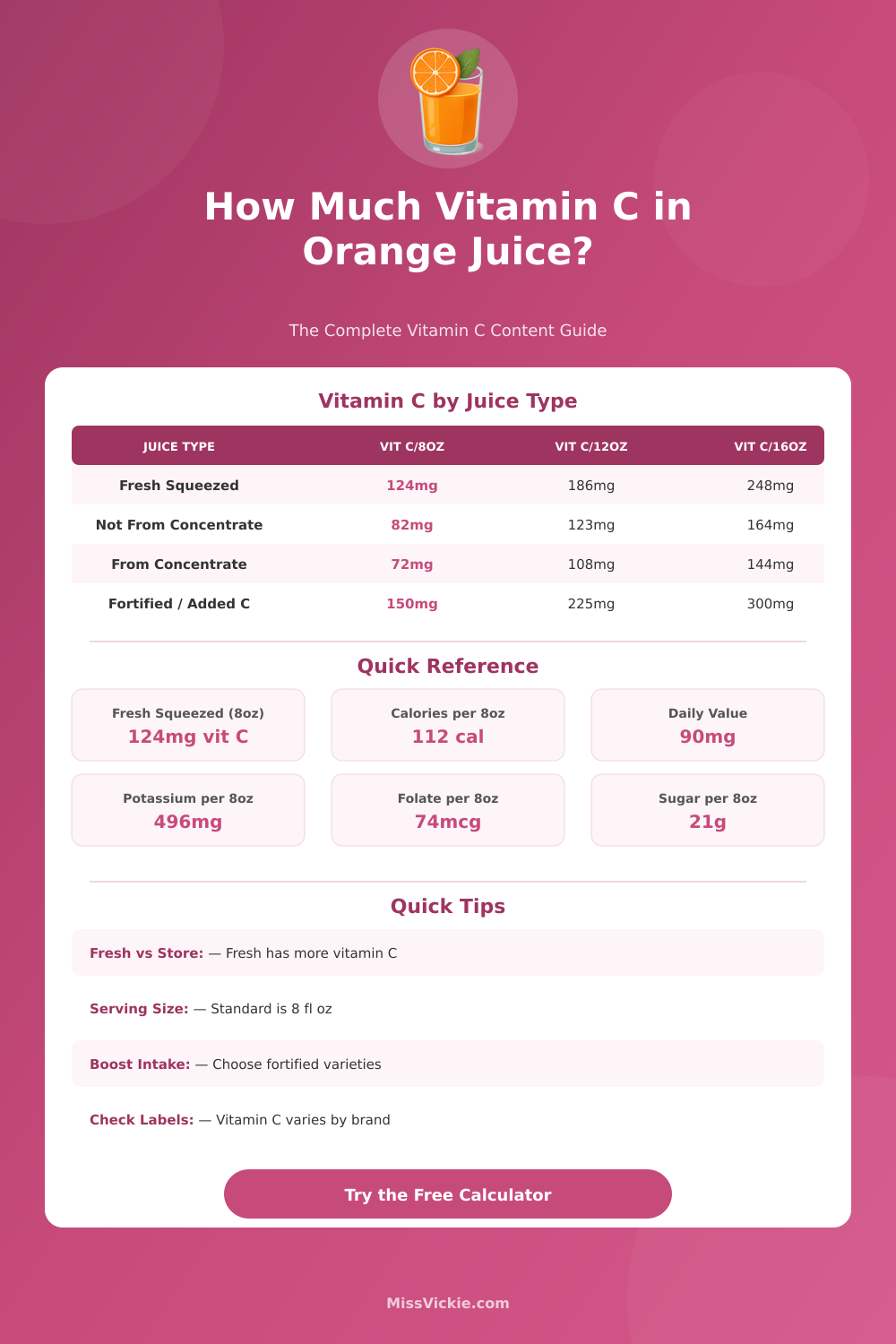
| Juice Type | 8 fl oz (240ml) | 12 fl oz (355ml) | 16 fl oz (473ml) |
|---|---|---|---|
| Fresh Squeezed | 124mg | 186mg | 248mg |
| Not From Concentrate | 82mg | 123mg | 164mg |
| From Concentrate | 72mg | 108mg | 144mg |
| Fortified / Added C | 150mg | 225mg | 300mg |
| Organic | 80mg | 120mg | 160mg |
| Tropicana | 90mg | 135mg | 180mg |
| Minute Maid | 78mg | 117mg | 156mg |
| Simply Orange | 85mg | 127.5mg | 170mg |
| Juice | Vitamin C | Calories | Notes |
|---|---|---|---|
| Orange Juice (fresh) | 124mg | 112 | Excellent source of vitamin C |
| Grapefruit Juice | 94mg | 96 | High vitamin C, lower calories |
| Pineapple Juice | 25mg | 132 | Contains bromelain enzyme |
| Apple Juice | 2mg | 114 | Very low vitamin C |
| Cranberry Juice | 24mg | 116 | Often fortified with vitamin C |
| Tomato Juice | 45mg | 41 | Lower sugar, good vitamin C |
| Measurement | Fl Oz | Milliliters | Cups |
|---|---|---|---|
| Small Glass | 6 fl oz | 177 ml | 0.75 cup |
| Standard Serving | 8 fl oz | 240 ml | 1 cup |
| Can / Bottle | 12 fl oz | 355 ml | 1.5 cups |
| Large Glass | 16 fl oz | 473 ml | 2 cups |
| Half Gallon | 64 fl oz | 1893 ml | 8 cups |
| Full Gallon | 128 fl oz | 3785 ml | 16 cups |
Orange Juice is made from liquid taken from oranges. One gets it by pressing or scraping the fruits. Many kinds exist based on the orange type used for instance blood oranges, navel oranges, Valencia oranges, clementines and mandarins.
For juice making one commonly chooses Valencia oranges as the ideal choice.
Orange Juice: How It Is Made, Health Facts and How to Store It
Freshly pressed Orange Juice is rich in vitamins and minerals, including Vitamin C, folate and potassium. One cup has 110 calories, 2 grams of protein, 27 grams of carbs and no fat. It serves well as a source of Vitamin C. One glass is enough to almost duoble the daily standard of that vitamin, which helps the immune system.
When oranges are cut or pressed, the Vitamin C starts to break down. After only 8 hours fresh juice can loose even 20 percent of its Vitamin C. So one should drink it soon after pressing.
Store-bought Orange Juice is not as simple as it looks. Big brands go through many steps. Drink companies work with experts on taste and smell to create mixes that bring back the natural orange flavor to the juice.
Those taste parts come from oranges themselves, so that brands can call it 100 percent juice. But the whole process is not always clear for the customers. Frozen focused Orange Juice has fewer nutrients than the fresh kind, and the nutrients drop over time.
Many store juices are heated, so one boils them. That removes water and makes the fruit sugars stronger. It is better to eat a whole orange, because the fibers slow the intake of sugar in the body.
With juice the sugar reaches the body much more quickly, because one removed the fibers. Among citrus fruits oranges are the most sugary, with glucose, fructose and sucrose.
Orange Juice helps to reach the daily target of two servings of fruits, but it should not pass half of that amount. The standard for adults is 8 ounces, for children 4 to 6 ounces. Studies show that drinking fruit juice lowers the blood pressure in adults.
It also raises the good HDL-cholesterol infolks with low levels, which is useful for heart health.
Opened bottles of Orange Juice stay good for nine days. Some brands have smooth texture and rich orange flavor without bitterness. Others have bitter taste or syrupy makeup.
The brand Good and Gather is smooth, a bit thick compared to budget ones, and has nice citrus smell. Dole Orange Juice has a light orange color, but smells a bit bitter. One can use Orange Juice in cooking, for instance to deglaze pans, prepare sauces or add taste to bread and crepe batters.