Onions Per Cup Calculator
Estimate how many whole onions to buy or prep for diced, sliced, minced, raw, sauteed, caramelized, soup, salsa, burger topping, and batch-cooking cup targets.
🧅Onion Presets
Choose a kitchen job, then adjust cups, cut size, onion type, trim loss, cooking shrink, recipe style, and flavor intensity.
⚖Onion Inputs
Onion cup estimate
Your onion estimate appears here.
Input Breakdown
Yield Breakdown
Planning Notes
📌Quick Onion Cup Rules
🔍Onion Type Comparison Grid
All-purpose medium onion estimate for sauces, soups, and pan bases.
Crisp and sharp for salsa, tacos, and raw chopped toppings.
Great raw color, often sliced thinner for salads and pickles.
Juicy mild bulbs can shrink more during long cooking.
Small, dense, aromatic onion relative for sauces and dressings.
Scallion slices are light, loose, and best measured after slicing.
Tiny onions suit braises and pickles more than diced cup swaps.
White and light green parts are bulky and need cleaning trim.
🥄Cut Size And Cup Weight Table
| Cut style | Typical cup weight | Medium onion cup yield | Best use | Measuring note |
|---|---|---|---|---|
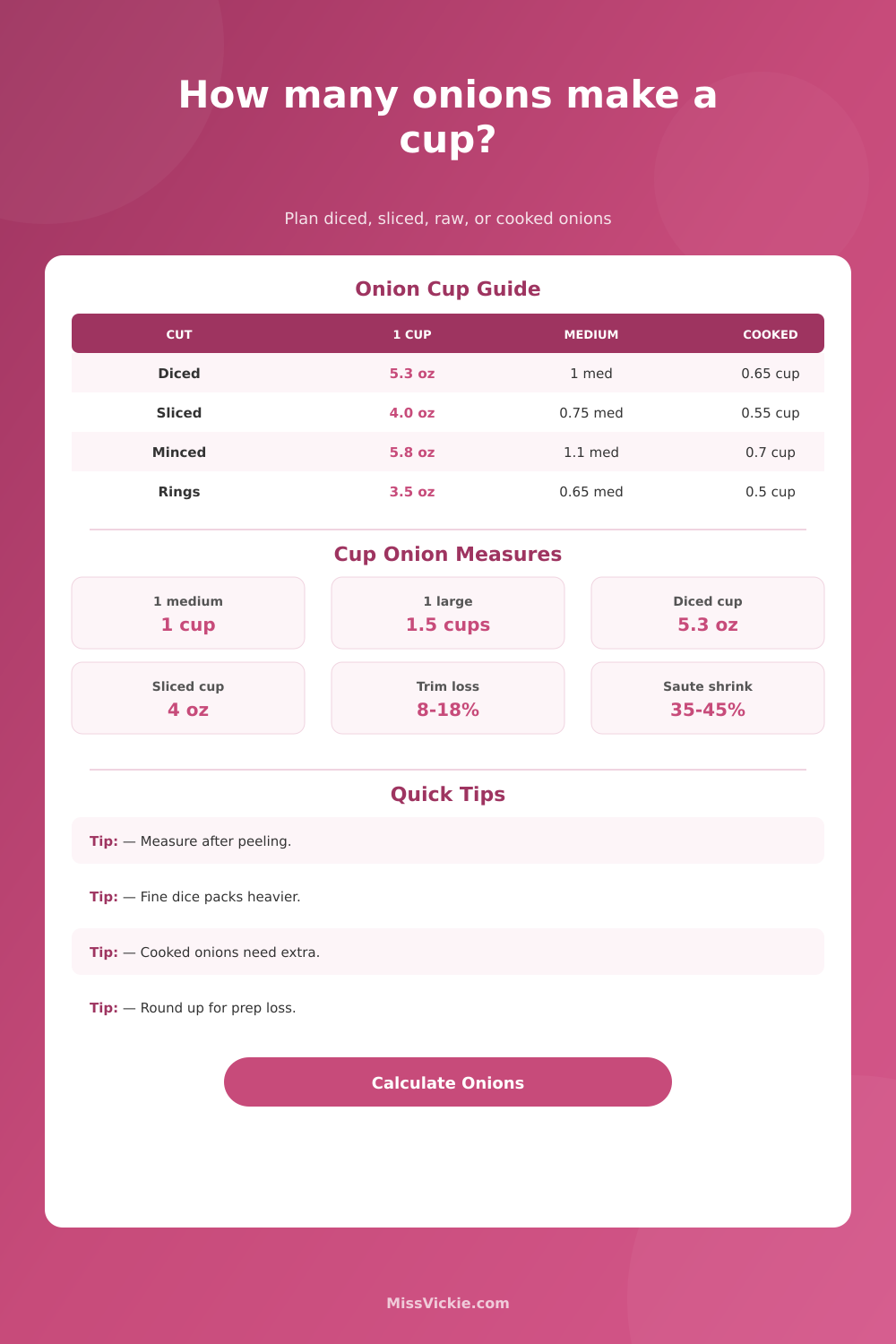
| Small dice, 1/4 inch | 5.4 oz / 153 g | About 1 cup | Soup base, chili, stuffing | Packs fairly tight in a dry cup |
| Medium dice, 1/2 inch | 5.0 oz / 142 g | About 1.05 cups | Pan meals and casseroles | Good all-purpose recipe cut |
| Large dice, 3/4 inch | 4.5 oz / 128 g | About 1.15 cups | Roasts, kabobs, braises | More air gaps between pieces |
| Minced onion | 5.8 oz / 164 g | About 0.9 cup | Sauces, meatloaf, patties | Fine pieces pack heaviest |
| Thin sliced onion | 4.0 oz / 113 g | About 1.3 cups | Salads, burgers, fajitas | Loose coils need gentle packing |
| Rings or petals | 3.5 oz / 99 g | About 1.5 cups | Frying, grilling, garnish | Lightest cup because of air space |
🧅Whole Onion Size Table
| Whole onion size | Typical whole weight | Usable after trim | Diced cup yield | Shopping use |
|---|---|---|---|---|
| Small bulb | 3.5 to 4.5 oz / 100 to 128 g | 3 to 4 oz | 0.6 to 0.8 cup | Single pan meals and garnish |
| Medium bulb | 5.5 to 6.5 oz / 156 to 184 g | 4.7 to 5.7 oz | 0.9 to 1.1 cups | Standard recipe conversion |
| Large bulb | 7.5 to 9 oz / 213 to 255 g | 6.5 to 7.8 oz | 1.3 to 1.6 cups | Batch soup, chili, and fillings |
| Jumbo bulb | 10 to 13 oz / 284 to 369 g | 8.8 to 11.4 oz | 1.8 to 2.3 cups | Caramelized onion and big prep |
| Mixed bag average | 4 to 9 oz / 113 to 255 g | Varies by bulb | 0.7 to 1.6 cups | Weigh if the bag has uneven sizes |
🔥Raw To Cooked Shrink Table
| Onion state | Cup shrink factor | Raw cups for 1 cooked cup | Best recipe fit | Flavor note |
|---|---|---|---|---|
| Raw measured cups | 1.00x | 1.0 cup | Salsa, salads, burger toppings | Sharpest onion bite |
| Quick saute | 0.78x | 1.3 cups | Fajitas, egg dishes, weeknight pans | Still visible and lightly sweet |
| Soft saute | 0.65x | 1.5 cups | Soup base, gravy, casseroles | Mellow and tender |
| Sweated base | 0.58x | 1.7 cups | Chowders, sauces, stews | Soft without much browning |
| Caramelized | 0.32x | 3.1 cups | Jammy topping and onion soup | Very sweet and concentrated |
| Fried topping | 0.42x | 2.4 cups | Casserole topping and garnish | Crisp texture, high moisture loss |
📋Recipe Planning Table
| Recipe style | Typical cup target | Good cut | Medium onions | Planning note |
|---|---|---|---|---|
| Tacos or burger topping | 1 to 2 raw cups | Small dice or thin slice | 1 to 2 | Rinse white onion if a milder raw bite is wanted |
| Salsa or chopped salad | 0.5 to 1.5 raw cups | Small dice or minced | 1/2 to 2 | Red and white onions measure well after fine chopping |
| Soup, stew, or chili | 1 to 4 softened cups | Small or medium dice | 2 to 7 | Cooked targets need extra raw onion for shrink |
| Stuffing or casserole | 1 to 3 softened cups | Medium dice | 2 to 5 | Prep a little extra for pan loss and tasting |
| Caramelized topping | 1 cooked cup | Thin sliced | 3 to 4 | Low heat turns several raw cups into a small topping |
| Gravy or pan sauce | 0.25 to 1 softened cup | Minced or small dice | 1/2 to 2 | Fine cuts disappear into sauce more easily |
💡Onion Measuring Tips
Onion yield shifts with age, variety, moisture, trim habits, knife size, cup packing, pan heat, and how long the onions cook.
When you see A RECIPE that says “two cups diced onions,” do you know how many bulbs to reach for? One? Two? You’re not sure. By measuring instead of guessing, the question goes away.
An onion’s weight depend on how it is cut, how much skin is removed, and how it will be cooked. Thin rings may fill your cup but have low weight. Chopped onions can be very watery. Knowing this lets you purchase what’s needed. But it also does the math for you with your particular cooking method and cut. You don’t have to do any imaginary mental math to convert anything. It’s mostly about knowing what it is measuring.
Why Measuring Onions Helps You Cook Better
If you select a medium dice option on the calculator, then it factors that these cubes will pack tightly into a cup. Because minced onion doesn’t leave as many air gaps between each piece, it use less space by ounce. A cup of minced onions may weigh the same than a cup of chopped onions, even though it won’t look like a full cup. Because of this, you need more weight to get a similar amount for a recipe. This can impact the flavor balance in something like salsa or soup. But when we cook it, it makes such a difference.
Water is lost during cooking. A recipe calls for “a cup” of caramelized onions? That’s not just one raw onion; you’ll need about three cups of raw chopped onion to get the one cup of cooked onion you need. And soft sautéed onions don’t shrink as much as those fried in fat, as chart demonstrates. Home cooks tend to overestimate this effect: Chop an onion. Fry it. Ask, “Where did all my onion go?” Answer: It evaporated. There is less volume and there is more flavor.
But there’s also the trim waste that will affect your estimate. Before any chopping starts, the root end, outer skin and tough stem goes into compost pile. With a big batch of onions, that adds up: preparing them typically results in about 12 percent waste. If they’re bruised or just plain dirty, it’ll be even more. Tweak that in the tool to match what you purchased. Produce at the farm may have more dirt on it; supermarket bulbs might been dry after being stored.
Prep: What kind of onion? For cooking bases, use yellow onion because it resists heat. When raw, red onions holds their shape, which is good for salsa or salad. Sweet onions shrink because they contain more water. More-is-less: With shallots, you get more bulbs than with a yellow onion to equal one cup, but they’re delicate in aroma. So use your knowledge here; think sweet= topping, sharp=garnish.
Cook smarter by planning ahead. Do you know when you’ll need two cups of cooked onion? Calculate the raw amount before starting and then chop away. This turns uncertainty into a straightforward step. Peel, dice, and cook knowing you’re finished. And not overcooking or under-cooking. Use enough onion but not too much. With this knowledge of waste, cooking method, and cut size, guessing is gone. Cooking become intentional.