
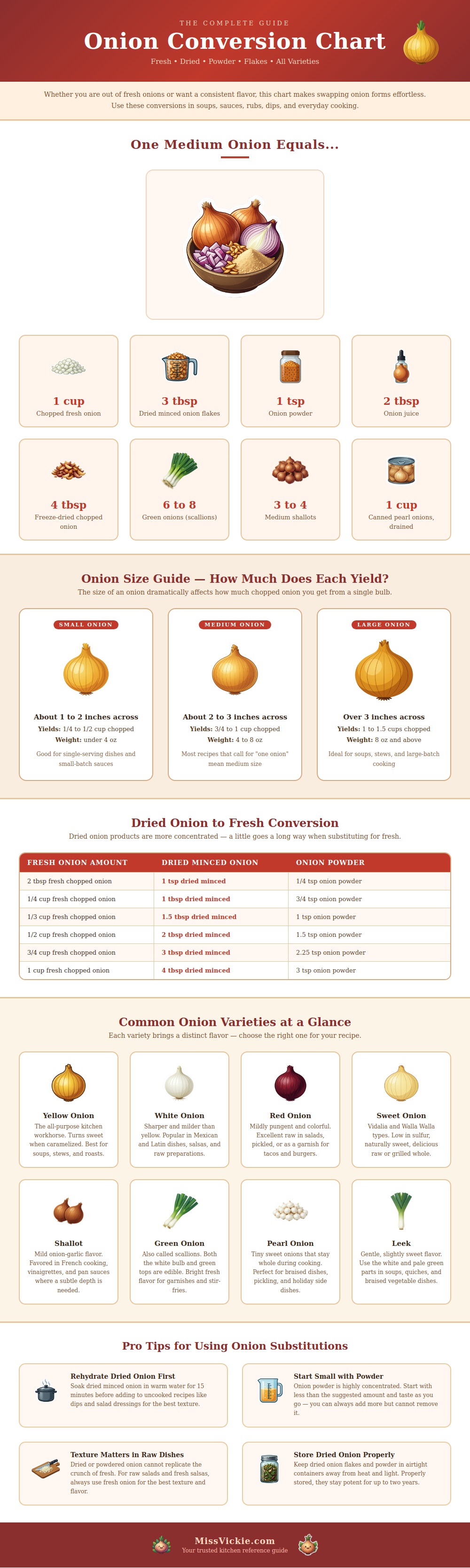
It’s the middle of a weeknight dinner recipe, when you realize: No onion in this house. You have just a dried packet of flakes (or maybe powder) from the pantry. Not a panic moment, exactly, but still, you’re working with math now. How many spoonfuls of dry stuff equal that single medium bulb called for in recipe? If only there were a trusty conversion chart! That way it becomes a matter of making simple swap, not having to guess.
I’ve laid this out nicely in the visual guide above, so no need for guessing. Basically, this system use one cup of chopped fresh vegetable as the equivalent of one standard medium onion. Everything else follows from there. And as you’ll note, once we take water out of the equation, you start seeing those volumes diminish.
How to Swap Onions in Your Recipe
Three tablespoons of dried minced flakes will recreate that same taste according to the chart, and it’s a big reduction in bulk without much loss in strength. Onion powder narrows the ratio even more, since the dehydrating process intensifies those sulfur compounds and sugars so much. About a teaspoon will be equivalent to your medium bulb. This is precisely why folks tend to overdo it with powder. They throw it on like it’s salt, while thinking of it as a potent extract.
Form is important but so is knowing how big it should be. But unlike knowing whether something is too hot, or too dry or too sweet, you don’t get any size clue from most recipes. It says “onion” but does not mention the size. If you use a 1-inch onion and someone else uses a 3-inch onion, you will both end up making very different meals.
As the infographic shows, onion yield varies depending on their size (diameter). Pulling out a tiny onion measuring less than two inches across will only net you around a half cup, while a really large onion (over three inches) may dish up as much as a cup and a half. Now you know why your grandmother’s version of whatever she makes doesn’t taste like yours, even though you’re using the exact same recipe. She probably had bigger bulbs, or perhaps was more precise in her measurement.
If you find some unusually heavy or dense onions at the store, reach into your bag and grab a medium-sized one. Plan on getting about a full cup of chopped ingredients.
There is another level of nuance: what kind of onion? Beyond just measuring out the correct amount, there’s also the matter of choosing the right kind. Generally, the yellow onion is the workhorse because it has just the right balance of sweetness and bite for caramelizing. Red ones have a mild taste and look good in salads. White ones are crisper and sharper, which is better when eaten raw in salsas. And so on; the how-to explains those differences briefly.
The point is that there’s no one-to-one translation from flavor profile, though there may be from measure to measure. You could measure accurately, switch out a hot yellow for a sweet Vidalia, and wreck a light vinaigrette. That’s an easy mistake to remedy, more liquid. A flavor-profile mistake needs to start from scratch.
Storing those swaps correctly is a silent-but-vital part of making sure they’re reliable. That teaspoon of onion powder isn’t going to be as strong as the equivalent amount of the fresh bulb, if the powder’s been sitting on the counter for several years, dried onion deteriorates quickly when exposed to any sort of light or heat. To keep things properly proportioned each time you reach for one, store it correctly. The details are in the visual aid. Basically, keep it in an air-tight container kept out of the sun. Stored this way, even powdered spices and dried herbs can retain their strength for as long as two years. When yours has grown musty instead of punchy, it won’t work, no matter how much the chart say to add.
And then there’s the question of texture, which no volume measurement can address. Fresh onions maintains their structure; powder dissolves and flakes soften. This won’t matter much once they’re cooked into a creamy soup or dip. But if it’s a tartare or fresh salsa where you want that crisp bite, you need the sort of thing only raw veggies can deliver. Well, no, no, nothing re-hydrated out of dried flakes is going to have that same snap as a slice of chilled white onion does. That’s what most home cooks lose sight of when changing forms: It’s all about flavor intensity…but also about how something feels in your mouth.
And then remember these rules. Then your pantry is less like a list of what you can’t eat and more a useful box of tricks, whether you’re plucking something fresh off a shelf or reaching into a stash of dried goods. The result? The result is a balanced flavor that enhances but doesn’t overpower what you’re eating. When you master these substitutions, an empty vegetable drawer isn’t a crisis; it’s just another item on your to-do list that you can handle without looking up from the cutting board.