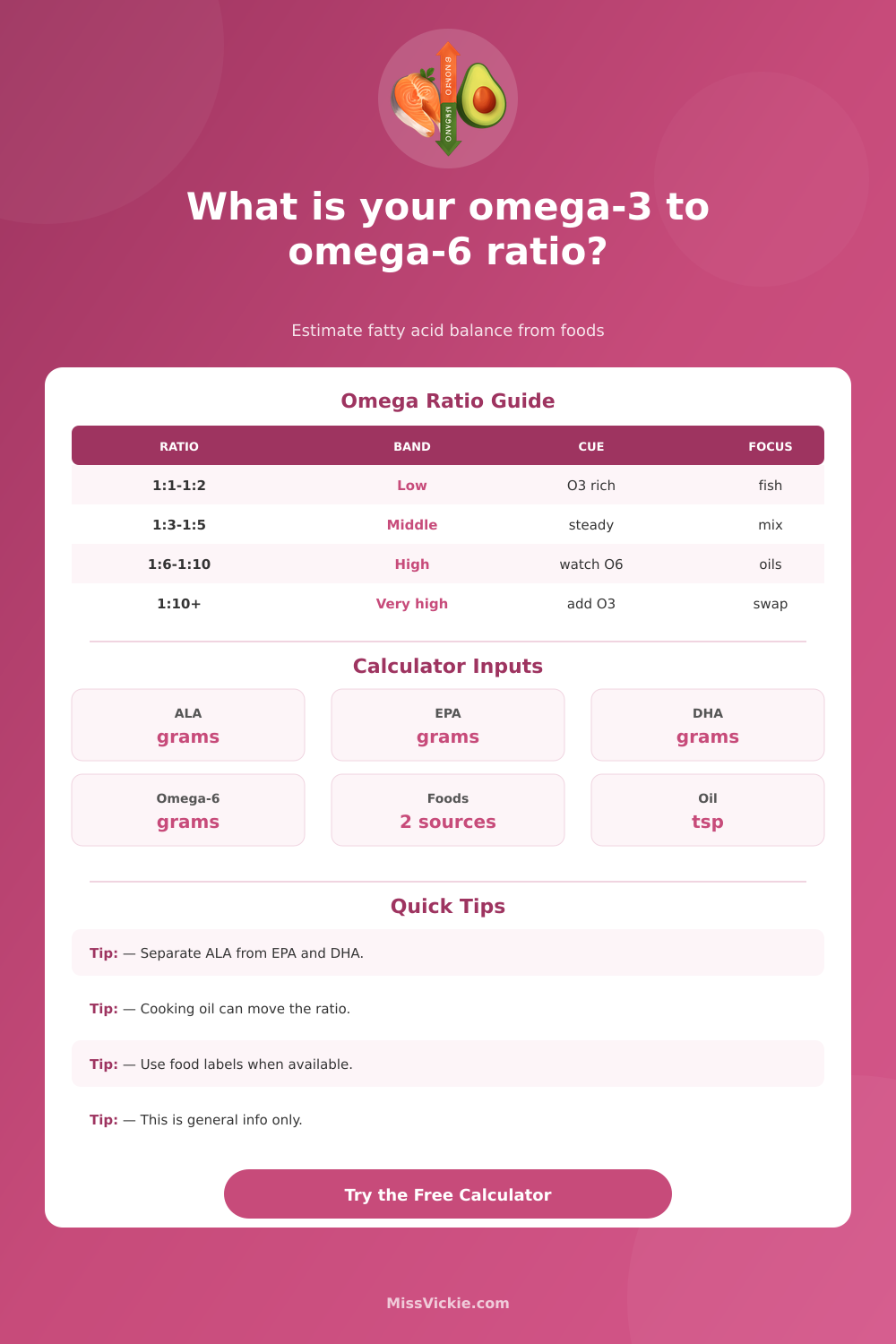
ALA, EPA, DHA, omega-6 grams, food sources, meal or day totals, and cooking oil
Omega-3 to Omega-6 Ratio Calculator
Estimate your omega-3 and omega-6 balance from manual grams, two food sources, cooking oil, and a meal or day multiplier. This tool is for general food planning only.
Pick a common food pattern, then edit the fatty acid grams, source servings, oil choice, and meal or day multiplier.
Omega Ratio Breakdown
| Food Source | Serving | Omega-3 Profile | Calculator Note |
|---|---|---|---|
| Cooked salmon | 3 oz | About 0.59g EPA and 1.24g DHA | Strong direct long-chain omega-3 source. |
| Sardines | 3 oz | About 0.45g EPA and 0.74g DHA | Small fish option with moderate omega-6. |
| Rainbow trout | 3 oz | About 0.40g EPA and 0.44g DHA | Good when you want a lighter fish entry. |
| Canned tuna | 3 oz | About 0.03g EPA and 0.23g DHA | Use label values when packed in oil. |
| Food Source | Serving | Omega-3 Profile | Omega-6 Watch Point |
|---|---|---|---|
| Ground flaxseed | 1 tbsp | About 2.35g ALA | Lower omega-6 than most nuts. |
| Chia seeds | 1 tbsp | About 1.8g ALA | Useful for smoothies and oatmeal. |
| Walnuts | 1 oz | About 2.57g ALA | Also about 10.8g omega-6 per ounce. |
| Hemp seeds | 1 tbsp | About 0.9g ALA | Omega-6 is higher than omega-3. |
| Oil Or Fat | Per Teaspoon Omega-3 | Per Teaspoon Omega-6 | Ratio Cue |
|---|---|---|---|
| Olive oil | About 0.01g ALA | About 0.31g | Low omega-6 cooking choice. |
| Canola oil | About 0.43g ALA | About 0.93g | Adds both ALA and omega-6. |
| Soybean oil | About 0.30g ALA | About 2.30g | Omega-6 climbs quickly by teaspoon. |
| Corn or sunflower oil | Trace to 0.05g ALA | About 2.4g to 2.7g | Usually pushes the ratio higher. |
| Omega-6 : Omega-3 | Calculator Band | What Often Drives It | Planning Cue |
|---|---|---|---|
| 1:1 to 2:1 | Omega-3 rich | Oily fish, flax, chia, low oil | Check that the entries reflect a real day. |
| 3:1 to 5:1 | Moderate | Mixed foods with some omega-3 sources | Often a balanced planning range. |
| 6:1 to 10:1 | High omega-6 | Seed oils, nuts, poultry, processed foods | Review oil amount and add omega-3 foods. |
| Above 10:1 | Very high omega-6 | Large oil portions with little EPA, DHA, or ALA | Use labels and retest with food swaps. |
An omega-3 to omega-6 ratio calculator allow people to track the amount of omega-3 and omega-6 fatty acid they consume in there diet. Because the balance of omega-3 to omega-6 fatty acids can have an impact on both inflammation in the body and heart health, many individual turn to a ratio calculator to provide insight into their dietary intake of these two type of fats. A ratio calculator is a tool that allows individuals to input information regarding their dietary intake of various food and recieve an estimate of the ratio of omega-3 to omega-6 fats consumed by an individual.
To understand how fats work within the body, various type of omega-3 fats must be individually considered. For instance, alpha-linoleic acid (ALA) is a type of omega-3 fatty acid that is found in foods like flaxseed, chia seeds, and walnuts. However, the body must convert ALA to be utilize by the body.
How to Use an Omega-3 to Omega-6 Ratio Calculator
In contrast, eicosapentaenoic acid (EPA) and docosahexaenoic acid (DHA) are forms of omega-3 fatty acids that are found in foods like fish and eggs; EPA and DHA do not need the body to convert them after there ingestion. Because the body only very limitedly convert ALA to EPA and DHA, it is necessary to treat these two type of fats separately from one another. Thus, a ratio calculator may allow individuals to input the grams of ALA, EPA, and DHA consumed by the individual separately to calculate the true value of their intake of omega-3 fatty acids.
In addition to calculating the omega-3 and omega-6 fat intake from the foods consumed, the ratio calculator may also allow individuals to input the amount of oil that they use in the meal that they cook. Oils can contain significant amounts of either omega-3 or omega-6 fat. For instance, oils like soybean oil and sunflower oil are high in omega-6 fats.
As a result of consuming these type of oils, the amount of omega-6 fats in the body will increase. Thus, incorporating this oil input into the calculator helps to determine the effect that cooking oils has upon the ratio of omega-3 to omega-6 fats consumed by an individual. The ratio calculator will output an indication of the current ratio of omega-3 to omega-6 fats of an individual’s diet.
For instance, the calculator can indicate whether an individual’s diet is high in omega-3 fats or high in omega-6 fats. Additionally, the ratio calculator may calculate the percentage of EPA and DHA of an individual’s total intake of omega-3 fats; the percentage of EPA and DHA indicate to an individual how much of the beneficial, usable form of omega-3 fats they are consuming with their diet. If the ratio calculator indicates to an individual that their intake of omega-6 fats is too high, they can take steps to change their diet to reduce their intake of those fat, perhaps by changing the type of oil that they use in the kitchen or by increasing their consumption of foods that are high in omega-3 fats, like fish.
Diets within the moddern world are often high in omega-6 fats, especially in the processed foods that those individuals regularly consume. The ratio calculator allows individuals to experiment with different dietary choice. For instance, an individual could use the calculator to determine what changes in oil type will have the most significant impact upon their ratio of omega-3 to omega-6 fats.
If they swap oils from soybean oil to olive oil, for instance, their ratio will improve; soybean oil is high in omega-6 fats, while olive oil is not. Additionally, using the calculator, individuals can also experiment with adding foods high in omega-3 fats, like walnuts or foods like flaxseed, to their meals. In addition to calculating the amount of each type of fat that an individual consume through their diet, the ratio calculator may additionally permit individual to adjust the calculation for the value of ALA.
For instance, the calculator may count ALA in at 100% of its value to the diet. However, because the body does not utilize all of the ALA consumed from foods like flaxseed and chia seeds, the percentage of ALA may additionally be lowered to reflect the limited ability of the body to utilize that fat. Each of these setting may be toggled within the ratio calculator.
Thus, while not a replacement for a blood test, a ratio calculator is a tool that can help an individual maintain the consistency of their diet. In addition to calculating the amount of fats consumed by the individual each day, the calculator may additionally calculate the portion size of each of those fats. The portion sizes determine the total amount of fat consumed by the individual.
For instance, increasing the portion size of foods high in omega-6 fats, like sunflower oil, will alter the ratio of omega-3 to omega-6 fats that is consumed by the individual. Thus, the allowance for inputting both grams and servings within the calculator allows the individual to evaluate the impact that different portion size may have on their ratio of omega-3 to omega-6 fats. Overall, the use of an omega-3 to omega-6 ratio calculator may help an individual to understand the impacts of their diet.
For instance, the individual may notice that altering the oil that they use within the kitchen has the most significant impact upon their ratio. Additionally, altering the portion sizes of foods high in omega-3 fats may lead to the changes in that ratio. Thus, while the calculator does not indicate to the individual their health goal for their body, the calculator does provide them with the number that they can use to make adjustments to their diets.