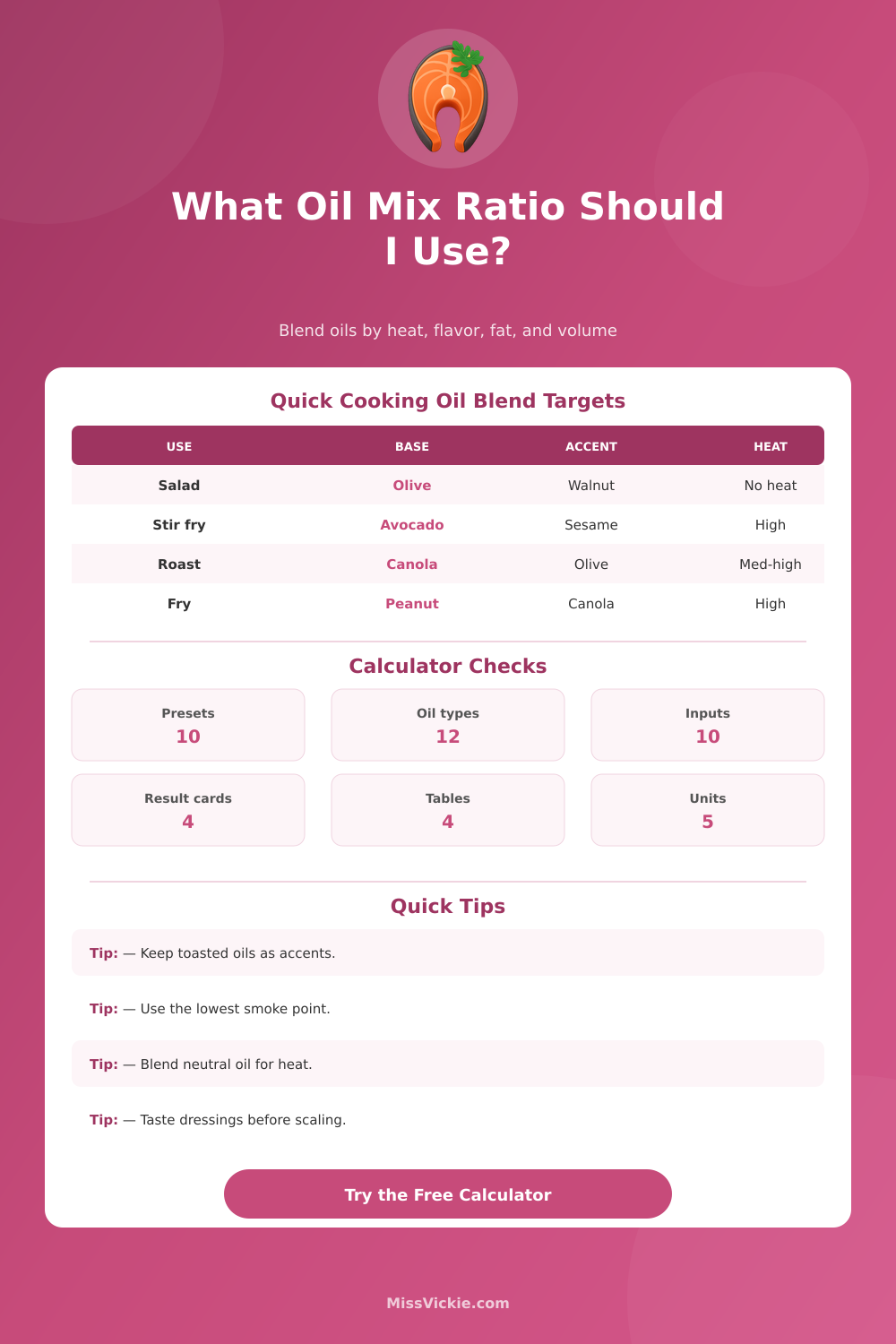
Oil Mix Ratio Calculator
Blend cooking oils by volume while checking fat profile, practical smoke point, flavor strength, and whether the ratio fits salad dressings, roasting, sauteing, frying, or finishing oil.
Use these as starting ratios, then adjust the oil choices, percentages, target volume, heat level, and flavor goal for your own recipe.
| Oil | Smoke point | Sat fat | Mono fat | Poly fat | Flavor |
|---|---|---|---|---|---|
| Extra virgin olive oil | About 375 F | 14% | 73% | 11% | fruity, peppery |
| Refined avocado oil | About 520 F | 12% | 70% | 13% | clean, buttery |
| Canola oil | About 400 F | 7% | 63% | 28% | very neutral |
| Grapeseed oil | About 420 F | 10% | 16% | 70% | light, neutral |
| Peanut oil | About 450 F | 17% | 46% | 32% | nutty, rounded |
| Toasted sesame oil | About 350 F | 14% | 40% | 42% | deep roasted |
| Measure | Milliliters | Tablespoons | Teaspoons | Kitchen note |
|---|---|---|---|---|
| 1 teaspoon | 4.9 ml | 0.33 tbsp | 1 tsp | useful for accent oils |
| 1 tablespoon | 14.8 ml | 1 tbsp | 3 tsp | standard tasting batch |
| 1/4 cup | 59 ml | 4 tbsp | 12 tsp | small dressing jar |
| 1/2 cup | 118 ml | 8 tbsp | 24 tsp | marinade or roast batch |
| 1 cup | 237 ml | 16 tbsp | 48 tsp | meal prep blend |
| 1 quart | 946 ml | 64 tbsp | 192 tsp | large fryer or catering |
| Use | Base share | Support share | Accent share | Best oils |
|---|---|---|---|---|
| Salad dressing | 60-80% | 10-30% | 5-15% | olive, canola, walnut, flax |
| Marinade | 70-85% | 10-25% | 0-10% | olive, grapeseed, avocado |
| Sauteing | 75-90% | 10-25% | 0-5% | avocado, canola, olive |
| Roasting | 70-90% | 10-30% | 0-5% | canola, avocado, peanut |
| Stir-frying | 85-95% | 0-10% | 1-5% | avocado, peanut, sesame |
| Finishing oil | 50-75% | 0-25% | 10-30% | olive, sesame, walnut |
Heat-first blend
Choose avocado, peanut, rice bran, or refined sunflower as the base. Keep flavorful or delicate oils small so the lowest smoke point does not pull the blend below the cooking temperature.
Flavor-first blend
Use extra virgin olive, toasted sesame, walnut, or coconut for character, then soften the edge with a neutral support oil. This is best for dressings, finishing, and low-heat cooking.
Fat-profile blend
Increase olive, avocado, or high-oleic sunflower for more monounsaturated fat. Add canola or flax only when the blend will stay cool or gently heated.
Use the most delicate oil as the limit
A weighted smoke point is helpful for comparison, but the most delicate oil still matters. If a blend includes flax, walnut, or toasted sesame, keep it for cold use, finishing, or brief low heat unless the accent percentage is very small.
Scale flavor after a spoon test
Strong oils get louder after salt, vinegar, garlic, chili, or heat. Mix one tablespoon first when using sesame, walnut, coconut, or robust olive oil, then scale the same percentages once the flavor lands where you want it.
An oil blend is a mixture of two or more different oils that can be use for cooking or for dressings. Oil blends can be create to balance the flavor, heat tolerance, or nutritional content of the oils. Because each oil have different properties, it is necessary to determine the correct ratio of each oil that will be used in the oil blend.
The oil mix ratio calculator can assist with calculating the proper ratio. The oil mix ratio calculator will ask you to enter the target volume of the oil blend that you would like to create. The target volume is the total amount of oil that you will use in your cooking.
How to Make an Oil Blend
That volume can be relatively small if you only plan to cook one meal, or it can be a much larger volume if you would like to prepare the oil blend for use over a longer period of time. After you enter the target volume of the oil blend, the calculator will ask you to enter the percentage of three different types of oils that will be used in the oil blend. The percentage of each oil will determine the proportion in which the oils will be combined together.
The base oil will contain the majority of the oil blend, and will determine the characteristics of the oil blend. The support oil will not contribute to the character of the oil blend, but will help fill in some of the gaps of the oil blend. The accent oil will contribute to the flavor or nutrients that are contained in the oil blend, but should not be the majority of the oil blend.
The calculator treat these three oils as a single oil blend, so changing one oil will impact the other two oils in relation to that change. The smoke point of each oil is a critical measurement of the oils that are to be used in the oil blend. The oil blend will have a most lowest smoke point compared to the other oils that are contained within the oil blend.
That lowest smoke point will be the maximum temperature to which the oil blend can be heated. For example, if walnut oil is added to the oil blend, it will lower the smoke point of the oil blend compared to the other oils alone. The heat margin is the difference in temperature between the lowest smoke point of the oil blend and the temperature that you will use for cooking.
The higher the heat margin, the more extra heat that can act upon the oil blend. The lower the heat margin, the more critical it is to monitor the heat of the pan in which the oil is being cooked. Another important measurement of the oil blend is the fat profile.
The fat profile contains the measurement of the saturated, monounsaturated, and polyunsaturated fats that is in the oil blend. Each oil in the oil blend is weighted according to the percentage of that oil in the oil blend. The fat profile can be important in determining the nutritional value of the oil blend.
For dressings that are used more frequently in the diet, the polyunsaturated fat content may be higher. Oil blends that are used for cooking may contain more monounsaturated fats, as these fats do not break down as rapid as the polyunsaturated fats. The fat-priority menu option will allow you to weight the oil blend towards specific fats to determine if the oil blend will satisfy your fat requirement.
Another factor to consider when creating an oil blend is the flavor of each oil. Each oil is assigned a flavor intensity to calculate the flavor of the oil blend. If the target flavor of the oil blend is strong, oils will feature strong flavors in the oil blend.
For dressings or other recipes, a strong flavor may be desired. If the target flavor is to be neutral, the oils that contain flavors will be of a lower percentage in the oil blend to ensure that the flavor of the oil blend isnt too strong. This calculation can help you determine whether or not the flavor of the oil blend will be correct prior to creating the oil blend.
The way in which you use the oil blend will change the way in which you create that oil blend. Oil blends that are used as marinades will differ from oil blends that are used as a finishing oil. Marinades are applied to the food, but are later wipe or drained off the food.
Finishing oil is tasted directly on the food. The flavor target will be more important in the creation of a finishing oil blend than the smoke point target. Oil blends used for marinades may have different targets according to their use.
The cooking-use menu will allow you to adjust the parameters of the oil blend based on the way in which you will use the oil blend. The way that you store the oil blend will also impact the oil blend. Polyunsaturated fats will become rancid if exposed to light and oxygen.
Oil blends that contain flax oil or grapeseed oil will become rancid more rapidly than oil blends that contain avocado oil. While the oil blend cannot be calculated to last how long before it becomes rancid, the fat-profile information will at least provide some indication of the rancidification of the oil blend. To limit the number of years that the oil blend will sit in a bottle, it is best to prepare smaller batches of the oil blend.
Some of the most common mistake with oil blends is the focus on only one feature of the oil blend. Some individuals only consider the smoke point of the oils, while others focus exclusively on the nutritional content of the oil blend. The oil blend ratio calculator avoids these mistakes by forcing the percentages of each oil to total to 100%.
If an individual makes a change to the percentage of one oil, the calculator will automatically change the percentages of the other oils. Reference tables are provided on the calculator to assist with the calculations or the oil blend creation. The smoke-point table will allow you to see what oils have the higher smoke points should your calculated heat margin be too small.
The fat-profile table will indicate which oils will change the fat content of the oil blend. The conversion of volume from ml to tbsp and cups is also provided to make it easier for you to determine the volume of oil blend that will be created. Prior to the preparation of the oil blend, it is recommended that you create a small batch of oil blend to test the flavor.
A tablespoon of oil blend can be tasted to determine if the flavor target is correct. Should the oil blend be too strong, the percentage of accent oil can be lowered, and the percentage of support oil increased. The oil blend ratio calculator will automatically calculate the new ratio.
Making small changes to the percentage of each oil will impact the smoke point, flavor, and fat balance of the oil blend. You should of checked the labels first to be sure. It could of helped too.
Youll find that actualy making the blend is easier than it looks.