
You’re standing there in your kitchen, holding a piece-of-crap cake board half-covered in frosting, when suddenly it hits you: the guest list has shifted; somebody said they were bringing their children; hell, somebody said they weren’t even coming anymore; and now you have no idea whether this number eight will be enough food, either too little or to much, to feed all those people without leaving any of them hungry. That’s a special type of birthday host anxiety. You might not care what the damn cake tastes like or looks like, or whether it’s crumbly or soft as silk. But you do worry about math. And, more specifically, what you can actualy get into that decorated shape that you bought for its aesthetics instead of its ability to efficiently hold food.
Because they are so clearly cool on a dessert table, number cakes has come to dominate celebrations of milestones. Personalized! Tall! Photogenic! And yet there’s a catch. Most people don’t notice it until the knife is out: When it comes to yield, the shape of the digit do matter, more different than you’d think. Open shapes, like a one or a seven, pack far less cake mass into same footprint as closed loops, such as an eight or even a zero. It’s that geometry gap that makes for parties gone wrong. If your plan is to feed a crowd using a single two-layer cake, you’re going to run out of dessert midway through the toast. Here are the specifics.
How to Choose the Right Number Cake Size
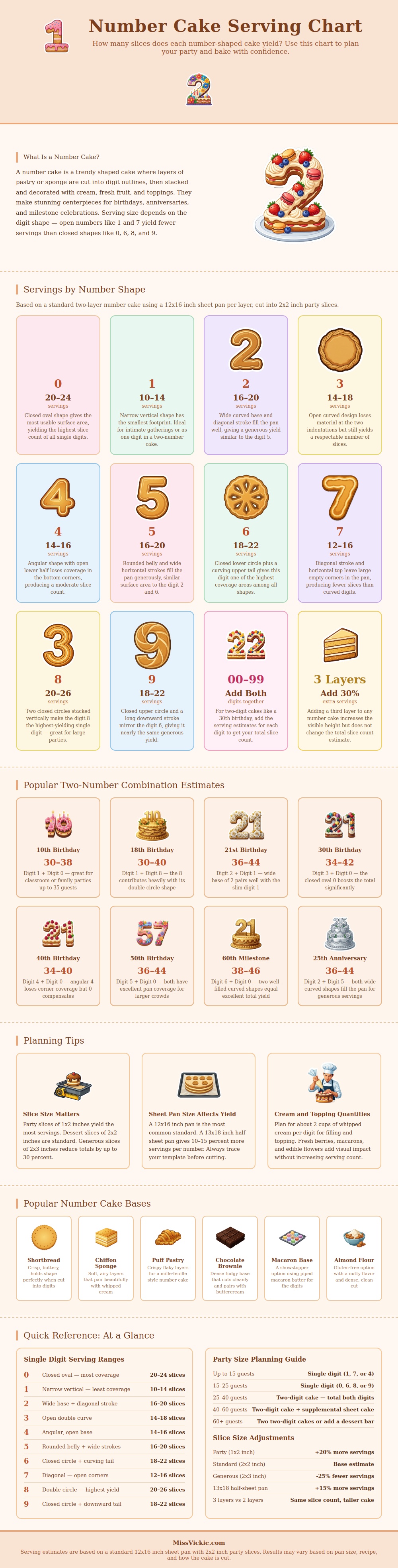
Here’s how every digit compares in terms of usable surface area: As you can see, the closed digits is winning out on this one. A number eight basically offers up two circles piled on top of each other. Very little pan space gets wasted. If there were a heavyweight champ of all the one-digits, it would be an eight. Conversely, the skinny rectangle known as a number one isn’t packing any punch. Sure, it may look sleek, but that’s not a lot of sponge to work with. It is great for an intimate get-together, sure. But at a big ol’ shindig? Yeah, better think about those empty spaces in the pan and missing corner.
Which brings us back to this: The shape of the digits make more sense as a cake strategy than simply guesstimating which birthday deserves the two-digit treatment. For a two-digit cake, you need only makes a quick addition in your head: the result from the first digit plus the second. Both the zero and the five add something to a forty- or a thirty-year-old’s cake; they both offer a plump curve that fills out a sheet pan nicely. In contrast, the zero tries to help out a ten, but the one pulls it all down; even with the help of its partner, there’s not much to work with. It’s simple math, and it prevents you from getting a last-minute backup sheet cake.
Also keep in mind: what thickness do you intend to slice? Your typical party size will be two by two inches. That is a fair amount of cake for most adults and kids alike. So if you’re feeling especially generous; or serving a group with hearty appetites… Make your pieces larger. You’ll get a lot less cake per slice. On the other hand, if you’d rather serve a slightly smaller portion, say one by two inches for parties, that same cake will serve a lot more people. The graphic makes this point well. It reminds us that serving size isn’t set in stone; it is a decision. You can often change it simply by adjusting your piece size instead of baking an all-new cake base.
Remember that the cake’s height counts too. A second layer might be necessary just to make the centerpiece look impressive, and it allow for taller decoration elements as well. But it doesn’t increase the number of slices. Whether you’ve got two layers or three, the surface area will still be the same. Visual drama vs. This is the actual volume of food. If it’s going to be photographed heavily, go for it, but keep this trade off in mind as you’re considering both your dessert spread and your budget.
Consider your base. Some types of bases (like puff pastry and short bread) keeps their shapes really well if they’re cut out into complicated-looking fingers. They can handle a hefty topping such as macarons or fresh berries without collapsing around the edges. Other bases (such as chiffon sponge) are lighter and fluffier, which may be preferable in terms of texture but will need to be treated carefully while being cut. A denser base, such as brownie, will produce neat lines. However, it tends to be richer in taste, which could make it slightly too heavy for a post-meal dessert.
So the takeaway is this: Make your cake guests happy by having enough to go around but not so much that you’re left feeling overwhelmed by leftover sweets. This visual guide should of help you guess accurately how many guests will be fed. It helps you find a shape appropriate for your number of people and account for desired thickness of each slice so you can bake away with no worries in mind. Let the math do its thing, it’ll work out.