🧁 Muffin Calorie Calculator
Estimate homemade muffin calories from batter weight, muffin size, ingredient style, add-ins, baked yield, topping weight, and servings.
Pick a starting batch, then adjust the batter, add-ins, topping, yield, or muffin count to match your recipe.
Batch Inputs
Current Batch Snapshot
Base value from the selected ingredient style.
Calories for the selected mix-in weight.
Calories for sugar, glaze, streusel, or swirls.
Target raw batter for the selected muffin size.
Calories are estimated from practical baking nutrition averages. Exact results vary by flour, sugar, oil, dairy, and brand labels.
Muffin Calorie Results
Calorie Breakdown
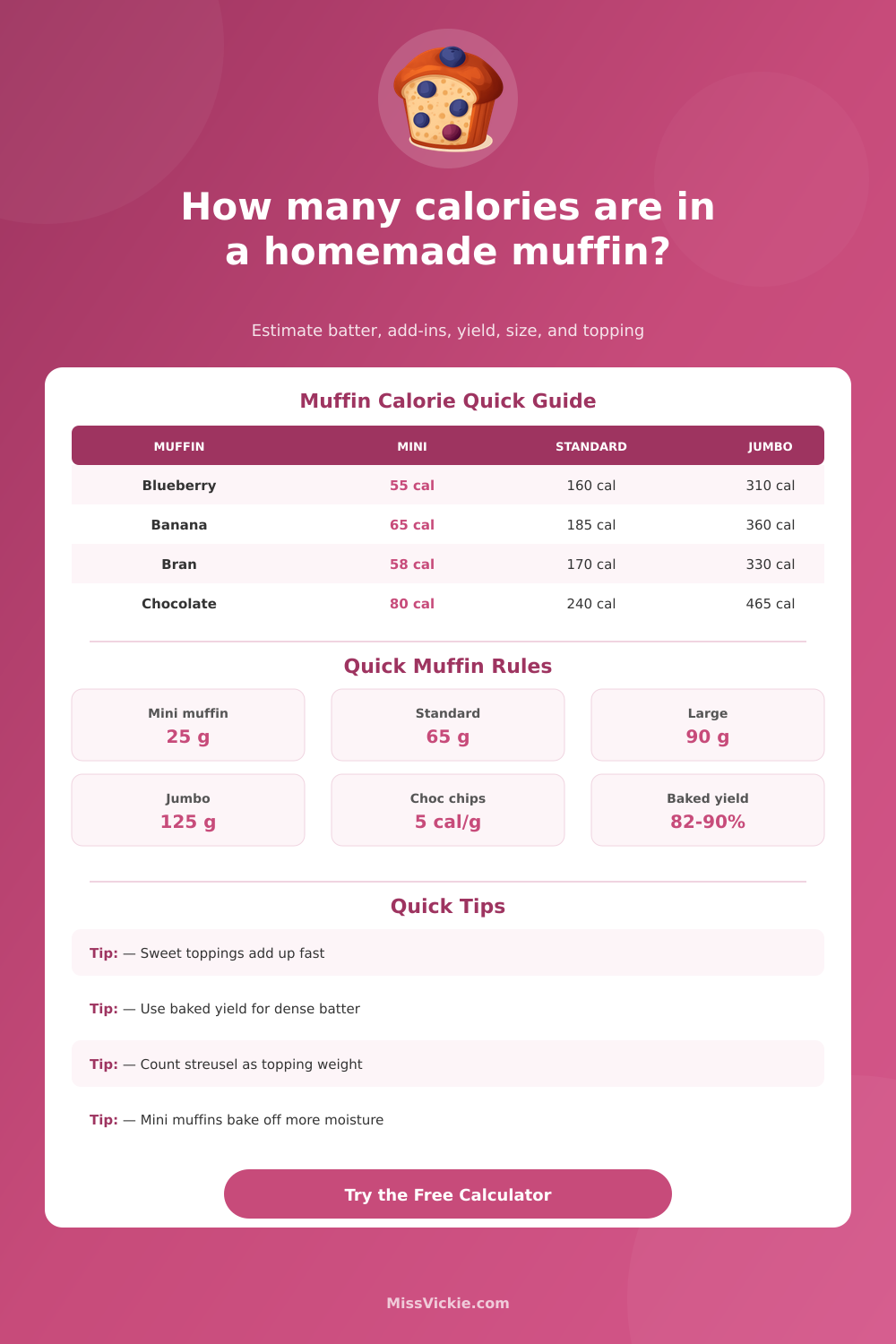
These cards compare the same batch portioned into common muffin sizes, using your current batter, add-ins, topping, richness, and yield settings.
Mini Muffins
0 cal25 g raw portions
Standard Muffins
0 cal65 g raw portions
Large Muffins
0 cal90 g raw portions
Jumbo Muffins
0 cal125 g raw portions
| Batter style | Calories per 100 g | Protein | Best use |
|---|---|---|---|
| Blueberry muffin batter | 255 | 4.4 g | Fruit muffins with moderate sugar and oil. |
| Banana muffin batter | 275 | 4.8 g | Moist breakfast muffins with mashed fruit. |
| Bran or whole wheat batter | 235 | 5.4 g | Hearty muffins where fiber lowers calorie density. |
| Chocolate muffin batter | 325 | 5.0 g | Richer dessert-style muffins before chips. |
| Lemon poppy seed batter | 305 | 4.6 g | Sweet oil-based batter often paired with glaze. |
| Cornbread muffin batter | 290 | 5.1 g | Savory or lightly sweet side muffins. |
| Ingredient | Calories per gram | Typical batch weight | Calorie behavior |
|---|---|---|---|
| Fresh blueberries | 0.57 | 100 to 180 g | Low calorie but adds moisture and possible yield loss. |
| Chocolate chips | 5.00 | 120 to 250 g | Raises calories quickly in standard and jumbo muffins. |
| Walnuts or pecans | 6.30 | 60 to 140 g | Dense calories with crunch and fat. |
| Streusel topping | 4.35 | 80 to 180 g | Often the largest hidden calorie addition. |
| Glaze | 3.40 | 50 to 120 g | Sugar-heavy topping spread across the batch. |
| Cream cheese swirl | 3.20 | 90 to 180 g | Adds fat, sugar, and a richer center. |
| Batch goal | Raw weight each | Typical count | Planning note |
|---|---|---|---|
| Mini brunch tray | 22 to 28 g | 24 to 48 | Good for parties where people sample several flavors. |
| Standard breakfast | 60 to 70 g | 10 to 14 | Most home muffin pans land in this range. |
| Large cafe muffin | 85 to 100 g | 8 to 10 | Feels generous without becoming a jumbo bakery portion. |
| Jumbo bakery muffin | 115 to 140 g | 6 to 8 | Calories rise fast when topping and chips are added. |
| Meal prep muffins | 55 to 75 g | 12 to 18 | Use consistent batter weight for even nutrition tracking. |
Using the full bowl weight catches the flour, sugar, oil, egg, and dairy already mixed into the recipe. Then add chips, nuts, fruit, or topping separately when they are easy to weigh.
If the same batter makes 10 tall muffins instead of 12 standard muffins, the batch calories do not change, but each muffin becomes noticeably higher in calories.
Calculating the calories in a batch of muffin requires understanding the relationship between weight of the ingredients and the weight of the finished muffins. Although many peoples use volume measurements like cups or teaspoons to measure the ingredients for there muffins, the volume of an ingredient isnt always the same as the weight of that ingredient. Therefore, it is important to use weight measurements to measure the ingredients for your muffins.
The muffin calorie calculator allow you to track the calories in your batch of muffins by weighing the batter that contain the ingredients, the number of muffins that will be produced, and the weight of each of these muffins. The weight of the batter will contain the calories from the ingredients in the muffin batter. Each ingredient contain a specific amount of calories per gram; flour, sugar and fat all contain different amount of calories per gram of that ingredient.
How to Calculate Calories in a Batch of Muffins
Therefore, weighing the batter will allow you to determine how many calories you are adding to the oven for baking. Once you know the total weight of the batter, you can calculate how many calories is contained in each individual muffin. As the muffins bake, they will lose some of there moisture.
The loss of moisture will lead to a reduction of the total weight of the baked muffins. However, the total calories contained in the muffins will remain the same. Therefore, it is important to account for the loss in moisture and weight of the muffins when calculating their total calories.
The muffin calorie calculator allows you to account for the loss of moisture from the muffins while baking the muffins, ensuring that the calorie count of the muffins reflects the actual calories of the baked goods. Add-ins to the muffin batter, such as blueberries, chocolate chips or nuts will change the total calories of the batch of muffins. Blueberries contain very few calories per gram, while ingredients like chocolate chips or nuts contains many calories per gram.
Therefore, it is important to weigh any add-ins to account for there calories, as well as weigh any toppings on the muffins (additional calories from toppings will be reflected in the total calorie count of the muffin batch). The size of the muffin batch will impact the number of calories per muffin. For example, if you divide a batch of muffin batter into twelve muffins, each individual muffin will contain more calorie than if you divided that same batch of muffin batter into twenty-four muffins.
The total calories in all of the muffins will remain the same, but the number of calories per muffin can change if you alter the number of muffins that are baked. The size selector in the muffin calorie calculator allows you to determine how many calories each individual muffin will contain if you divide the total batch of muffins into any specific number of muffins. Small difference in the baking process may lead to small errors in how many calories are contained in each batch of muffins.
For instance, if you use different brands of flour or use eggs of different size in each batch of muffin batter, you may experience a slight change in the number of calories of each batch of muffins. Though these small differences may not be important for each batch of muffins individually, they can add up over time. Thus, the number of calories of each batch of muffins that you bake may differ slightly from the number of calories calculated by the calculator.
The number of muffins that you bake may also be different than what you expected. For instance, you may have assumed that you would produce twelve batches of muffins, but ended up only producing ten batches of muffins. Each of these muffins will contain more calories than if you baked twelve muffins.
The serving size field in the calculator will allow you to set the number of muffins that you baked, allowing you to easily determine the number of calories that contains in each of your baked muffins. It is also possible that some of your muffin batter got lost in the baking process; some of the batter may have remained clinging to the mixing bowls or the paper liners that you use to cover the muffin pans. These lost batch of muffins also contain calories.
The loss percentage feature in the muffin calorie calculator allows you to account for this lost batter. By weighing your ingredients, accounting for the loss of moisture from the muffins during baking, the calories of any add-ins to the muffins, the size of each batch of muffins, any baking errors, the actual number of muffins that are baked, and the amount of batter that may be lost during the baking process, you can achieve an accurate picture of the total calories that your batch of muffins contain.