MissVickie muffin tin fill planner
How Much Muffin Batter In Each Cup Calculator
Estimate how much batter to scoop into each muffin cup from pan size, cup dimensions, total batter, batter style, add-ins, liner thickness, rise room, and desired dome.
Pick a common muffin batch, then edit the cup size, fill target, batter volume, add-ins, and reserve amount for your pan.
Full Muffin Cup Breakdown
Best for flat snack muffins, testing rise, or very runny batter.
The safest everyday fill for standard muffins and paper liners.
Good for thick batter that can hold a soft rounded top.
Use with thick batter, strong pans, and enough oven spring control.
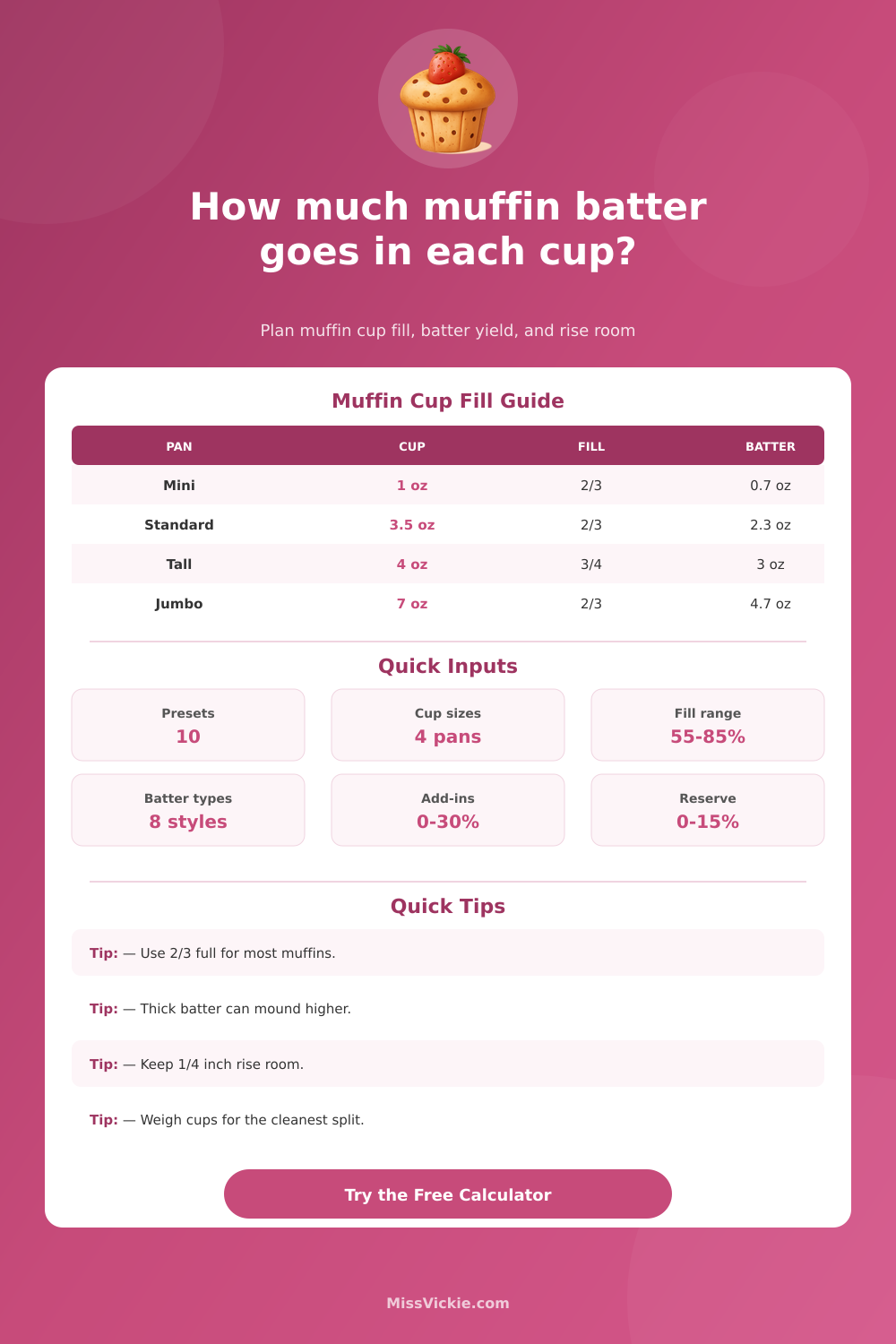
| Pan Type | Approx Well Capacity | Two-Thirds Fill | Three-Quarters Fill | Best Use |
|---|---|---|---|---|
| Mini muffin pan | 25 to 35 ml | 17 to 23 ml | 19 to 26 ml | Bite-size muffins, lunchbox batches, party trays |
| Standard muffin pan | 100 to 110 ml | 67 to 73 ml | 75 to 83 ml | Classic home muffins with moderate domes |
| Tall standard pan | 115 to 130 ml | 77 to 87 ml | 86 to 98 ml | Taller liners, fruit muffins, coffee shop style tops |
| Jumbo muffin pan | 190 to 220 ml | 127 to 147 ml | 143 to 165 ml | Large bakery muffins or meal-size muffins |
| Batter Style | Typical Fill | Density Used | Rise Behavior | Calculator Adjustment |
|---|---|---|---|---|
| Classic quick-bread muffin | About two-thirds full | 1.03 g per ml | Balanced dome with moderate oven spring | No special fill shift unless add-ins are high |
| Thin pourable batter | Half to two-thirds full | 1.00 g per ml | Spreads quickly and can overflow if high | Recommends a small fill reduction |
| Thick scoopable batter | Three-quarters full | 1.06 g per ml | Holds a mound and rises upward | Allows a little more practical fill |
| Bran or whole grain batter | Two-thirds to three-quarters full | 1.08 g per ml | Dense structure with slower rise | Adds weight estimate and lowers overflow risk |
| Banana or pumpkin batter | Two-thirds full | 1.07 g per ml | Moist batter browns and domes gently | Keeps a little extra rise room |
| Cake-like sweet muffin | Two-thirds to three-quarters full | 1.01 g per ml | Soft crumb with stronger oven spring | Flags overflow sooner at high fill levels |
| Scoop Size | Tablespoons | Milliliters | Approx Cup Fraction | Useful For |
|---|---|---|---|---|
| #60 scoop | 1 tablespoon | 15 ml | 1/16 cup | Mini muffins or topping portions |
| #40 scoop | 1.5 tablespoons | 22 ml | About 0.09 cup | Mini muffin cups filled generously |
| #24 scoop | 2.7 tablespoons | 40 ml | About 1/6 cup | Small standard muffins or split scoops |
| #20 scoop | 3.2 tablespoons | 48 ml | About 0.2 cup | Standard muffins with moderate fill |
| #16 scoop | 4 tablespoons | 59 ml | 1/4 cup | Standard muffins with rounded tops |
| #10 scoop | 6.4 tablespoons | 95 ml | About 0.4 cup | Tall cups or smaller jumbo muffins |
| Total Batter | Mini Muffins | Standard Muffins | Jumbo Muffins | Planning Note |
|---|---|---|---|---|
| 2 cups batter | About 22 to 28 | About 5 to 7 | About 2 to 3 | Good for half batches and test flavors |
| 4 cups batter | About 45 to 56 | About 10 to 13 | About 5 to 6 | Often enough for one standard 12-cup pan |
| 6 cups batter | About 68 to 84 | About 15 to 19 | About 7 to 9 | Useful for larger family batches |
| 8 cups batter | About 90 to 112 | About 20 to 25 | About 10 to 12 | Plan two standard pans or one jumbo batch |
Determining the proper amounts of batter to put in each individual muffin cup are an important part of the baking process. If you dont put enough batters into each muffin cup, your muffins will come out flatly and not fill the paper liners. If you do not have enough time to prepare the muffin batter to a proper amount for each cup, the batter will spill out of the muffin pan.
The amount of batter you put in each cup will determine whether the muffin have a domed top or a lopsided top. A single tablespoon of batter too much or too little in one cup can cause the muffin to have the wrong shape; thus, it is important to be careful when distributing the batter. Most recipes includes the total amount of batter that is to be used in the recipe, but rarely provide the amount of batter that should be used for each individual muffin cup.
How Much Batter to Put in Each Muffin Cup
If you are required to scale a recipe up or down in terms of the number of muffins that you are baking, the math involved in determining the amount of batter for each cup becomes more difficultly. Additionally, adding ingredient like fruit or chocolate chips will change the volume and the weight of the batter. The factors that must be accounted for include the number of cups, the thickness of the batter, the type of liner for each muffin cup, and how the muffin batter will rise in the oven.
If these variables are not account for, you may underfill the muffin cup or overfill each cup with batter. The fill level of each cup is something that can be determined in a number of ways, but many baker find that relying upon visual estimation is likely to result in mistakes. Most recipes suggest filling each muffin cup to the two-thirds mark, but thick batters may allow for more batter to be poured into each cup than thin batters.
Additionally, each type of add-in for muffins will change the batter; blueberries will release juice, for example. Thus, the batter that appeared to be the correct amount before the add-ins were measured and added may need to be changed after adding those ingredient. The type of liner for each muffin cup also has the potential to affect how much batter is to be poured into each cup.
Standard paper liners will allow less batter to be poured into each cup than muffin liners with a tulip shape. These tall liners allow for more batter to be add to each cup because the liners will flare out at the opening of the cup. Finally, using silicone muffin cup will allow for an even further change in the batter because the silicone cups will hold heat differently than metal muffin pans.
Each of these variables will impact the rising of the batter, and, therefore, how much batter to add to each cup. The rise of the muffin batter itself is a variable in the baking process that will impact how much batter is to be poured into each cup. Bakers can make muffins with batters that will rise a lot in the oven or batters that will remain dense.
Additionally, the altitude at which the muffins are baked will impact the rise of the batter; at higher altitude, the batter will rise more quickly. Thus, a batter that fills each cup to the proper level at sea level may overflow from each cup when the muffins are baked at altitude. A heavy batter with little leavening agent will require a higher amount of batter to each cup than a light batter.
Using an online calculator to input the type of batter, the add-ins, the type of liner, the altitude, and the number of muffin cups that are to be baked will allow the baker to mathematically determine the proper amount of batter to be used in each cup. The number of muffins that are to be baked may require different amount of batter for muffin pans of different sizes. For instance, it is impossible to use the same amount of batter to fill mini muffin pans as large jumbo muffin pans.
The area of the pan that each muffin will occupy and the depth of each muffin cup will determine how much batter is required for each type of pan. If you know the amount of batter that will be poured into each individual cup, it is possible to calculate how many muffins can be made from a batch of batter. In addition to the amount of batter for the muffin pans, it is also important to account for the amount of batter that will remain in the bowl after scooping the batter into the muffin pans.
One of the most accurate ways to ensure that muffin cups contain the same amount of batter is to weigh the batter for each cup. Using a scale will allow the baker to ensure that each muffin cup has the same amount of batter. While scooping the batter with a tablespoon or two will be faster than weighing the batter, it is less accurately.
The accuracy of a tablespoon scoop depends upon how firmly the batter is scooped into each cup. For thicker batters a cookie scoop may be a better tool to portion out the batter for each cup. For thinner batters a measuring cup may be the better tool to use when portioning out the batter.
It is also important to take into account the amount of batter that will remain in the bowl after baking. Although a small amount of batter left in the bowl may seem small, it can be enough to fill a few additional muffin cups. If all of the remaining batter is poured into the muffin pans, it is possible that the muffin pans will be overfilled with batter.
Thus, it is helpful to make allowance in the batter recipe for a small percentage of batter to be reserved in case of additional needs. The way in which the baked muffin is to be used may also impact the amount of batter to be used in each cup. For instance, if the muffin is to be used as a flat-topped item, it may be best to ensure that the batter does not rise too high above the muffin pan.
In contrast, if the muffin is to be used as a display item in a bakery, high rise are desired. Thus, the decision of whether to bake a flat or domed muffin may be made prior to measuring out the batter for each cup. Finally, the temperature and length of time in which the muffins will bake will impact the outcome of the baking process.
If the oven is too hot or if the muffins are taken out of the oven too soon, the result may not be as expected. Thus, while the oven temperature and baking time cannot be perfectly controlled, the results may be managed by using the proper amount of batter for each cup. If an online calculator is used to input the type of muffin pan, the type of batter, the add-ins, the type of liner for the muffin cup, the number of muffins that will be baked, and the altitude at which the muffin will be baked, the baker will know how much batter to use in each cup to minimize guesswork in the baking process.