MissVickie batter portion planner
How Much Batter Per Muffin Calculator
Estimate batter per muffin from pan capacity, muffin count, dome goal, batter density, add-ins, liner choice, topping room, scraping loss, and reserve allowance.
Choose a real baking situation, then fine-tune the pan, fill target, batter style, toppings, and batch buffer.
Calculation Breakdown
About 1.5 tablespoons for a classic two-bite muffin.
About 1/4 cup plus a tablespoon for a normal dome.
Works for fruit muffins that need a rounded top.
Usually a little over half cup per large bakery muffin.
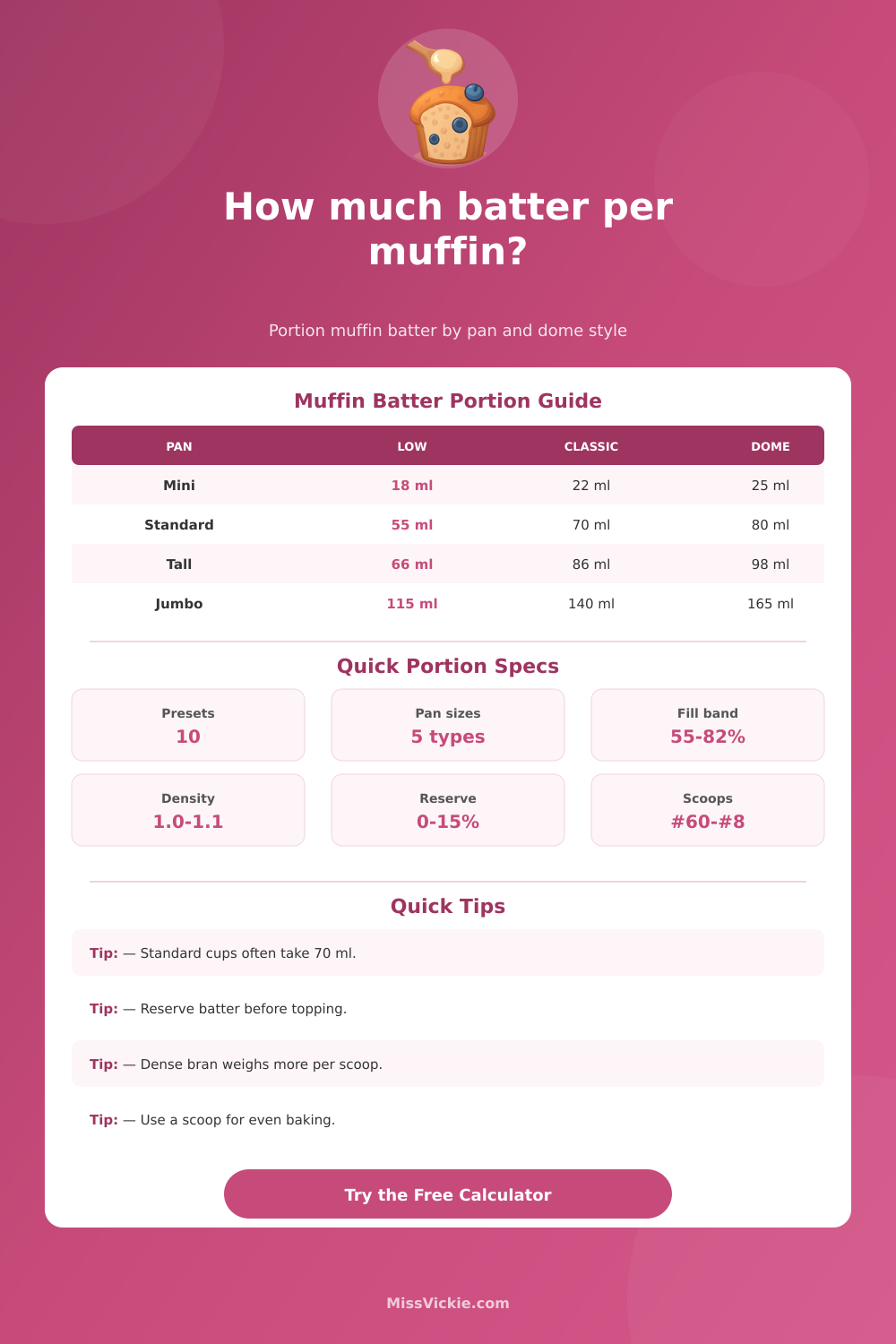
| Pan format | Rim capacity | Classic portion | Dome portion | Best use |
|---|---|---|---|---|
| Mini muffin pan | 28 to 32 ml | 20 to 23 ml | 24 to 26 ml | Party trays, lunch boxes, tasting batches |
| Standard muffin pan | 100 to 110 ml | 67 to 73 ml | 78 to 88 ml | Everyday muffins and one dozen recipes |
| Tall standard pan | 120 to 130 ml | 80 to 88 ml | 94 to 105 ml | Blueberry, apple, bran, and coffee shop muffins |
| Jumbo muffin pan | 190 to 220 ml | 127 to 147 ml | 148 to 180 ml | Large bakery muffins and meal-size portions |
| Popover well | 230 to 280 ml | 150 to 185 ml | 180 to 215 ml | Extra tall muffins with paper collars |
| Batter style | Density estimate | Fill shift | Rise cue | Portion note |
|---|---|---|---|---|
| Classic quick-bread | 1.03 g per ml | Baseline | Moderate dome | Use two-thirds full for most recipes |
| Thin pourable batter | 1.00 g per ml | Lower by 4% | Spreads early | Leave more room to prevent flat spillover |
| Thick scoopable batter | 1.06 g per ml | Add 3% | Rises upward | Can mound slightly above level scoop |
| Bran or oat batter | 1.08 g per ml | Add 1% | Heavier rise | Weights look higher for the same volume |
| Banana or pumpkin | 1.07 g per ml | Lower by 2% | Moist center | Keep room for slower structure setting |
| Gluten-free batter | 1.05 g per ml | Lower by 2% | Blend varies | Rest batter before final portioning |
| Scoop size | Tablespoons | Milliliters | Cup estimate | Typical muffin use |
|---|---|---|---|---|
| #60 scoop | 1 tbsp | 15 ml | 1/16 cup | Small mini muffins or topping portions |
| #40 scoop | 1.5 tbsp | 22 ml | 0.09 cup | Classic mini muffins |
| #30 scoop | 2 tbsp | 30 ml | 1/8 cup | Large minis or small standard cups |
| #20 scoop | 3.2 tbsp | 48 ml | 0.20 cup | Low standard muffin fill |
| #16 scoop | 4 tbsp | 59 ml | 1/4 cup | Standard muffins with room left |
| #12 scoop | 5.3 tbsp | 78 ml | 1/3 cup | Rounded standard muffins |
| #10 scoop | 6.4 tbsp | 95 ml | 0.40 cup | Tall liners or modest jumbo cups |
| #8 scoop | 8 tbsp | 118 ml | 1/2 cup | Jumbo muffins and deep wells |
| Batch plan | Mini muffins | Standard muffins | Jumbo muffins | Typical batter needed |
|---|---|---|---|---|
| Small test batch | 12 to 16 | 4 to 5 | 1 to 2 | 1.5 to 2 cups batter |
| One dozen standard | 40 to 50 | 12 | 5 to 6 | 3.5 to 4 cups batter |
| Tall fruit muffins | 50 to 60 | 12 to 14 | 6 to 7 | 4.5 to 5.5 cups batter |
| Double batch | 90 to 105 | 24 | 10 to 12 | 7.5 to 8.5 cups batter |
| Party mini tray | 48 to 60 | 14 to 18 | 6 to 8 | 4 to 5.25 cups batter |
Determining the correct amount of batter to pour into each muffin cup is a necesary step in the baking of muffins. The amount of batter that is poured into each cup will determine the final shape of the baked muffins. If there is too little batter added to each cup, the resulting muffins will be flat and dry.
If there is too much batter added to each cup, the batter will overflow the muffin pan during baking, the batter will burn on the sides of the pan, and the pan will be dificult to clean after baking. Considering these potential outcomes, its better to consider the capacity of the muffin cups prior to adding batter to each cup. The amount of batter that is required to prepare muffins can be affected by a variety of different variables.
How Much Batter to Put in Each Muffin Cup
Variables to consider may include the size of the baking pan that you will use, the level to which the muffin cups should be filled with batter, the density of the batter, and any additives that should be included within the muffin batter. For example, a twelve-cup muffin pan may be of the same size as another twelve-cup muffin pan, but one recipe may suggest that the muffin cups is to be filled to the level of two-thirds of the way into the cups, while another recipe may indicate that the muffin cups should be filled to form a large dome on top of each muffin cup. The amount of batter that can be lost within the mixing bowl is another variable that should be considered, as should the amount of batter that is typically reserved as a backup amount in case the scoops of batter that are used to portion the batter into each cup are not even.
Another variable that may affect the amount of batter needed is the density of the muffin batter. Batters may be of different densities due to each recipe’s inclusion of different ingredients. For instance, classic muffin batters are of medium density, but batters that contain ingredients like bran or oats will have a higher density due to the increased weight of those ingredients.
Batters that contain ingredients like banana or pumpkin will also have different densities due to the moisture content of those ingredients. Each of these different densities will require a different amount of batter to filling the same number of muffin cups. In addition to the density of the batter, the type of liner that is used for each muffin cup can also impact the amount of batter that should be poured into each cup.
For instance, paper liners for muffin cups will typically allow for less batter to be poured into each cup than the depth of each cup made of metal. Similarly, liners that are tall and tulip shaped will allow for more batter to be poured into each cup than liners of the same size that are not tall and tulip-shaped. Finally, silicone muffin cups have the potential to expand when the muffin batter is added to the cups.
Additionally, any toppings for muffins will take up some of the space within each cup, so any muffin recipe that indicates any toppings will also require that each cup be filled with enough batter to allow for those toppings to be added. It is possible to use a calculator to account for each of these variables for muffin recipes. The calculator will account for the number of muffin cups in the pan, the type of muffin cup liners, the depth of the muffin pan, the density of the muffin batter, and any amount of batter that should be reserved for potential spillage from the scoops of batter.
While the calculator will not ensure that each muffin will have a perfect dome when baked, the calculator will remove the possibility of incorrectly guessing the amount of batter that is required for the recipe. Some common mistakes when baking muffins may include treating each muffin recipe as if it is the same. For instance, one may use a muffin recipe that was written for use in standard sized muffin pans in a jumbo sized muffin pan.
Another mistake is treating batters that are thick as if they would behave the same as thin batters. Yet another common mistake is measuring ingredients like fruit or nuts that are to be included within the muffins after all of the batter has been portioned into each muffin cup. By not accounting for the volume that these ingredients will take up within each muffin cup, one may not have enough batter to fill each muffin cup.
The amount of batter that may remain within the sides of the mixing bowl or scoop is another mistake. In this instance, it is better to include the batter percentage that is to be reserved within the batter calculations for each recipe. In addition to the factors described above, the final baking of each muffin may also impact the outcome of the baking process.
For instance, the temperature of the oven in which the muffins are baked, the length of time that the batter rests prior to baking, and the strength of the leavening agents within the muffin batter will impact the rise of each muffin after baking. Regardless of the amount of batter that is poured into each muffin cup, each muffin may rise to a different extent due to these other factors. For instance, if the oven in which the muffins are baked does not reach the accurate baking temperature, each muffin may be baked to a different extent.
In this case, one method of avoiding errors is to fill one muffin cup to test how the topping and batter react in the oven. If the portioning is even and correct, each muffin will bake evenly, each muffin cup will form its domes correctly, and each muffin will release evenly from the pan.