🧁 Baking Powder for Muffins Calculator
Estimate baking powder for muffins from flour weight, muffin count, batter acidity, fruit or chocolate load, dome target, pan size, baking temperature, and baking soda balance.
Pick a familiar muffin style, then adjust the flour, pan, acidity, add-ins, dome target, bake heat, and baking soda already in your recipe.
Muffin leavening breakdown
Flour gives the main structure. The calculator begins with cups of flour by weight, not guessed scoops.
Buttermilk, yogurt, banana, lemon, cocoa, and molasses can use baking soda alongside baking powder.
Berries, banana, chocolate, bran, and streusel can weigh down the crumb, so lift may need a modest bump.
Tulip liners, jumbo wells, silicone, fill height, and bake temperature all affect how quickly the top sets.
Starting powder by muffin style
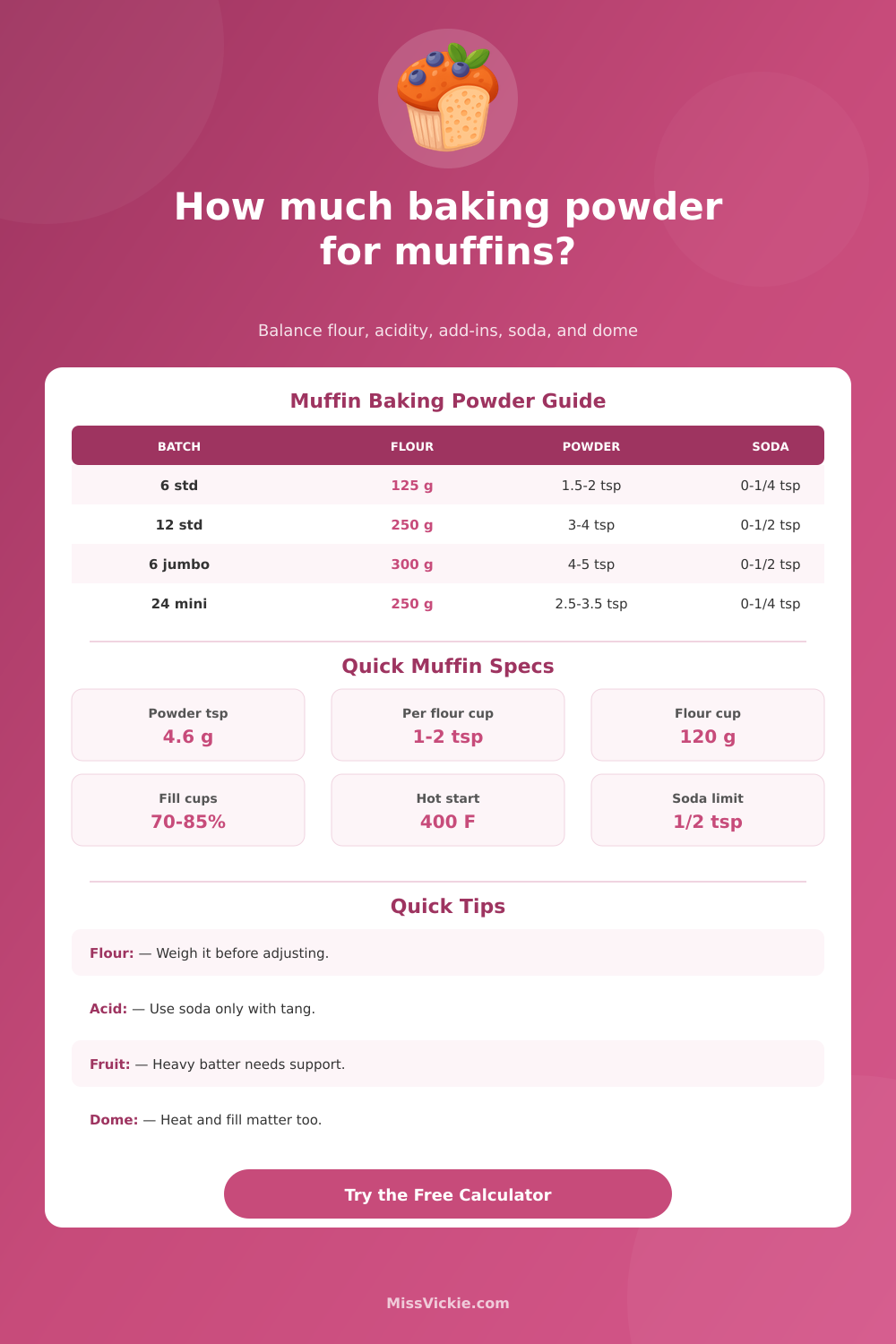
| Muffin style | Flour weight | Baking powder | Soda note |
|---|---|---|---|
| Standard 12 muffins | 240 to 280 g | 3 to 4 tsp | Use 0 to 1/2 tsp soda if acidic. |
| Mini 24 muffins | 220 to 260 g | 2 1/2 to 3 1/2 tsp | Too much powder can peak fast. |
| Bakery 6 muffins | 260 to 340 g | 4 to 5 tsp | Hot start and high fill matter. |
| Jumbo 6 muffins | 300 to 380 g | 4 1/2 to 6 tsp | Reduce if centers tunnel or collapse. |
| Gluten-free muffins | 220 to 300 g blend | 3 1/2 to 5 tsp | Rest batter so starches hydrate. |
Acidity and soda balance
| Batter acidity | Common ingredients | Soda range | Powder effect |
|---|---|---|---|
| Neutral | Milk, water, vanilla | Usually 0 tsp | Rely on baking powder. |
| Light acid | Fruit, brown sugar | 0 to 1/8 tsp per cup | Small reduction only. |
| Medium acid | Yogurt, banana | 1/8 to 1/4 tsp per cup | Powder can be trimmed. |
| High acid | Buttermilk, sour cream | 1/4 tsp per cup | Use soda plus powder. |
| Very tangy | Lemon, vinegar, cocoa | Up to 3/8 tsp per cup | Watch soapy soda flavor. |
Pan, fill, and heat guidance
| Goal | Fill level | Helpful heat | Leavening note |
|---|---|---|---|
| Flat cafe top | 65 to 72% | 350 to 365 F | Use the lower powder range. |
| Gentle dome | 72 to 80% | 365 to 385 F | Balanced for most recipes. |
| Bakery dome | 80 to 88% | 390 to 410 F start | Needs enough structure and lift. |
| Jumbo muffin | 75 to 85% | 375 to 400 F start | Deep batter needs steady center set. |
| Silicone cups | 70 to 80% | 375 to 395 F | May need a small powder boost. |
Add-in load adjustments
| Add-in load | Examples | Lift change | Mixing note |
|---|---|---|---|
| Light | Spice, vanilla, zest | No change | Do not overmix after flour. |
| Moist fruit | Blueberries, apple | Small increase | Fold gently to avoid streaks. |
| Puree | Banana, pumpkin | Increase plus soda | Acid and moisture matter. |
| Chocolate chips | Chips, chunks | Small increase | Reserve some for the tops. |
| Bran or oats | Bran, oat flour | Moderate increase | Rest batter for hydration. |
This calculator gives a practical kitchen estimate. Exact results still depend on flour type, batter thickness, sugar, fat, egg structure, mixing, pan color, and oven accuracy.
Baking powder is a leavening agent that make muffins rise; baking powder determine the height of the tops of the muffins and the texture of the crumb within the muffin. Baking powder can also have an influence on the flavor of the muffins; too much baking powder can leave a soapy flavor in the muffin. Several different factors influence the amount of baking powder that is required for a muffin recipe, including the amount of leavening that meets the flour, the acidity of the muffin, and the weight of any add-ins that are to be included in the recipe.
Additionally, the type of pan in which the muffins are to be baked also influence the results of the baking process. Although most baking recipes includes baking powder in amounts specified by the recipe, most recipes are written with the assumption that the batter for the muffin is to be plain and that the muffins are to be baked in standard muffin pans. However, many muffin batters are not plain, and many muffin pans are not standard in size and composition.
How Much Baking Powder to Use in Muffins
For instance, if mashed banana is added to a recipe for muffins, the baker should adjust the baking powder amount due to the acidity of the mashed banana. Additionally, the addition of ingredients that add to the weight of the muffin, such as chocolate chips, or ingredients that reacts to the liquids in the muffin, such as bran or oats, will influence the amount baking powder that is required for those muffins to rise appropriate. Thus, baking powder calculators help bakers to determine the amount baking powder that is required for a given recipe by taking into account these different variables.
The variables of the temperature at which the muffins are to be baked and the color of the pans in which the muffins are baked also influence baking powder results. Dark pans tend to set the edges of the muffins faster than light pans, which can trap the gas created by the baking powder within the muffin before the center of the muffin expands. Additionally, silicone baking cups allow for less transfer of heat to the baking cups than do metal pans, meaning that baking powder calculators may need to be adjusted to account for baking in silicone pans.
Finally, the temperature at which the muffins are baked can influence the results of baking the muffins; high oven temperatures can create tall domes of baked muffins, but may also result in tunnels being formed within the muffins if those high temperatures create baking structure too quick to rise to the surface of the muffin pans. Baking soda is a different leavening agent than baking powder, and reacts with the acids contained within ingredients like buttermilk, yogurt, and lemon. Because baking soda reacts with these acids, recipes that use baking soda can contain less baking powder than those that do not use baking soda.
However, if you include too much baking soda in a recipe without enough acid to neutralize that baking soda, the baking soda can leave a metallic aftertaste to the muffin. Thus, baking powder and baking soda calculators help to ensure that the baking soda and baking powder amounts are balanced to avoid metallic or flat tasting muffins. Finally, the amount of filling that is to be poured into each muffin cup, as well as the length of time that the batter is to rest prior to pouring into the muffin pans will impact the outcome of baking the muffins.
Baking muffin cups that are filled to 85 percent of the way, for instance, will require more baking powder than those that are filled only to 70 percent of the way. Additionally, resting the batter for twenty minutes can allow the flour in the muffin batter to hydrate, leading to an improved texture of the baked muffins; however, allowing the batter to rest for twenty minutes also permits the gas from the baking powder to escape from the muffin batter. Baking powder calculators take into account both these factors in addition to those related to baking powder alone.
The altitude at which the muffins are to be baked is another variable that can impact the baking powder results. The lower the air pressure at which the muffins are baked, the more quickly the gas from the baking powder can rise to the top of the muffin batter; too rapid a rising of the batter can result in the formation of muffins whose tops collapses after they exit the oven. Reducing the amount of baking powder is one way to prevent these collapsed muffins from setting; however, any reduction in baking powder must be made prior to mixing the ingredients for the muffin batter.
In order to produce the same results with any given recipe, each of these variables must be paid attention to. One variable that should always be considered is the weight of the baking flour; weight measurements are more accurate than measuring the volume of the baking ingredients. The acidity of the muffin is another variable that will influence baking results; baking soda cannot be used in muffins that are not acidic.
Additionally, the weight of the ingredients that are to be added to the muffin batter and the style of the pan in which the muffins are to be baked will impact whether or not baking powder is required for those recipes. Finally, baking powder calculators help to translate these different variables into appropriate and repeatable baking powder amounts so that muffins may be baked without guessing at the proper amount of baking powder to include in each recipe.