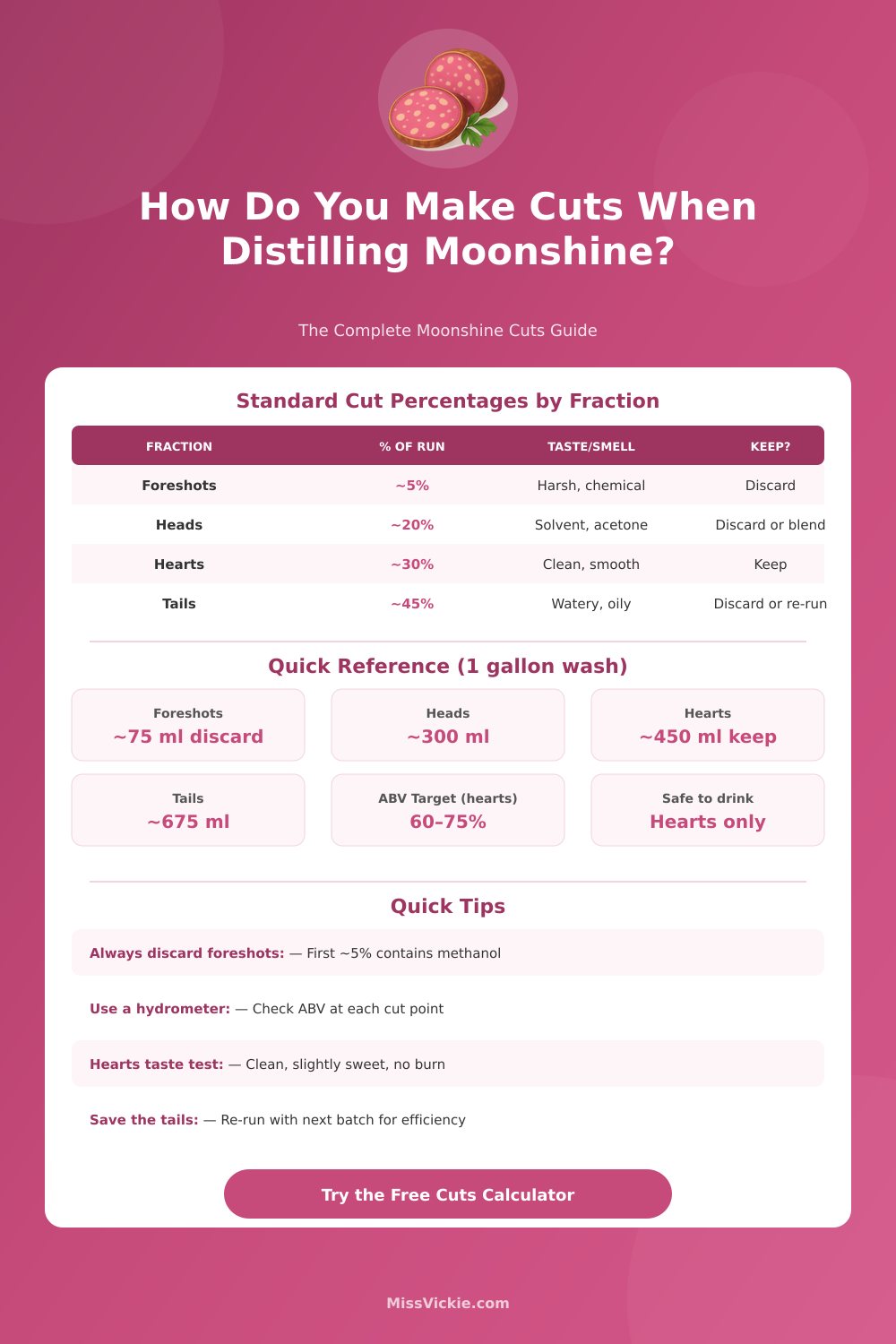
🥃 Moonshine Cuts Calculator
Calculate foreshots, heads, hearts, and tails volumes for any batch size
| Wash Volume | Foreshots | Heads | Hearts | Tails |
|---|---|---|---|---|
| 1 gallon (3.8 L) | 75 ml | 300 ml | 450 ml | 675 ml |
| 2 gallons (7.6 L) | 150 ml | 600 ml | 900 ml | 1,350 ml |
| 5 gallons (18.9 L) | 375 ml | 1,500 ml | 2,250 ml | 3,375 ml |
| 10 gallons (37.9 L) | 750 ml | 3,000 ml | 4,500 ml | 6,750 ml |
| 20 gallons (75.7 L) | 1,500 ml | 6,000 ml | 9,000 ml | 13,500 ml |
| 50 gallons (189 L) | 3,750 ml | 15,000 ml | 22,500 ml | 33,750 ml |
| Fraction | Smell | Taste | ABV Range | Action |
|---|---|---|---|---|
| Foreshots | Chemical, solvent | Harsh, burns | 75–85% | Always discard |
| Heads | Acetone, nail polish | Bitter, sharp | 60–75% | Discard or save for re-run |
| Hearts | Clean, slightly sweet | Smooth, clean alcohol | 60–75% | Keep for drinking |
| Tails | Wet cardboard, funky | Watery, oily | Below 40% | Save for next re-run |
| Mash Type | Est. Total Output | Hearts Yield | Notes |
|---|---|---|---|
| Corn Mash (40% ABV) | ~1,500 ml | ~450 ml | Classic moonshine flavor |
| Sugar Wash (50% ABV) | ~1,875 ml | ~562 ml | Clean, neutral spirit |
| Fruit Mash (35% ABV) | ~1,312 ml | ~393 ml | Fruity esters, complex |
| Rye Mash (42% ABV) | ~1,575 ml | ~472 ml | Spicy, full-bodied |
| Wheat Mash (38% ABV) | ~1,425 ml | ~427 ml | Mild, soft character |
| Barley Mash (38% ABV) | ~1,425 ml | ~427 ml | Malty, whiskey-like |
Moonshine has a great history. You make this strong liquid traditionally, and the name itself comes from the habit of distilling at night… Especially when the moon shined enough for work Moonshiners who wanted to make alcohol set up their gear deep in the woods after dark to escape the attention of the police.
The people who led those banned operations were called moonshiners because they work under moonlight to hide their actions. There is a Scottish version of that story: here whiskey distillers liked to work during full moons so that they could see without torches that could attract tax collectors from afar.
Moonshine: History and How It Is Made
However the moonshine movement did not exist only in United States. Illegal liquor operations already existed by smugglers along coasts of England in the 1700s. After the independence of United States, it quickly spread, Pennsylvania was one of the first hotspots, mostly because of anger about the new liquor tax. Moonshiners thought: why give part of their incomes to the government if you can keep everything yourselv?
They simply did not register.
Real moonshine lovers have clear ideas about what counts as real. It must be homemade, unaged whiskey, crystal clear, based on corn and with high alcohol grade. You find it in mason jars directly from the homemade distillery.
Through the years it received many colorful nicknames (white lightning), corn liquor, stump water, skullcracker, wildcat and ruckus juice., that all mean the same. Technically, corn whiskey is the nearest official category in United States.
The recipe consists mainly of corn… Around 80 %, mixed with around 20 % malted barley. But here is the tricky part: white whiskey is one of the most difficult spirits to make, although it sounds easy.
Most whiskeys improve during time in barrels. Moonshine skips that aging stage. It is basic ethanol that did not spend months in wood.
When we reached the 2000s, commercial distilleries started to use the moonshine label for legal spirits. Some brands offer wild tastes. One of them offers 128-proof version, that they call pure and simple.
You mix flavored variations in margaritas, cocktails, fruit punches or drink directly. Fresh from the distillery? That burns like fire.
But if you let it rest against charred oak, peach or apple for time, something excellent happens.
Grade of alcohol matters for moonshine. It affects directly the force and safety of drinking. Because real moonshine is not controlled, the proof depends on the producer.
One shot matches roughly to 1.27 bottles of standard American beer.
In 2015, Mountain Dew launched Dewshine as honor to its moonshine tradition, but it flopped with consumers and soon disappeared fromthe stores.