Molasses in Gingerbread Cookies Calculator
Estimate molasses for gingerbread cookies from flour weight, cookie count and size, molasses type, brown sugar ratio, spice intensity, dough chill, texture target, baking soda balance, moisture retention, and rollout thickness.
Choose a starting dough style, then adjust the flour, cookie dimensions, sugar, spice, chill, soda, and texture before calculating.
| Molasses Type | Flavor Strength | Usual Ratio | Best Cookie Style | Calculator Adjustment |
|---|---|---|---|---|
| Light or mild molasses | Sweet and gentle | 25% to 30% of flour weight | Kids cookies, iced cutouts | Adds a little more for gingerbread color. |
| Robust unsulfured molasses | Classic bittersweet | 22% to 27% of flour weight | Standard cutouts and rounds | Uses the baseline gingerbread dose. |
| Dark baking molasses | Strong and slightly bitter | 20% to 25% of flour weight | Bold spice cookies | Reduces slightly so spice is not muddy. |
| Blackstrap molasses | Very bitter and mineral | 16% to 21% of flour weight | Small amount in dark dough | Reduces more and raises sugar warning. |
| Golden syrup blend | Lighter and less acidic | 26% to 32% of flour weight | Softer pale gingerbread | Adds moisture but lowers soda demand. |
| Sorghum syrup style | Tangy, grassy, sweet | 23% to 29% of flour weight | Soft farmhouse cookies | Uses a mild boost for chew. |
| Cookie Format | Rollout Thickness | Molasses Behavior | Texture Risk | Best Adjustment |
|---|---|---|---|---|
| Mini 1.5-inch cookies | 1/8 to 3/16 inch | Evaporates quickly | Can turn hard fast | Use less molasses and bake briefly. |
| Medium cutouts | 1/4 inch | Balanced moisture loss | Edges brown before center dries | Classic ratio works well. |
| Large cookies | 1/4 to 3/8 inch | Center keeps more syrup | May wrinkle if underbaked | Increase chill and avoid excess syrup. |
| Chewy thick rounds | 3/8 inch | Molasses holds softness | Spread from warm dough | Add molasses only with longer chill. |
| House panels | 1/4 to 1/2 inch | Too much syrup weakens structure | Warping and bend | Reduce molasses, raise flour strength. |
Cleaner snap, less spread, but molasses bitterness can stay sharp.
Balances robust molasses and gives a familiar gingerbread lift.
More browning and spread; useful with high-acid doughs.
Can taste soapy unless molasses and other acids are high.
| Texture Goal | Molasses Direction | Brown Sugar Direction | Chill Need | Rollout Note |
|---|---|---|---|---|
| Dry snap | Lower syrup ratio | Lower to classic | Short to medium | Thin sheets bake crispest. |
| Balanced cutout | Classic syrup ratio | Classic | 1 to 2 hours | Quarter inch dough keeps clean edges. |
| Chewy center | Higher syrup ratio | Sweet or extra sweet | Overnight preferred | Thicker dough protects the middle. |
| Soft cakey cookie | Higher syrup and soda | Sweet | Medium | Roll thick or scoop instead. |
| House structure | Lower syrup ratio | Low to classic | Long chill | Even sheets prevent warped panels. |
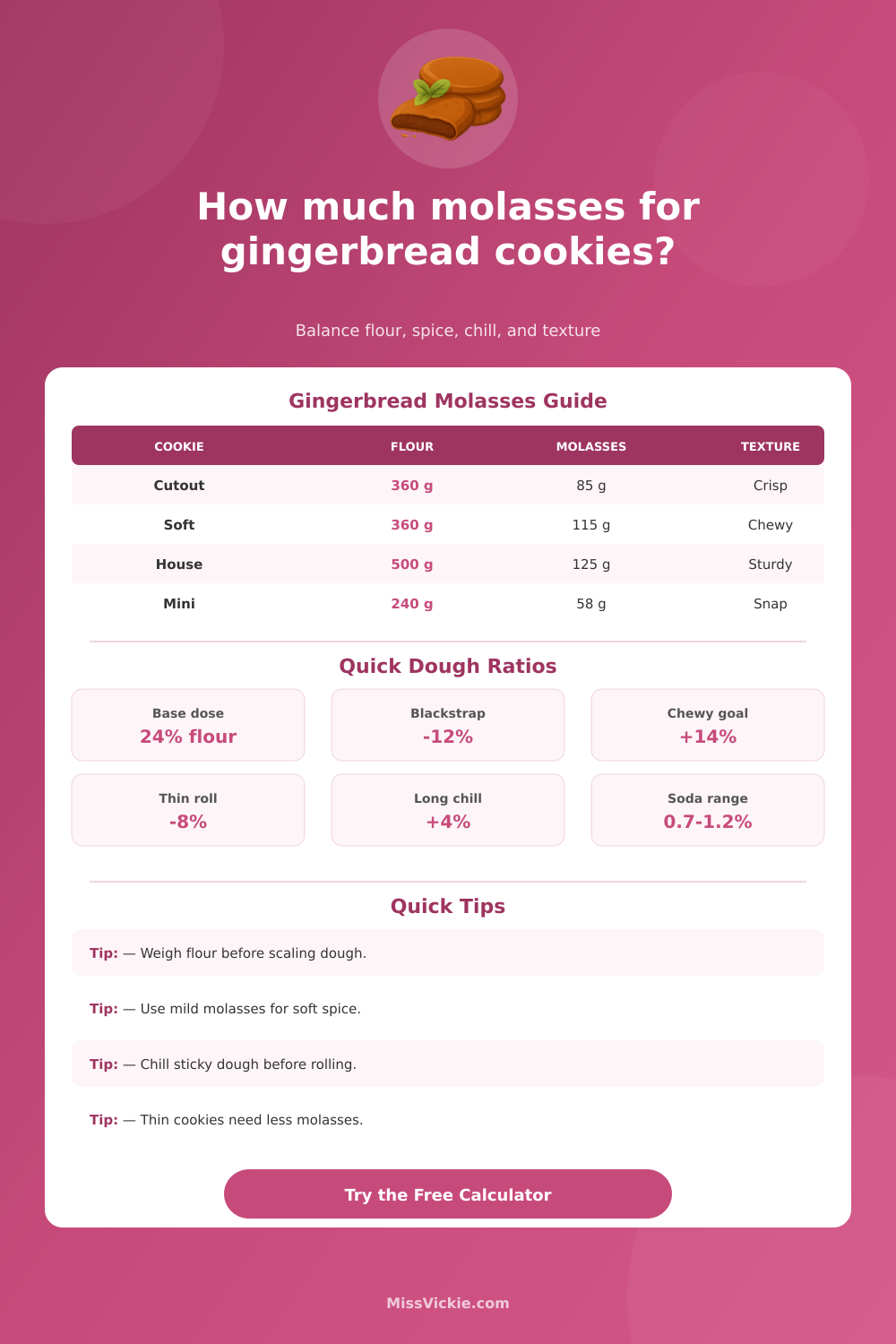
Gingerbread cookies are all about getting your molasses right. Under-molasses is a pale, flat flavor; the ginger seem detached from the rest of the dough. Too much molasses results in gummy middles and edges that spreads until cookies smoosh into each other. It also prevents the dough from holding any structure, whether you need flat panels for houses or neat shape for cutouts.
It’s all in that syrup-to-flour ratio: How much syrup will the flour be able to support and still stay itself? The answer changes based off the type of cookie you’re attempting to create. If you use any recipe with a single amount and don’t cut into pieces of a different size, you’re on your own. If you do, where’s the guidance?
The Best Way to Use Molasses in Gingerbread Cookies
It turns out the key factor is how much the flour weigh. So after you figure out how much flour there will be, you can start adjusting the molasses up and down as a percent of flour (instead of a shot in the dark with those tablespoons). Above is calculator that figures it all out for you if you put in your cutter size, cookie number, and flour amount. Then it also accounts for the variables that realy make the difference: how thick to roll the dough, how long to chill it before cutting, what kind of texture to shoot for at the end, and how much baking soda and brown sugar is already in the mix.
Size does matter. It is unlike what most people think. Small cookies will not be able to absorbs much molasses without getting too gooey in the oven. The larger the round, the more syrupy center it have. It is a good thing if you like your cookies with a little chew. It is a bad thing if you’re looking for some nice clean edges.
Same goes for thickness. Thin cookies dry out quicker. They’ll burn faster and run the risk of turning brittle. Thicker slabs retains the moisture longer, and require a bit longer chill time to still remain workable while rolling them into shape.
The type of molasses also changes both flavor and acid at the same time. Light molasses adds color without much bitterness, while blackstrap brings a mineral edge that can overwhelms milder spice blends if used in equal amounts. That change is reflected on the calculator; decreasing the amount as the molasses darkens. Increase it just a bit if you’ve selected a blend or milder syrup.
There’s also a second player here, the brown sugar. Alongside the molasses, the tool considers what else is going into the dough. More brown sugar means there is more invert sugar and moisture in the dough. This allows you to use less molasses without losing tenderness.
Once you mix in the molasses, what happens next depends a lot on chill time, as well as baking soda. The longer the dough chills, the firmer the butter will be, and the more thoroughly the flour will hydrate. That means even if the dough is on the soft side, they won’t spread much and keep their precise shapes.
Baking soda also interacts with the molasses’ acid: You’ll need to adjust your soda accordingly depending on the desired amount of browning (and thus lift). Too little, and you’re left with a dull-colored cookie with an overly sharp bit of bitterness; too much, and your cookies may turn out tasting slightly soapy.
We’re not looking for any magic number. We’re looking for a range, what we think will make a cookie that we actualy want to bake. From there it’s easy to get a sense of the remaining options: the weight of the flour, the desired texture.
The result? The cookies keep their shape. They have just enough spice to be noticed but not to taste like pepper, and they are perfectly textured throughout, whether it is your first or final dozen from the tin. You should of tried them!