How Much Molasses to Make Brown Sugar
Calculate the molasses and white sugar needed for light, medium, dark, or custom brown sugar batches, with cup, tablespoon, ounce, gram, pound, and kilogram conversions.
Choose a kitchen scenario to load a realistic batch size, sweetness style, molasses type, texture goal, and rounding preference.
Full Batch Breakdown
Balanced for cookies, toppings, quick breads, and everyday substitutions.
Useful when you want more caramel color without a strong molasses note.
Deeper flavor for gingerbread, barbecue sauces, baked beans, and glazes.
Strong, moist, and best used when the recipe benefits from bold color.
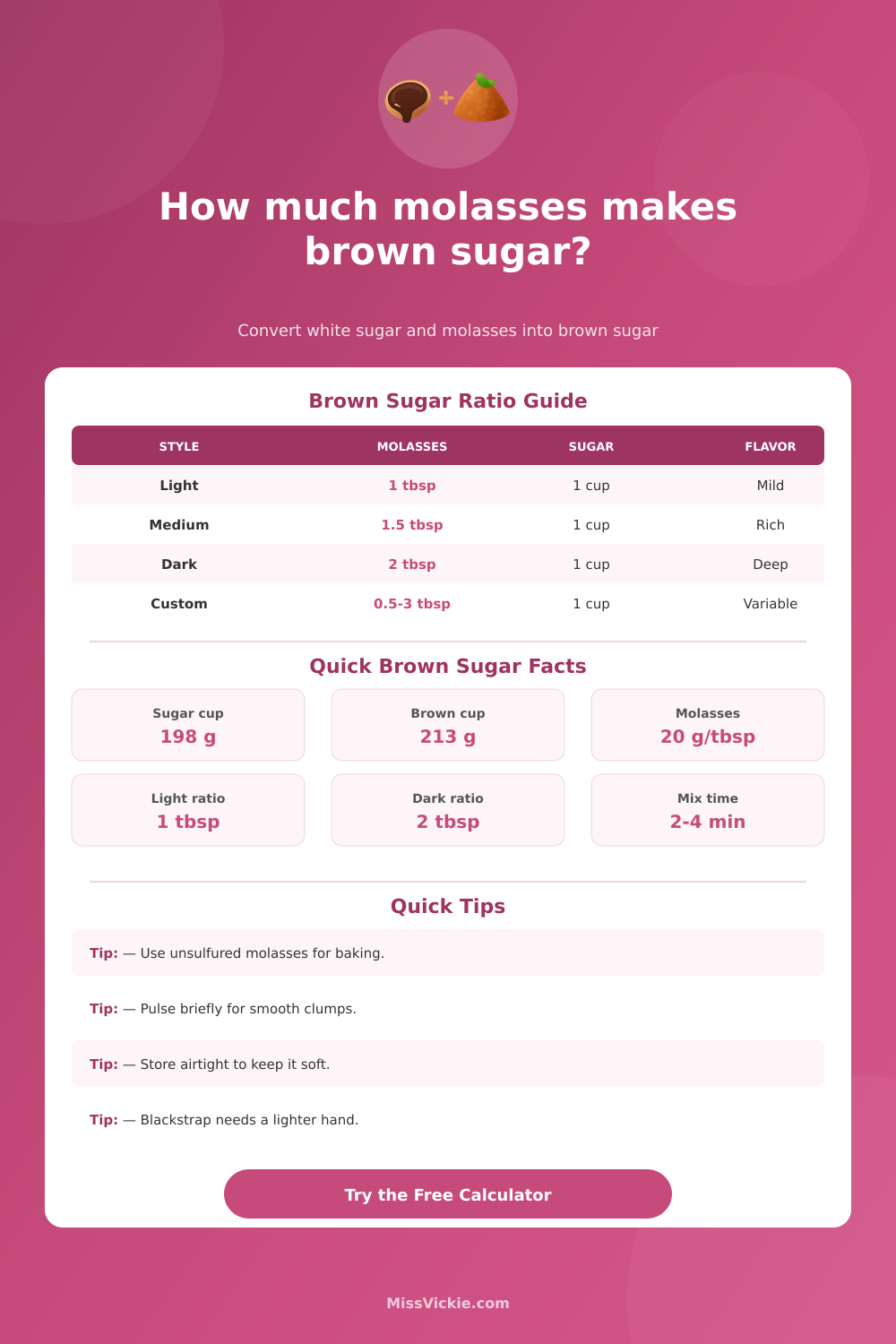
| Brown Sugar Style | Molasses Per Cup White Sugar | Approx. Molasses Weight | Best Kitchen Uses |
|---|---|---|---|
| Very light brown sugar | 1/2 tablespoon | 10 grams | Sprinkling, oatmeal, delicate vanilla bakes |
| Light brown sugar | 1 tablespoon | 20 grams | Chocolate chip cookies, crumb toppings, banana bread |
| Medium brown sugar | 1 1/2 tablespoons | 30 grams | Spice cakes, muffins, soft sandwich cookies |
| Dark brown sugar | 2 tablespoons | 40 grams | Gingerbread, barbecue sauce, baked beans, glazes |
| Extra dark batch | 2 1/2 tablespoons | 50 grams | Deep molasses desserts and bold savory sauces |
| Measure | White Sugar | Molasses | Brown Sugar Yield |
|---|---|---|---|
| 1 teaspoon molasses | About 1/3 cup sugar for light style | 6.7 grams | About 70 grams brown sugar |
| 1 tablespoon molasses | 1 cup granulated sugar | 20 grams or 15 ml | About 213 grams light brown sugar |
| 2 tablespoons molasses | 1 cup granulated sugar | 40 grams or 30 ml | About 238 grams dark brown sugar mix |
| 1/4 cup molasses | 2 cups sugar for dark style | 80 grams or 60 ml | About 476 grams brown sugar |
| 1/2 cup molasses | 4 cups sugar for dark style | 160 grams or 120 ml | About 952 grams brown sugar |
| Molasses Type | Flavor Strength | Calculator Adjustment | Brown Sugar Note |
|---|---|---|---|
| Unsulfured baking molasses | Classic | Use the standard ratio | Best default for homemade brown sugar |
| Mild or fancy molasses | Light | Add a small amount | Gentler flavor and slightly softer color |
| Robust full-flavor molasses | Strong | Use a little less | Good for dark cookies and sauces |
| Blackstrap molasses | Very strong | Use much less | Bitter if used at the same dark ratio |
| Dark treacle | Deep | Use slightly less | Sticky texture with a pronounced finish |
| Finished Batch | Light Brown Sugar | Dark Brown Sugar | Storage Fit |
|---|---|---|---|
| 1/4 cup | 1 1/2 teaspoons molasses | 1 tablespoon molasses | Single recipe add-in |
| 1/2 cup | 1/2 tablespoon molasses | 1 tablespoon molasses | Small prep bowl |
| 1 cup | 1 tablespoon molasses | 2 tablespoons molasses | Pint jar with headspace |
| 2 cups | 2 tablespoons molasses | 1/4 cup molasses | Quart jar or pantry tub |
| 1 kilogram | About 94 grams molasses | About 168 grams molasses | Large airtight canister |
Making homemade brown sugar allow for control over the flavor and moisture of the brown sugar. Many person reach for the brown sugar in the pantry for baking recipes, but making homemade brown sugar can offer specific result to each recipe. Homemade brown sugar allows for control over the flavor of the brown sugar, control over the moisture level in the brown sugar, and also provides control over the color of the brown sugar.
To make homemade brown sugar, all that is required are two ingredient: white sugar and molasses. The white sugar will serve as a structure for the homemade brown sugar, while the molasses will provide the color and moisture to the product. The amount of molasses that is added to the white sugar will determine the color and flavor of the resulting homemade brown sugar.
How to Make Homemade Brown Sugar
Using a small amount of molasses will create a light colored, light flavored homemade brown sugar. In contrast, using a large amount of molasses will create a dark colored, dark flavored homemade brown sugar. Because of the strong flavor of dark homemade brown sugar, you can use it in recipes like gingerbread or barbecue sauce.
In addition to the flavor and color of the homemade brown sugar, the texture of the homemade brown sugar can also be controlled. Depending on the type of recipe that is being prepared, a person may want the homemade brown sugar to be in a loose texture to allow it to be easily sprinkle on top of other ingredients or in a packed texture to allow the sugar to be easily creamed into cookie dough. You can control the texture of the homemade brown sugar by adjust the amount of molasses that is added to the white sugar.
As with the flavor and color of the homemade brown sugar, a more liquid ingredient like unsulfured baking molasses can be used or a stronger blackstrap molasses. Blackstrap molasses has a more bitter flavor then unsulfured baking molasses, so care must be taken when using this ingredient in the homemade brown sugar. To assist with determining the proper amount of each ingredient, a calculator can be utilized.
The calculator will make the math for the amount of white sugar and molasses that should be combined to make homemade brown sugar. The calculator is also able to account for the amount of each ingredient needed to make a specific batch size of homemade brown sugar. Additionally, the calculator can account for what is referred to as “bowl loss,” which is the portion of the homemade brown sugar that typically stick to the sides of the mixing bowl.
By accounting for bowl loss in the calculator, the user wont become out of homemade brown sugar during the mixing process. The calculator will display the ingredients in the users preferred unit of measure. The type of white sugar that is used can also have an impact on the texture of the resulting homemade brown sugar.
The most common type of sugar for making homemade brown sugar is granulated sugar. However, caster sugar, which contain smaller crystals than granulated sugar, may be used to make homemade brown sugar. Other types of sugar, such as cane sugar or demerara sugar, contain different size crystals than granulated sugar.
While the different sized crystals have a small impact on the texture of the homemade brown sugar within a single batch of sugar, the difference in crystal size becomes more important for making large amount of homemade brown sugar for various recipes. Homemade brown sugar needs to be stored in a specific manner to avoid dry out. Because homemade brown sugar contains molasses, it will dry out faster than store bought brown sugar.
To prevent homemade brown sugar from drying out, the sugar should be stored in an airtight container. Should homemade brown sugar become too dry, a small piece of bread or a sugar softener can be place in the container to add moisture to the homemade brown sugar. The ratio of molasses to white sugar will allow for the user to make homemade brown sugar, but any change to that ratio will change the result of the homemade brown sugar.
Changing the amount of molasses that is used will change the color of the homemade brown sugar and the taste of the homemade brown sugar. Using a calculator to determine the amounts of each ingredient will allow the user to select the ratio of each ingredient that is needed for you’re recipe. By understanding how the two ingredients interact when making homemade brown sugar, the user will understand the ingredients and processes necessary to make the specific type of homemade brown sugar needed for there recipes.