Moka Pot Ratio Calculator
Calculate moka pot coffee dose, water fill, brewed yield, cup count, grind correction, roast adjustment, and strength from your basket size and brew target.
Choose a common moka setup, then adjust basket size, dose, chamber fill, roast, grind, yield, cup size, and target strength.
Ratio Breakdown
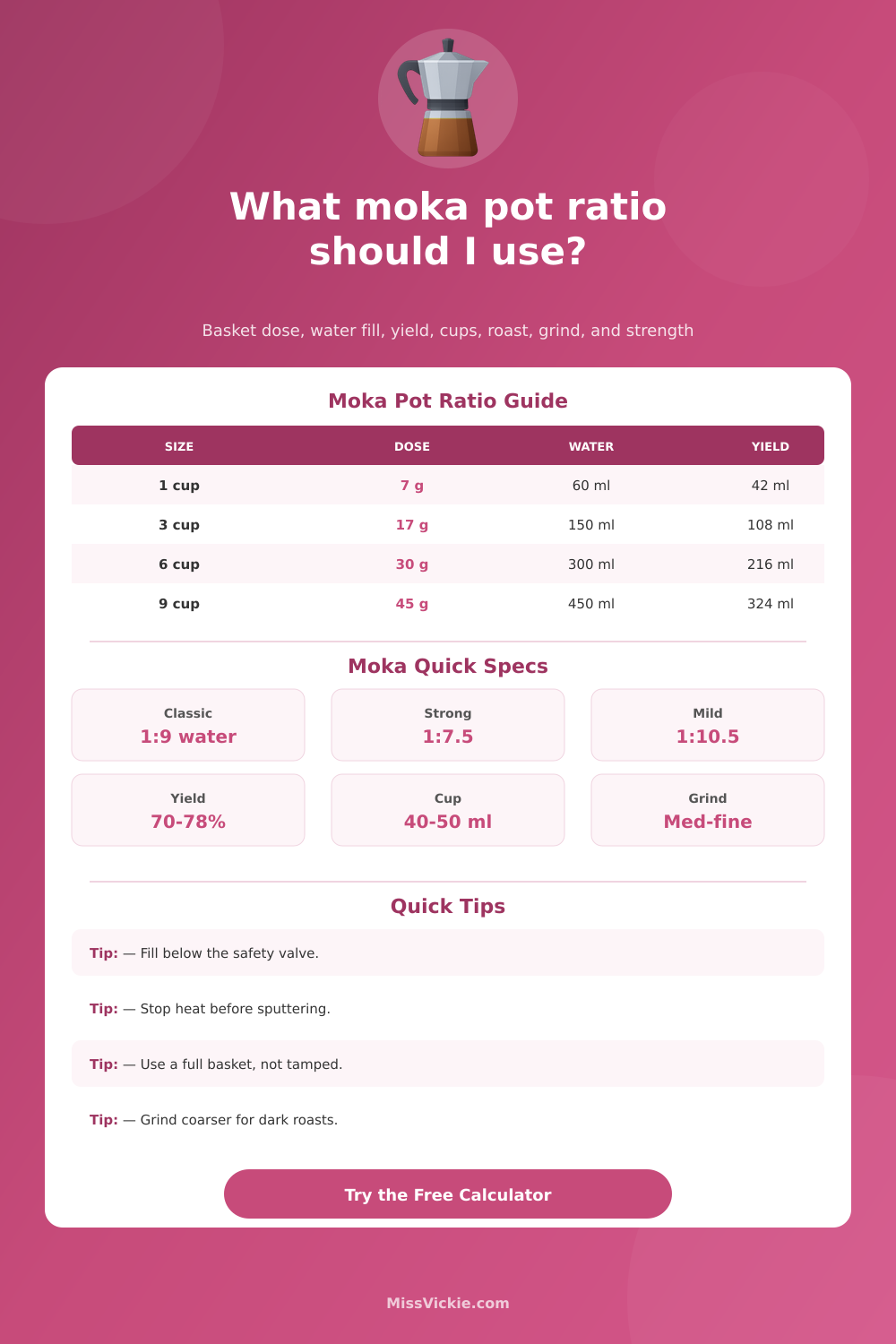
60 ml fill, 40 to 45 ml yield, best for one small straight moka.
150 ml fill, 100 to 115 ml yield, the common solo morning size.
300 ml fill, 205 to 230 ml yield, enough for two larger drinks.
450 ml fill, 305 to 340 ml yield, useful for a brunch batch.
| Moka Size | Typical Basket Dose | Water Below Valve | Expected Yield | Classic Cups |
|---|---|---|---|---|
| 1 cup | 6.5 to 8 g | 55 to 70 ml | 38 to 50 ml | 1 small cup |
| 2 cup | 10 to 13 g | 95 to 120 ml | 68 to 90 ml | 2 small cups |
| 3 cup | 15 to 18 g | 140 to 170 ml | 100 to 125 ml | 2 to 3 cups |
| 4 cup | 20 to 23 g | 190 to 230 ml | 135 to 170 ml | 3 to 4 cups |
| 6 cup | 28 to 33 g | 280 to 330 ml | 200 to 245 ml | 5 to 6 cups |
| 9 cup | 42 to 48 g | 420 to 480 ml | 300 to 360 ml | 7 to 9 cups |
| 12 cup | 56 to 64 g | 560 to 650 ml | 400 to 485 ml | 10 to 12 cups |
| Strength Target | Water-to-Coffee | Yield-to-Coffee | Best Cup Use | Flavor Direction |
|---|---|---|---|---|
| Gentle | 1:10 to 1:11 | 1:7.5 to 1:8.5 | Longer straight cup | Softer body, less bitterness |
| Classic | 1:8.5 to 1:9.5 | 1:6 to 1:7.5 | Traditional moka cup | Rich, balanced, concentrated |
| Bold | 1:7.3 to 1:8.3 | 1:5.2 to 1:6.4 | Milk drink base | Dense body, stronger finish |
| Very intense | 1:6.5 to 1:7.5 | 1:4.8 to 1:5.8 | Short base or dilution | Heavy body, higher bitterness risk |
| Bean or Grind Choice | Dose Adjustment | Water Adjustment | Yield Shift | Practical Cue |
|---|---|---|---|---|
| Light roast | Add 2% | Add 3% | Slightly lower | Use medium-fine grind and hot water start. |
| Medium roast | No change | No change | Standard | Good default for most moka pots. |
| Dark roast | Reduce 4% | Reduce 2% | Slightly higher | Grind a touch coarser to reduce bitterness. |
| Fine grind | No tamping | Reduce 3% | Lower and slower | Use if brew sputters early or tastes harsh. |
| Coarse grind | Fill fully | Add 2% | Higher and faster | Use if the cup tastes thin or sour. |
| Uneven grinder | Reduce 2% | Reduce 2% | Less predictable | Settle grounds level and avoid tamping. |
| Serving Style | Cup Size | 3 Cup Pot Yield | 6 Cup Pot Yield | Dilution Note |
|---|---|---|---|---|
| Tiny moka cup | 30 ml | 3 to 4 cups | 7 to 8 cups | Straight, no dilution. |
| Classic moka cup | 45 ml | 2 to 3 cups | 4 to 5 cups | Best for traditional serving. |
| Small coffee cup | 90 ml | 1 cup | 2 to 3 cups | Add hot water for a softer cup. |
| Milk drink base | 60 ml base | 1 to 2 drinks | 3 to 4 drinks | Use bold strength for milk drinks. |
A moka pot is a tool that many peoples use to brew coffee using steam and pressure. Most individuals use a moka pot to brew coffee with a thick texture. However, many do not use the device corectly.
If the brewed coffee from a moka pot taste bad, it is likely due to the coffee grounds to water ratio. The coffee grounds to water ratio is essential because a moka pot does not use a coffee grinder pump for brew the coffee. The balance of the coffee grounds and water determine the brewed coffees quality.
How to Brew Coffee in a Moka Pot
To brew coffee corectly, one must understand how the coffee basket function in a moka pot. If there isnt enough coffee grounds in the basket, the water will pass quick through the coffee grounds. Insufficient coffee grounds will produce thin coffee with a sour taste.
If there are too many coffee grounds or they are packed too tight in the coffee basket, the water will have difficulty moving through the coffee grounds. This will result in the coffee having a bitter taste, or the moka pots safety valve will release steam due to the pressure building up within the device. It is best to have the coffee basket fill to create an even flow of water through the coffee grounds.
The calculator include in this article can help you determine the amount of coffee grounds and the amount of water for your moka pot. The calculator is helpful in that it eliminates the need to calculate the gram and milliliters of water and coffee grounds manually. This calculator can help you if you have a certain amount of coffee grounds remaining in your ground coffee.
Alternatively, you can use the calculator to determine the amount of water and coffee grounds needed to brew a specific number of cup of coffee. The coffee grounds and water ratio will be adjusted to match your constraints so that you can avoid guessing the exact amount of coffee grounds and water needed. Another factor to consider when brewing coffee in a moka pot is the roast level of the coffee beans.
If the coffee beans is light roast, they will be more denser than if they were dark roast beans. Due to the density of the light roast coffee beans, the water will find it more difficult to interact with them. Hence, you will likely need more coffee grounds or more water when using light roast coffee beans.
If the coffee beans is dark roast, they will be more porous and soluble with the water. Hence, they will release the oils and bitterness of the coffee very quick. Using a standard coffee grounds to water ratio with dark roast coffee beans can easily produce a bitter taste when brewed in a moka pot.
Using a coarser grind of coffee grounds for dark roast coffee beans can reduce the excess bitterness that brews out of the coffee pot. The temperature of the water placed in the base of the moka pot is another significant factor to brewing coffee. Many individuals like to place cold water into the base of the moka pot.
Using cold water will force the coffee grounds to remain in contact with the heat for an extended period while the water heats up. This can lead to overcooked coffee grounds that produce a bitter taste when brewed. Using hot water in the base of the moka pot will reduce the amount of time the coffee grounds are in contact with the heat.
Using hot water will result in a cleaner taste from the brewed coffee. The ratio of the brewed coffee to the amount of water you add to the moka pot is determine by the absorption of water by the coffee grounds. When brewed, the volume of coffee will always be less than the volume of water added to the moka pot base by the coffee grounds.
If you are brewing coffee with the intention of making a latte, use a short yield ratio of water to coffee grounds. A concentrated coffee brewed in a moka pot is useful for mixing with milk. If you are brewing black coffee, use a longer yield ratio so that the brewed coffee is easier to drink.
It is not a good idea to allow the moka pot to continue brew once the water in the base of the moka pot is completely emptied. The steam released when the water in the base of the moka pot is completely emptied will contain bitter compounds in the coffee that will modify the taste of the coffee to taste like charcoal. It is a good idea to remove the moka pot from the heat source as soon as the stream of coffee coming out of the top of the moka pot change to a pale color.
By removing the moka pot from the heat, you will avoid the bitter compounds brewed in the coffee. You will also preserve the sweetness of the brewed coffee. If the brewed coffee from a moka pot is too intense and strong for your liking, use the process of dilution to adjust the strength of the coffee.
Dilution of brewed coffee is the process of adding hot water to the brewed coffee. Adding hot water to brewed coffee will make the coffee taste more like an Americano. The acidity of the brewed coffee will become more apparent when hot water is added.
The coffee strength calculator can help you determine how much brewed coffee to prepare before adding hot water to adjust the strength of the coffee to your liking. To brew coffee in a moka pot successfully, use a scale to measure out the coffee grounds and the amount of water. Using a scale to measure coffee grounds will allow you to stop guessing the amount of coffee grounds to add to the coffee basket.
Using a scale will allow you to measure the coffee grounds so that you will brew the same amount every time you brew coffee. Using a scale will allow you to control the moka pot instead of guessing how much coffee grounds and water to use in the brewing process.