MissVickie Kitchen Math
Caster Sugar Measurement Converter
Convert caster sugar between weight and volume, then auto-scale for bakes, candy pulls, and drink syrups. Density, granule texture, sweetness target, and process loss are all built in.
Preset Batch Starters
Choose one preset for a fast setup, then fine-tune inputs if your recipe card uses different units.
Converter Inputs
Full Conversion Breakdown
Comparison Grid: Same Batch Across Sugar Styles
Use this to preview how the same target sweetness changes measured volume and texture feel in different sugar crystals.
Classic Caster
0 cup
Neutral sweetness and standard crumb profile.
Ultrafine Caster
0 cup
Fast dissolve for meringues and cold drinks.
Golden Caster
0 cup
Richer color and faint caramel notes.
Organic Caster
0 cup
Slightly denser scoop behavior by batch.
Reference Table 1: Density by Granule and Scoop
| Sugar Type | g per Cup Level | g per Cup Fluffed | g per Cup Packed | g per Tbsp Level | Dissolve Speed |
|---|---|---|---|---|---|
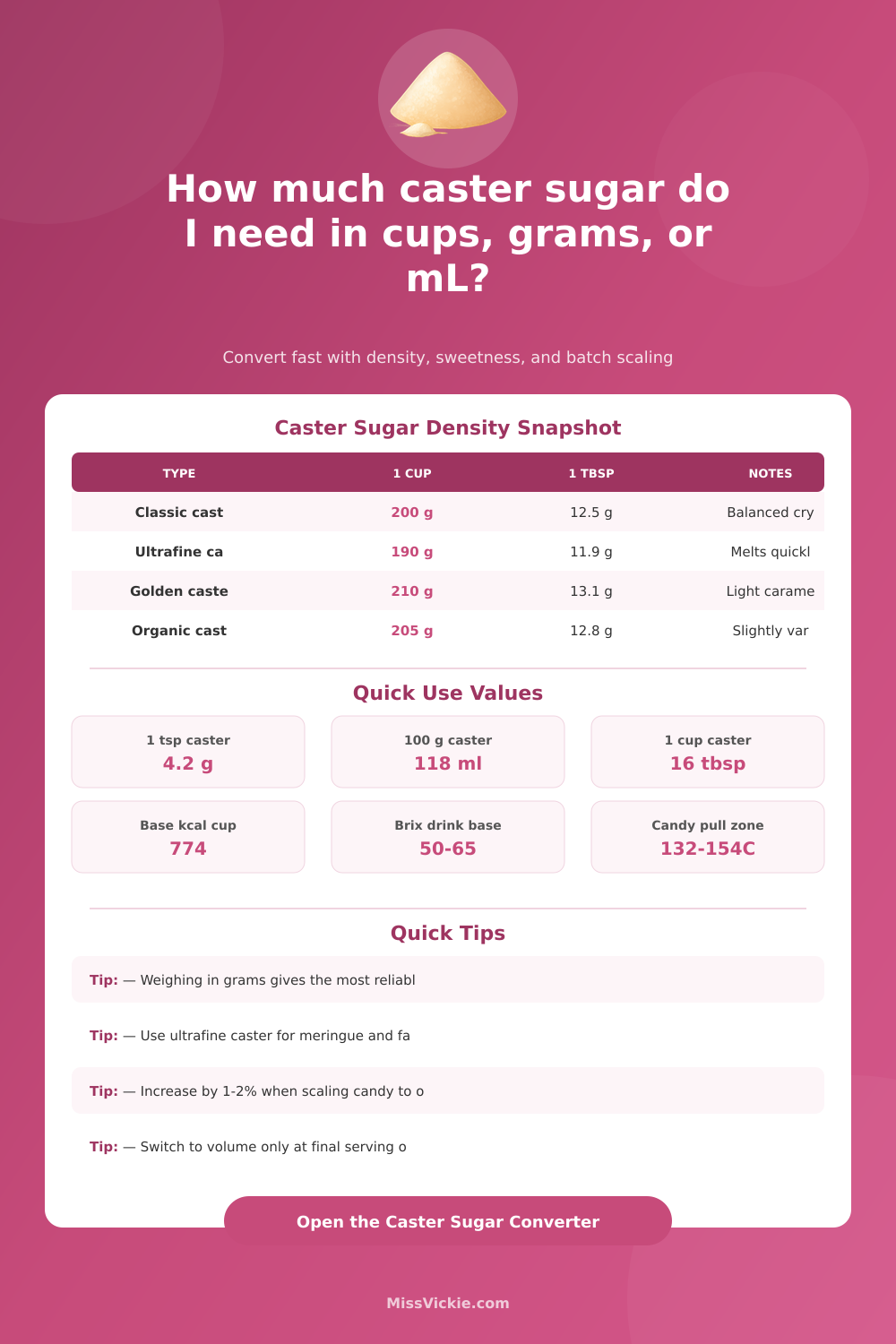
| Classic caster | 200 g | 188 g | 216 g | 12.5 g | Medium-fast |
| Ultrafine caster | 190 g | 178 g | 206 g | 11.9 g | Very fast |
| Golden caster | 210 g | 197 g | 227 g | 13.1 g | Medium |
| Organic caster | 205 g | 193 g | 221 g | 12.8 g | Medium-fast |
| Sanding sugar | 220 g | 207 g | 238 g | 13.8 g | Slow |
| Powdered sugar | 120 g | 113 g | 130 g | 7.5 g | Instant |
Reference Table 2: Caster Sugar Substitution Guide
| If Recipe Calls For | Swap With | Use This Ratio | Texture Notes | Best In |
|---|---|---|---|---|
| 1 cup caster | 1 cup ultrafine caster | 1.00x | Closest match | Sponge, cookies |
| 1 cup caster | 1 cup granulated (blitzed) | 1.00x | Pulse 15-20 sec | Cakes, quick breads |
| 1 cup caster | 0.95 cup superfine blend | 0.95x volume | Dissolves faster | Meringue, macarons |
| 1 cup caster | 1.10 cup powdered | 1.10x volume | Adds starch feel | Frosting only |
| 1 cup caster | 0.78 cup honey + reduce liquid | 0.78x volume | More moisture | Drinks, glaze |
| 1 cup caster | 0.72 cup maple syrup + reduce liquid | 0.72x volume | Earthy profile | Breakfast bakes |
| 100 g caster | 100 g any dry sugar | weight-for-weight | Safest method | All recipe types |
Reference Table 3: Baking, Candy, and Drink Targets
| Use Case | Sugar % of Base | Typical Batch | Caster Preference | Notes |
|---|---|---|---|---|
| Victoria sponge | 85-100% | 200 g butter + 200 g sugar | Classic | Even crumb and steady rise |
| Swiss meringue | 180-220% | 120 g egg white + 220 g sugar | Ultrafine | Glossy whip and stable peaks |
| Buttercream | 90-140% | 300 g butter + 320 g sugar | Powdered or ultrafine | Caster works if dissolved first |
| Fruit jam set | 60-100% | 1 kg fruit + 650 g sugar | Golden/classic | Boosts shine and shelf life |
| Chewy fudge | 110-155% | 500 g dairy mix + 620 g sugar | Classic | Control heat for smooth pull |
| Taffy | 130-190% | 350 g base + 560 g sugar | Classic/organic | Humidity affects pull timing |
| Lemon syrup | 70-130% | 500 ml liquid + 350 g sugar | Ultrafine | Faster dissolve when cold |
| Cocktail cordial | 95-150% | 400 ml juice + 420 g sugar | Golden | Round sweetness and depth |
Reference Table 4: Syrup and Candy Concentration Bands
| Band | Brix Range | Approx Sugar g per 100 ml Water | Temperature Cue | Primary Use |
|---|---|---|---|---|
| Light syrup | 30-40 | 45-67 g | below 100C | Tea, fruit soak |
| Simple syrup | 45-55 | 82-122 g | 100-104C | Cocktails |
| Rich syrup | 58-67 | 138-203 g | 104-108C | Coffee, cold foam |
| Thread stage | 70-79 | 233-376 g | 106-112C | Glaze, candied peel |
| Soft ball | 80-85 | 400-567 g | 112-116C | Fudge, fondant |
| Firm ball | 86-90 | 614-900 g | 118-121C | Caramel centers |
| Hard ball / soft crack | 91-96 | 1011-2400 g | 122-143C | Taffy, marshmallow |
| Hard crack | 97-99 | 3233-9900 g | 149-154C | Brittle, lollipop |
Two Practical Tips
Caster sugar has granules that is finer then granulated sugar yet coarser than powdered sugar. Due to the specific size of the granules of caster sugar, caster sugar can be difficult to measure using volume measurements. The volume measurements of caster sugar can vary in weight depending on amount of air in the caster sugar.
If you fluff the caster sugar, one cup of caster sugar can weigh 188 gram. If the caster sugar is packed into the cup, one cup of caster sugar can weigh 216 grams. Since the weight of caster sugar can vary, it is best to weigh the amount of caster sugar needed for a recipe in grams.
How to Measure and Use Caster Sugar
Using grams to measure caster sugar is more accurate than measuring the ingredient in cups. Additionally, using grams to measure caster sugar will ensure that the recipe yield the same results each time it is prepared. There are various types of caster sugar that can be used for specific baking purposes.
Ultrafine caster sugar is best used in recipes that requires the sugar to dissolve quickly, such as meringues. If you use another type of caster sugar that does not dissolve quick in meringues, the meringues may have a grainy texture. Golden caster sugar has a slight caramel flavor and is best used in baked goods that contain browned butter or fruit jams.
Organic caster sugar can be denser than non-organic caster sugar. This is due to the way in which the mill mills organic caster sugar. The type of caster sugar used in a recipe impacts the sweetness and texture of an end product.
When scaling a recipe that use caster sugar, it is essential to pay careful attention to the amount of caster sugar to be used in the recipe. If you double the recipe, you should also double the amount of caster sugar to ensure that the texture of the baked goods remains the same. During the cooking process, some of the caster sugar may stick to the cooking pans.
Additionally, if the room where the recipe is being cooked in are humid, the caster sugar may clump together. Due to the fact that humidity can impact the amount of caster sugar that is used during cooking, it may be necesary to add more grams of caster sugar if the humidity in the cooking area is very high. This is also true of candy making; if you are making candy with caster sugar, the amount of sugar impacts the temperature at which the candy reaches certain stages of cooking.
Other types of sugar can be used as a replacement for caster sugar. Granulated sugar can be pulsed in a blender to resemble caster sugar. However, the granulated sugar should only be pulsed for 15 seconds to ensure that it dont clump together.
Powdered sugar can be used in recipes in which powdered sugar is typically used, such as frostings. However, powdered sugar often contains starch. If candies are used that contain powdered sugar, the candy may feel gummy.
Additionally, if liquid such as honey is used as a replacement for caster sugar, the other liquids in the recipe should be reduced by 20% since honey is a liquid and will make the end product too soggy. Using another type of sugar in place of caster sugar require the same number of gram of that sugar as the caster sugar called for in the recipe to ensure that the sweetness of the products remains the same. Using a scale to measure the amount of caster sugar that will be used in a recipe is the best way to ensure that the recipes are successful.
By weighing the amount of caster sugar required for a recipe, the baker will avoid any errors caused by using volume measurements. Additionally, by knowing the different types of caster sugar, bakers can make sure to use the best type of caster sugar for the recipe. By accounting for the humidity in the area where the recipe will be made and understanding how to scale the recipe correctly, bakers can ensure the texture and sweetness of the food.
By using precision in measuring the amount of caster sugar to be used in a recipe, bakers will be able to achieve the same results each time they attempt to bake the same type of candy or baked good.