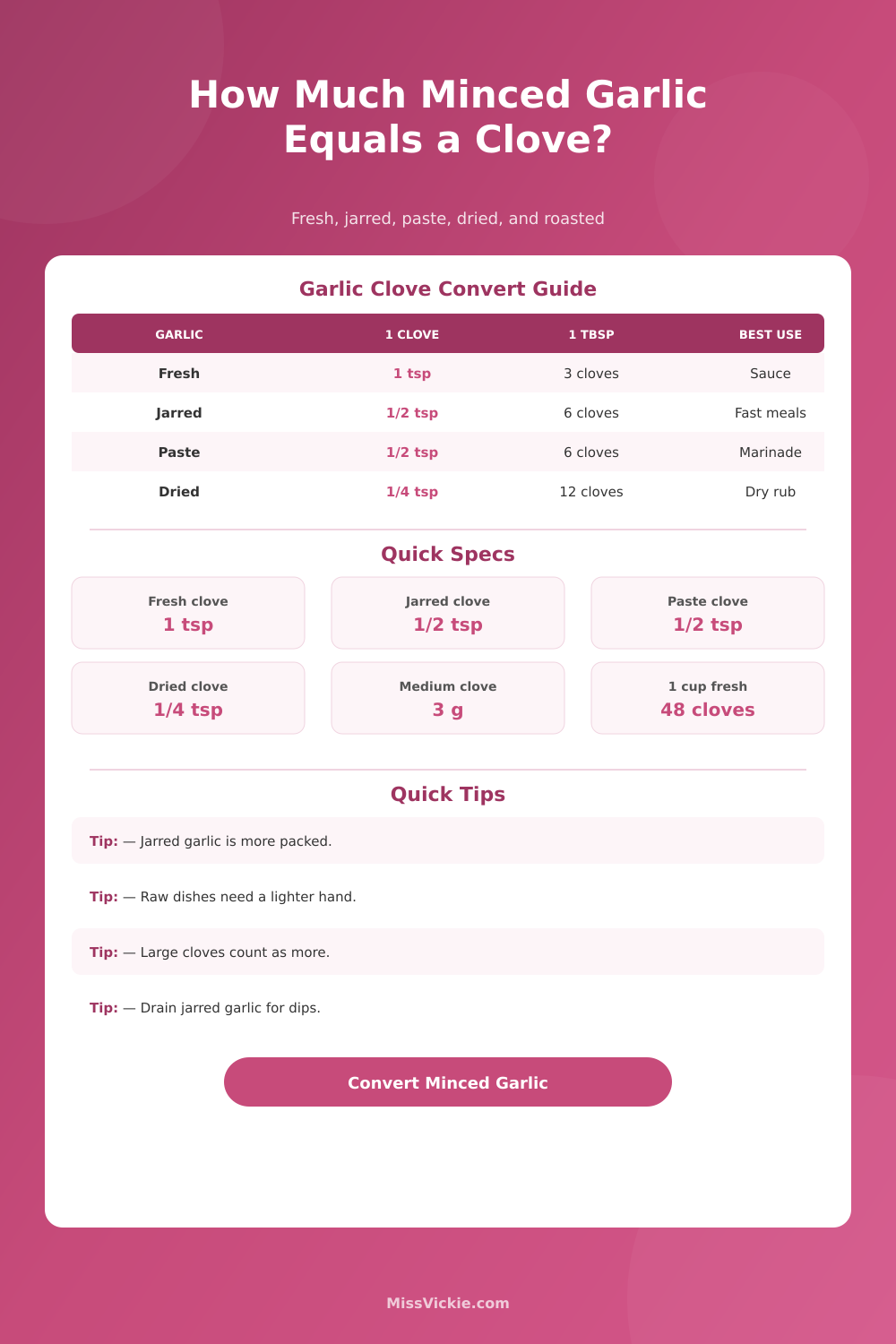
Fresh, jarred, paste, dried, and roasted garlic math
Minced Garlic to Clove Converter
Convert minced garlic into cloves, teaspoons, tablespoons, cups, grams, and recipe-ready equivalents with garlic form, clove size, flavor strength, recipe style, and moisture adjustments.
Fresh minced garlic is usually figured as 1 teaspoon per medium clove. Jarred garlic and garlic paste are more compact, while dried minced garlic is much more concentrated by spoon.
Fresh Minced
1 tsp
Best everyday swap for one medium clove when garlic is chopped fine and used right away.
Jarred Minced
1/2 tsp
Packed in liquid, so the spoon is dense. Good for fast sauces, soups, and skillet meals.
Garlic Paste
1/2 tsp
Smooth and potent, ideal in marinades, yogurt sauces, dressings, and spreadable mixes.
Dried Minced
1/4 tsp
Concentrated and dry. Use for rubs, crumbs, spice blends, and low-moisture fillings.
| Garlic Form | Equals 1 Medium Clove | Approx Grams | Flavor Note |
|---|---|---|---|
| Fresh minced, fine | 1 tsp | 3 g | Clean, sharp, standard recipe match |
| Fresh minced, coarse | 1 1/8 tsp | 3.2 g | Looser spoon, larger pieces |
| Jarred minced garlic | 1/2 tsp | 2.5 g | Dense, lightly brined, ready to use |
| Garlic paste | 1/2 tsp | 2.4 g | Strong contact flavor, smooth texture |
| Frozen crushed garlic | 1 tsp | 3 g | Close to fresh after thawing |
| Roasted mashed garlic | 1 1/4 tsp | 4 g | Sweet, soft, lower bite |
| Dried minced garlic | 1/4 tsp | 0.7 g | Needs moisture or cook time |
| Garlic powder | 1/8 tsp | 0.4 g | Fine, fast-spreading dry flavor |
| Clove Size | Fresh Minced | Weight | How to Count It |
|---|---|---|---|
| Small clove | 2/3 tsp | 2 g | Use 1.5 small cloves for 1 medium clove |
| Medium clove | 1 tsp | 3 g | Standard recipe clove |
| Large clove | 1 2/3 tsp | 5 g | Counts as about 1.7 medium cloves |
| Jumbo clove | 2 1/3 tsp | 7 g | Counts as about 2.3 medium cloves |
| Measure | Fresh Minced | Jarred Minced | Dried Minced |
|---|---|---|---|
| 1 teaspoon | 1 clove | 2 cloves | 4 cloves |
| 1 tablespoon | 3 cloves | 6 cloves | 12 cloves |
| 1/4 cup | 12 cloves | 24 cloves | 48 cloves |
| 1/2 cup | 24 cloves | 48 cloves | 96 cloves |
| 1 cup | 48 cloves | 96 cloves | 192 cloves |
| Recipe Style | Factor | Why It Changes | Best Garlic Form |
|---|---|---|---|
| Raw dressing or dip | 0.85x | Raw garlic tastes sharper | Fresh fine or paste |
| Sauce or skillet base | 1.00x | Balanced heat and liquid | Fresh or jarred |
| Soup, stew, or braise | 1.15x | Long cooking softens bite | Fresh, frozen, jarred |
| Garlic bread or butter | 0.95x | Fat carries garlic strongly | Fresh fine or paste |
| Dry rub or spice blend | 0.70x | Dry forms spread fast | Dried minced or powder |
You have A jar of minced garlic sitting in the pantry, and you want to make something that calls for three cloves‘ worth. But when was the last time you used this stuff? It has been weeks, at least. Will it still taste like garlic? No, it won’t, and that is why you’re wondering if it will mess up dish you’re cooking.
And there lies the need for converting cloves to tablespoons, or teaspoons. Seems like a chemistry question, doesn’t it? No, its more like kitchen math, and it can influences the flavor.
How to Measure Garlic for Your Cooking
First off: There’s nothing uniform about the size of a garlic clove. Some are big; some are little (and some look shriveled). When chopped finely and packed tightly, a medium-sized clove yield about a teaspoon of fresh minced garlic. Weighed, that would be about three grams, give or take depending on whether bulb is moist or dry, and how skillful your fingers is with a knife.
Another difference is that jarred garlic is denser than fresh garlic. It’s all packed really closely together, since the cloves was first peeled and then either soaked in some kind of liquid (usually oil, or sometimes vinegar) before packing. There are no air pockets; it’s super-compact. A half-teaspoon of jarred garlic taste about like one medium-sized fresh clove. If you’re creating something where the raw garlic has an intended punch, like a dip or a vinaigrette, you’ll taste difference between a clove that’s just been crushed versus one that’s been cooked down into the jar.
With math out of your hands, you won’t have to guess how much to double or halve when using this converter. What about garlic? Fresh versus jarred isn’t the only garlic divide; there’s also garlic paste. Paste has been smoothed out to be even, making it stronger and smoother. Less go further. You could also use powdered or dried minced garlic. This stuff is a concentrated dose of garlic flavors since its dehydrated. In exchange for some of its water weight, what you get are just straight-up garlic-sulfur goodness. One flake of dry will sub for one fresh clove, but be sure to give those dried flakes time to plump up again in liquid before using. Otherwise they’ll crunch between your teeth and shock you.
A word about clove size: Most home cooks don’t know that larger cloves from bigger bulbs is roughly twice as large as smaller ones by volume. That is why the converter take their relative sizes into account when it calculates. That way, you won’t end up with double the amount of garlic just because you’re working with a larger or smaller clove. It also factors in your intended method of preparation. You want raw? Use less garlic since the strong taste isn’t softened by any heat. Are you stewing or saucing? Go ahead and toss in more; time on the stove mellows those rough edges.
The volume isn’t everything: Remember, this is also about texture and pungency. For example, minced fresh garlic make a great dry rub. But it doesn’t work well in a dry rub because it’s going to form clumps. Use either dried flakes or powder if you want that kind of thing. When roasting veggies, raw chopped garlic can gets burnt before your carrots become soft. Garlic paste or jarred garlic will blend with oil without burning.
Think through the role of the garlic in whatever dish you’re making. Is it a supporting player or the star? Use more if it’s the latter; less if it’s the former. Higher amounts will increase the garlic taste and heat to bring the flavor to the front. Lower amounts will soften the garlic flavor so it stays in the background.
Unless you’re making a delicate dish where accuracy of grams matters (like baked goods), forget about the scales. Taste test as you go with savory dishes. It’s okay to eyeball things because a little goes a long way, and it is all up to personal preference. Use the basic conversion, then adjust to taste (more if it doesn’t sound pungent enough). And don’t worry, you’ll save yourself some peeling time thanks to the jarred garlic, which lasts months. A jar-full goes further than an equivalent amount of fresh garlic, since it’s packed tighter. So, less is equal. Remember that when you reach for the jar again. Then you won’t make your dish either too weak or more punch-in-the-face-strong.
It’s not about perfect measuring; it’s about balance in the dish.