🥛 MissVickie milk math
ML to Grams Milk Converter
Convert milk from milliliters to grams with milk-type density, temperature, foam, and kitchen rounding built in for reliable recipe scaling.
Ten real milk scenarios are ready to load. Each preset sets the milk type, volume, unit path, and rounding style, then calculates right away.
Set the milk type, temperature, and measuring style, then pick your starting amount and output unit. The calculator keeps the math readable for kitchen use.
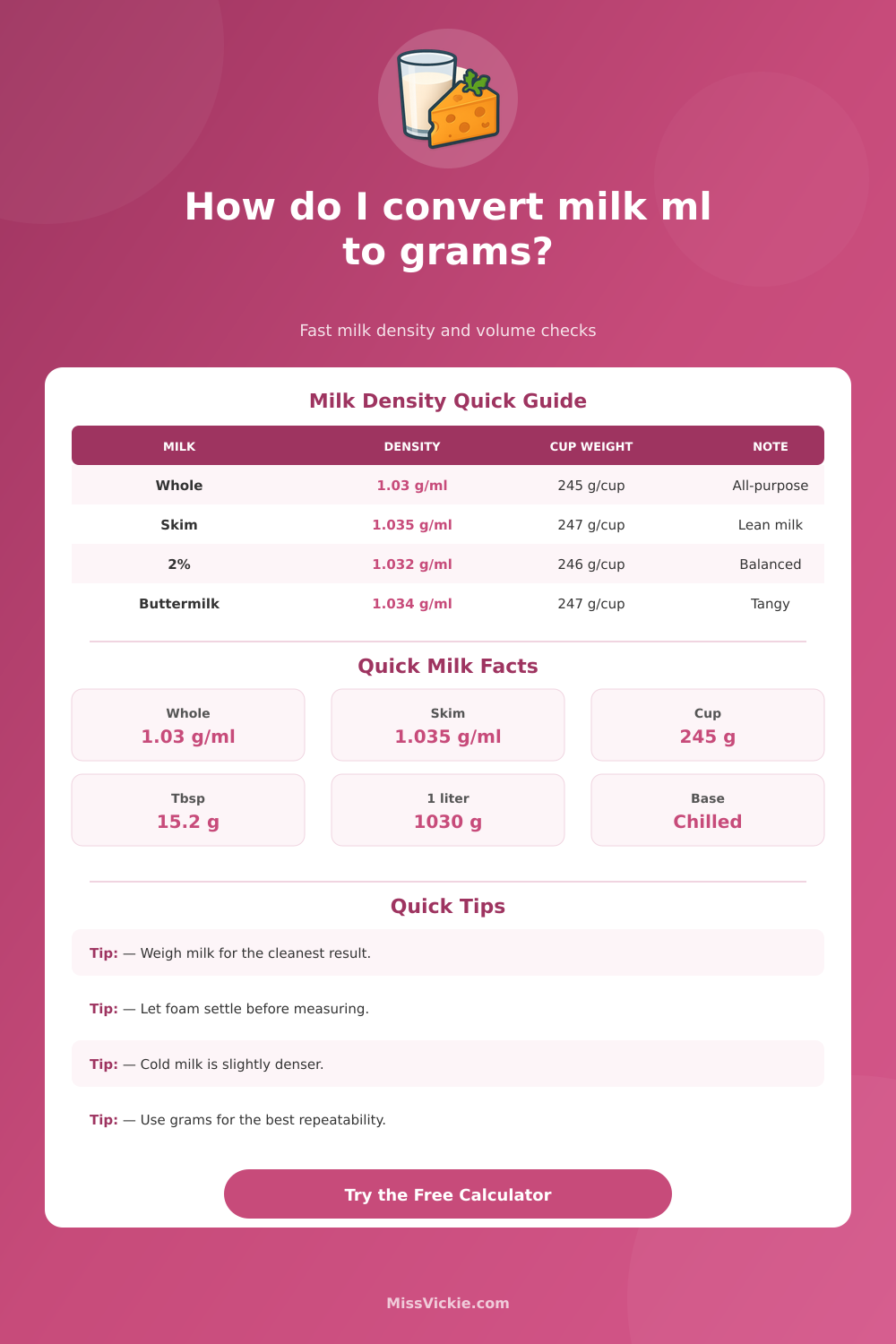
These reference values are tuned for everyday kitchen conversion. They keep the ml-to-grams result close to what a scale should show for each milk style.
| Milk Type | Density | Gram Check | Why It Matters |
|---|---|---|---|
| Whole milk | 1.030 g/ml | About 245 g/cup | Baseline dairy milk for most recipes. |
| Skim milk | 1.035 g/ml | About 247 g/cup | Slightly denser because fat is lower. |
| 2% milk | 1.032 g/ml | About 246 g/cup | Common all-purpose milk in baking. |
| Buttermilk | 1.034 g/ml | About 247 g/cup | Tangy, slightly thicker, and easy to scale. |
Use this table when you want to compare household measures against the selected milk type. The numbers are rounded for fast kitchen checking.
| Volume | Whole Milk | Skim Milk | Quick Use |
|---|---|---|---|
| 1 tbsp | 15.2 g | 15.3 g | Spoon test |
| 1/4 cup | 61.3 g | 61.8 g | Small pour |
| 1 cup | 243.9 g | 245.1 g | Recipe base |
| 1 liter | 1030 g | 1035 g | Batch scale |
Milk density shifts slightly with temperature, and foam changes how much milk is packed into the same volume. The calculator uses both factors.
| Condition | Factor | Typical Change | Best Match |
|---|---|---|---|
| Cold | 1.004x | Slightly denser | Fridge milk |
| Chilled | 1.002x | Close to baseline | Most dairy use |
| Warm | 0.996x | A little lighter | Sauces and pan work |
| Frothy | 0.975x | More air, less mass | Steam wand milk |
Different kitchen tools can nudge a volume reading. These cards compare the four methods most people use when they move milk between cups, ml, and grams.
Best when you want repeatable results and the least variation from pour to pour.
Great for a jug or measuring glass when you only need a quick liquid check.
Useful for family recipes, but the fill line and foam level matter more.
Handy when your recipe mixes imperial labels with a metric kitchen scale.
This table compares several everyday milk types so you can match the converter to the recipe style, from pancakes and coffee to canned milk and shakes.
| Use Case | Milk Style | Best Output | Typical Note |
|---|---|---|---|
| Pancakes | Whole milk | Grams | Good body and easy scaling. |
| Coffee | 2% or oat | ml | Keep the pour smooth and settle the foam. |
| Sauce | Warm milk | g | Measure by weight for steady thickness. |
| Baking | Skim milk | g | Lower fat and a slightly denser cup. |
Converting milk from milliliter to grams involve changing a volume measurement to a weight measurement. A milliliter measure the amount of space that milk take up, while a gram measure the weight of milk. Since milk isnt water, milk have a different density than water.
The density of water are 1 gram per milliliter, but because milk is not pure water, it’s density are slightly differently. Because the density of milk is not the same as water, one milliliter of milk will not weighs one gram. Milk’s density change according to the types of milk that is measured.
How to convert milk from milliliters to grams
The density of whole milk is 1.03 gram per milliliter because of the fat content in the milk. Skim milk have a density of 1.035 grams per milliliter because the skim milk has had most of its fat removed. The density of plant based milks, like oat milk, is 1.02 grams per milliliter due to the different ingredient in oat milk as compared to dairy milk.
These different densities demonstrates that the weight of the same volume of milk can change based on the type of milk that are being measured. The density of milk also change according to the temperature of the milk. Using cold milk from the refrigerator will result in the milk being denser than warm milk.
This is because cold milk molecules contracts and warm milk molecules expands. Therefore, warm milk will weigh less than cold milk. In addition, air bubble in milk can impact the weight of the milk.
If milk contain air bubbles, such as foamed milk, the air bubbles will increase the volume of milk without add to the weight of the milk. Thus, 100 milliliters of foamy milk will weigh less than 100 milliliters of liquid milk. Using a scale to weigh out milk in grams will provide more accurate measurements than using measuring cup to measure the volume of milk in milliliters.
This is because the volume of milk can change according to how the milk is poured into the measuring cup. The weight of the milk will remain the same regardless of how the milk is poured. Therefore, when baking item with milk, it is best to measure the milk according to how much it weigh in grams.
When baking, accuracy in measuring ingredients are essential for well balanced baked goods. If too many of one ingredient is used compared to another, the baking result could either be too dry or too gummy. Thus, using precise measurement of milk by weight will ensure that the recipe outcome will be as described in the recipe.
The densities of different types of processed milk also change the way that milk is measured in grams. Evaporated milk have a density of 1.07 grams per milliliter because water has been removed from the milk. Condensed milk is even denser than evaporated milk because it contain additional sugar and even more water has been removed from the milk.
The density of condensed milk is 1.30 grams per milliliter, meaning 100 milliliters of condensed milk will weigh 130 gram. Knowing the type of milk that youll use is half the battle in finding the correct density of milk to use in a recipe. Weighing milk according to its grams will help with the tracking of the nutrition of milk.
Most nutrition information are given in measurements of 100 grams of the product. For instance, if milk is weighed according to the grams of milk in a product, the calories and grams of protein in that milk can be easily measured. If 250 grams of whole milk is weighed, the protein content and the kilocalorie content of that milk can be determined.
Converting the liquid measurement of milk to grams will ensure that milk is consistently measured. If milk is consistently measured, the results of the products that use milk will also be consistently measurable and achievable.