💡 Microwave Watt Calculator
Estimate output wattage, power density, energy use, and reheating performance from real food loads
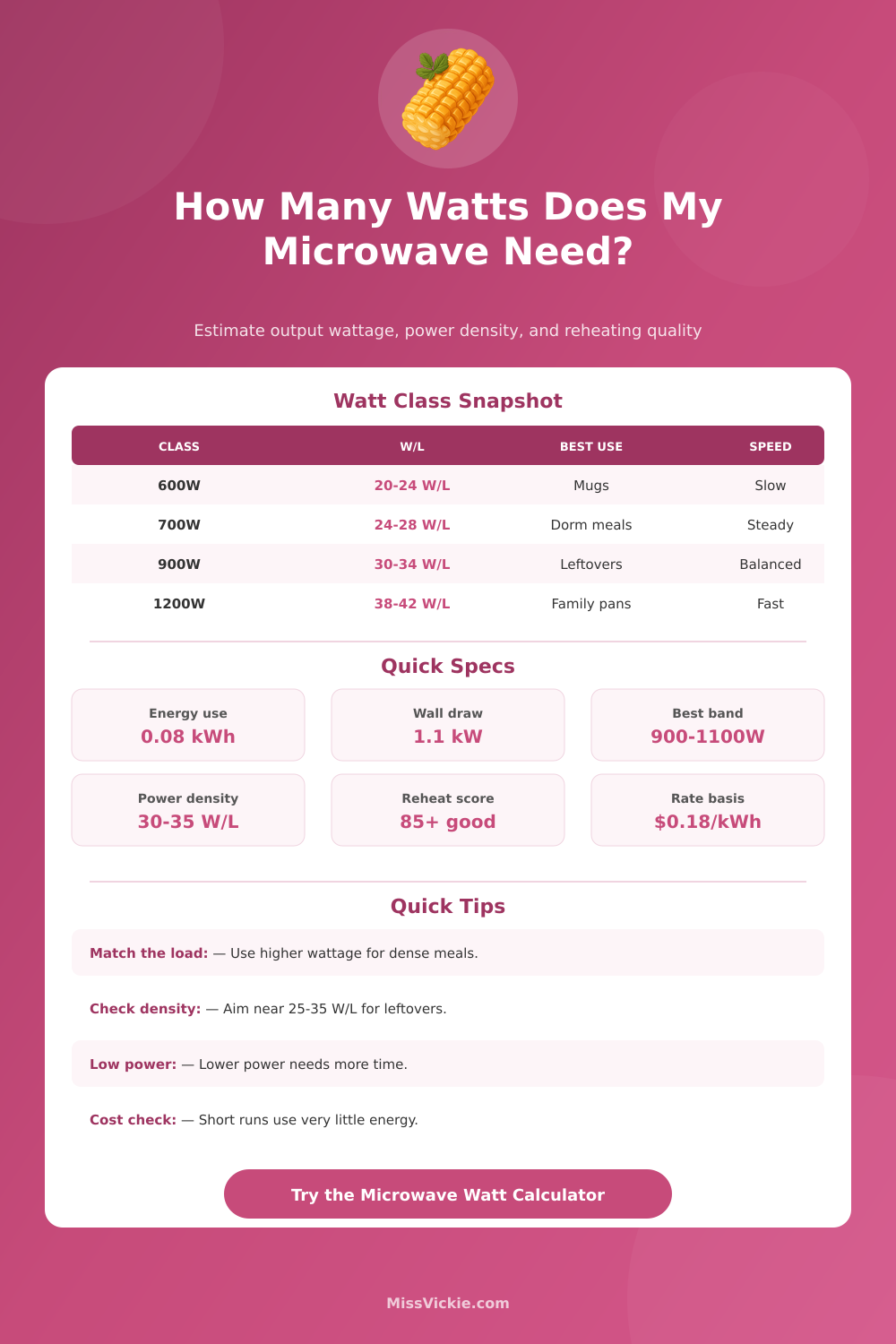
| Class | Output | Typical cavity | Best fit |
|---|---|---|---|
| 600W | 20-24 W/L | 0.7-0.9 cu ft | Small mugs, defrosting, gentle reheats |
| 700W | 24-28 W/L | 0.8-1.0 cu ft | Dorm meals, ramen, simple bowls |
| 900W | 30-34 W/L | 1.0-1.2 cu ft | Everyday leftovers, rice, vegetables |
| 1200W | 38-42 W/L | 1.3-1.6 cu ft | Large plates, casseroles, family reheats |
| Load | Specific heat | Transfer | Ideal class |
|---|---|---|---|
| Soup / broth | 4.12 kJ/kg°C | 0.72 | 700-900W |
| Oatmeal / porridge | 4.05 kJ/kg°C | 0.74 | 600-800W |
| Rice / grains | 3.65 kJ/kg°C | 0.70 | 800-1000W |
| Leftover plate | 3.35 kJ/kg°C | 0.68 | 900-1100W |
| Vegetables | 3.80 kJ/kg°C | 0.73 | 800-1000W |
| Casserole | 3.20 kJ/kg°C | 0.64 | 900-1100W |
| Frozen meal | 2.90 kJ/kg°C | 0.58 | 1000-1200W |
| Beverage / mug | 4.18 kJ/kg°C | 0.78 | 600-800W |
| Run | Energy | Cost at $0.18 | What it means |
|---|---|---|---|
| 1 minute, 700W | 0.012 kWh | $0.00 | Quick cup or snack run |
| 2 minutes, 900W | 0.024 kWh | $0.00 | Short plate reheat |
| 3 minutes, 1100W | 0.042 kWh | $0.01 | Balanced lunch portion |
| 5 minutes, 1200W | 0.067 kWh | $0.01 | Dense dinner or casserole |
| Food | Start | Target | Tip |
|---|---|---|---|
| Beverage | 20°C / 68°F | 65°C / 149°F | Heat in short bursts |
| Soup | 5°C / 41°F | 74°C / 165°F | Stir once halfway |
| Rice | 4°C / 39°F | 72°C / 162°F | Cover with a lid |
| Leftovers | 5°C / 41°F | 74°C / 165°F | Rest before serving |
| Frozen meal | -10°C / 14°F | 74°C / 165°F | Use extra thaw time |
| Casserole | 5°C / 41°F | 74°C / 165°F | Rotate for even heat |
Microwaves often heat food in a way that results in the food becoming scalding on the edges yet have a frozen center. This is due to the fact that the power of the microwave doesnt always match the type of food that is to be heated. The power of the microwave should be matched to the density of the food to ensure that the food is heated even throughout the cooking process.
The power density of the microwave is a measurement of the amount of watt that the microwave has per liter of the interior of the microwave. This value of power density is important to potential users of the microwave in that the power density will determine the rate at which the food will heat within the microwave, as well as the quality of the heating of the food. Differnt type of food require different levels of power density to effectively heat the food.
Choose the Right Microwave Power for Your Food
For instance, foods with a high heat capacity, like broth, will heat more quickly than foods with a lower heat capacity, like rice. Additionally, foods like soup will heat more different than casseroles due to their differing densities. Microwaves with a low power density, like 20 watts per liter, can be used to heat foods like snacks.
Conversely, high power density microwaves, like 40 watts per liter, are better for heating foods with high densities, like frozen meals. However, using a high wattage setting can lead to hot spots within the food if the user doesnt manage the food proper within the microwave. The temperature of the food impacts the functioning of the microwave.
Additionally, the starting temperature of the food will impact the amount of energy required to heat the food to a safe temperature. For instance, food from the refrigerator will have to be heated to 165 degrees F. To ensure food safety. The energy required will depend upon the temperature difference between the food and the desired temperature, the heat capacity of the food, and how the microwave energy penetrates the food.
The moisture and density of the food will impact the penetration of the microwave energy into the food. Foods with more moisture will allow for the microwave energy to penetrate the food more effective. Additionally, the type of container in which the food is heated will impact the heating process of the food; a covered glass bowl will heat food more effective than open plates.
The size of the cavity of the microwave can also impact the heating of the food within the microwave. For instance, if large portion of food are placed into small microwaves, the power density of the microwave will drop, leading to longer cooking times. Too much food in a small microwave will result in uneven heating of the food.
While there is some cost associated with utilizing a microwave, those costs are quite low. Heat cycles performed with a microwave for two minutes will use a small amount of energy from the electricity supply. Therefore, heating food in a microwave will cost about as much as leave a lightbulb on for the same length of time.
The wattage indicated on the microwave may not be the energy absorbed by the food. For instance, a 900-watt microwave may draw more energy from the electrical supply than 900 watts of energy due to inefficiencies in the microwave. Thus, the energy absorbed by the food may be less than the indicated wattage of the microwave.
Pre-set settings on the microwave can be helpful for the individuals that use the microwave; the pre-set settings account for the starting temperatures of the food, such as food from the fridge or deep freeze. These pre-set settings allow the food to reach a food-safety temperature without overcook the food. There are a few common mistakes that may be made when using a microwave.
For instance, heating beverages at full power can cause the beverage to explode. Therefore, using medium power for heating beverages will reduce this risk. Another common mistake is to heat dense food without stir it.
Foods should be stirred midway through heating because microwaves will heat the surface of the food more than the interior of the food. Additionally, foods that are frozen require more time to heat due to the energy required to melt the ice within the food before the food can be heated. Placing a lid on the food that is made of glass or a vented lid is more efficient than a paper cover for covering the food.
To achieve the best results with heating food in a microwave, individuals should aim for a power density of 30 to 35 watts per liter. Individuals who live in dorms and live alone may prefer the lower power setting to heat foods like ramen noodles. However, families may prefer higher power settings within the microwave to heat foods like casseroles more quickly.
Another way to achieve even heating is to allow the food to rest for a few minutes after the microwave cycle is complete. When food is allowed to rest, the carryover cooking of the food will allow the food to reach a uniform temperature. Additionally, short burst of energy from the microwave, with frequent stirring, will heat the food evenly throughout the meal.