📊 Microwave Cubic Feet Calculator
Measure the real cavity size, estimate usable cooking space, and compare your microwave against common capacity classes before you buy or replace it.
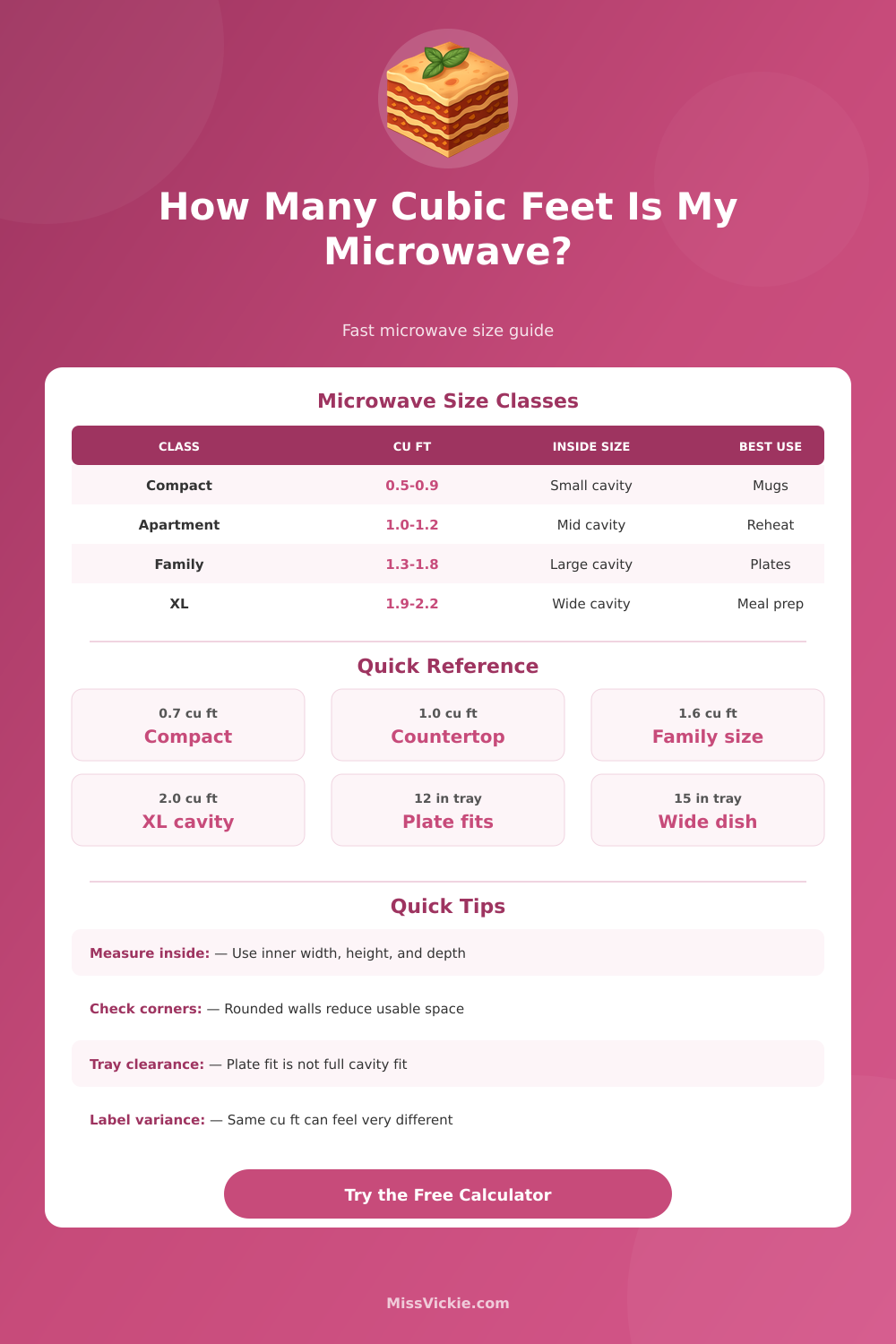
| Class | Gross Cu Ft | Typical Interior | What It Feels Like |
|---|---|---|---|
| Compact | 0.5-0.9 | 12-13.5 x 8-9 x 12-13.5 in | Mugs, cereal bowls, small plates |
| Apartment | 1.0-1.2 | 13.5-14.5 x 9-9.5 x 14-15 in | Most reheating and single-dish meals |
| Family | 1.3-1.8 | 15-16.5 x 9.5-10 x 15-17.5 in | Dinner plates, casseroles, takeout trays |
| XL | 1.9-2.2 | 16.5-18 x 10 x 18-20 in | Wide bowls, meal prep boxes, large plates |
| Jumbo | 2.3+ | 18+ x 10+ x 20+ in | Oversized platters and extra-wide dishes |
| Turntable Diameter | Narrow Floor Needed | Typical Microwave Size | Practical Note |
|---|---|---|---|
| 9.5-10 in | 11-11.5 in | Compact 0.7-0.9 cu ft | Fine for mugs and small bowls |
| 10.5-12 in | 12.5-13.5 in | 1.0-1.2 cu ft | Good balance of plate room and cabinet fit |
| 12.5-13.5 in | 14-15 in | 1.3-1.8 cu ft | Better for standard dinner plates |
| 14-15 in | 15.5-16.5 in | 1.9-2.2 cu ft | Wide casseroles and large leftovers |
| 15.5+ in | 17 in+ | Jumbo or drawer-style | Watch the wall and trim allowances closely |
| Container Type | Target Clearance | Why It Matters | Space Penalty |
|---|---|---|---|
| Mug or cup | 0.5 in | Lets steam escape without spilling over | Very light |
| Soup bowl | 0.75-1 in | Keeps handles and lids from scraping walls | Light |
| Dinner plate | 1-1.25 in | Prevents edge contact while rotating | Moderate |
| Casserole dish | 1.25-1.5 in | Helps with easy lift-out and lid clearance | Moderate to high |
| Meal prep box | 1.5-2 in | Useful when stacking or using tall lids | High |
| Cavity Shape | Factor | What Changes | Best For |
|---|---|---|---|
| Boxy / Flat Sides | 1.00 | Most of the labeled volume feels usable | Square containers and wide plates |
| Rounded Corners | 0.96 | Edges and arcs trim usable floor area | Mixed everyday cookware |
| Sloped Back Cavity | 0.93 | Rear taper reduces stackable depth | Standard plates and bowls |
| Arched / Compact Top | 0.90 | Upper curve limits tall containers | Short dishes and reheating trays |
When you purchase a microwave, the number of cubic feet that are represented on the product will indicate the gross capacity of the microwave. However, the gross capacity of the microwave doesnt necessarily indicate the amount of usable space within that appliance. Many peoples turns to the measurement of the number of cubic feet as a means of purchasing a microwave.
However, the number of cubic feet may not be reflective of the size of the microwaves interior; the size of the turntable, and the number of dishes that may be of consideration to the person can all impact whether or not a microwave with a high number of cubic feet will be appropriately size for the individuals needs. In order to determine the gross capacity of a microwave, the cook calculates the width, height, and depth of the microwaves interior cavity, and divided by 1,728 to determine the number of cubic feet that the microwave can hold. The gross capacity, however, is typically higher than the capacity that can be used within the microwave.
Microwave Size: Labeled Size and Real Space
The walls of the microwave and the turntable that rotates within the microwave all take up some of the usable space for the dishes to be placed within the microwave. The thickness of the walls of the microwave can reduce the depth and width of the microwaves interior cavity. Additionally, the rounded corners of the cavity reduce the depth of the cavity where rectangular plates can be placed.
The diameter of the turntable can also reduce the number of dishes that may be placed within the microwave; if the diameter of the turntable is too small for the largest plates that will be placed within the microwave, the plate will hit the walls of the microwave. The concept of usable volume within a microwave is slightly different than the gross volume; usable volume takes into account the space that is lost due to the turntable and the shape of the cavity. Microwaves that have boxy cavities that have large flat surfaces tends to have more usable volume than those that have sloped backs or arched tops.
In microwaves that have sloped backs or arched tops, approximately 7 to 10% of the usable volume of the microwave is lost due to the shape of the microwave. Additionally, some types of installation for the microwave may reduce the usable volume of the microwave. For instance, over the range microwaves may lose some of their volume to the components that allow the microwave to vent steam; similarly, built-in microwaves may lose some of their volume due to the installation of trim kits to allow for even installation into the countertop.
Instead of using the cubic feet ratings to determine the size of the microwave that is best for ones kitchen, it is beneficial to measure the dimensions of the microwave itself. For instance, two microwaves may have the same number of cubic feet, yet one might have a turntable with a more larger diameter than the other. In addition, if the microwave has a narrow interior cavity, a large plate may be unable to rotate within the microwave.
It is recommended to allow for at least one inch of clearance around each of the dishes that are to be cooked within the microwave. If there isnt enough clearance between the dishes and the walls of the microwave, the dishes may scrape against the walls during rotation of the turntable, and the even cooking of the dishes may be negatively impact. One of the other ways in which microwaves may be categorized is according to the capacity that it has.
For instance, compact microwaves may have a capacity of less than 0.9 cubic feet, and are typically used to heat small items like mugs. Microwaves that are considered to be of apartment sized ranges has a capacity of between 1.0 and 1.2 cubic feet. These microwaves provide a balance between the size of the dishes that may be heated, and the space that may be required in an apartment for the microwave.
Family sized microwaves have a capacity of between 1.3 and 1.8 cubic feet, and are typically larger than apartment sized microwaves to allow for larger items to be heated. Finally, extra large microwaves have a capacity of larger than 1.9 cubic feet, and are typically purchased by individuals who need to cook extra large or extra wide items. The needs and habits of the individual that will use the microwave can help to determine the best size of microwave for that individual.
For instance, if an individual only needs to cook for one person at a time, an apartment sized microwave may be sufficient. If, however, an individual needs to cook for a family, a family sized microwave may be the better option. Similarly, if an individual cooks many meals in advance for which they must rotate the plates, then an extra large microwave may be the best choice.
In either case, though, it is also beneficial for those purchasing a microwave to test each of their largest plates for whether or not they will fit within the microwave. Actualy, you should of checked the dimensions first. The furnitures in the kitchen can be a lot of work to move, so dont forget to check the space around the microwave too.
One of the most important things is that your satisfied with the purchase. It isnt just about the cubic feet, its about the actual usable space. This can be more difficult than it looks.