Whipped cream stabilizer calculator
Meringue Powder for Whipped Cream Calculator
Estimate meringue powder for whipped cream from cream volume, powder strength, sugar level, target stiffness, service time, temperature, piping detail, flavor sensitivity, and hydration style.
🍰Quick whipped cream scenarios
Choose a realistic serving setup, then fine tune the cream, sugar, temperature, piping, and flavor controls below.
🥛Cream volume and stabilizer inputs
Whipped cream plan
⚖Common stabilizer reference
📋Meringue powder strength table
| Powder type | Adjustment | Best use | Handling note |
|---|---|---|---|
| Fresh egg-white-rich powder | Use about 90% | Plain vanilla cream, cake filling, short display | Start low because the taste can show in lightly sweetened cream. |
| Standard decorating meringue powder | Baseline estimate | Most whipped cream toppings and dessert bars | Hydrate or sift well so the powder does not leave tiny specks. |
| Older or starchier powder | Add about 18% | Chocolate, coffee, or stronger flavored cream | Check aroma before using; stale powder can taste dusty. |
| Premium powder with gums | Use about 82% | Piping, borders, and service where clean edges matter | Overdosing can make whipped cream slightly elastic. |
🍦Target stiffness and piping guide
| Target | Visual cue | Typical powder range | Best service style |
|---|---|---|---|
| Soft spoonable peaks | Peak bends gently | 1/2 to 2/3 tsp per cup | Shortcake, fruit bowls, spooned dessert topping |
| Medium dollop peaks | Peak stands but tip curls | 2/3 to 7/8 tsp per cup | Pie dollops, trifles, hot cocoa bars |
| Firm cake filling peaks | Peak stands upright | 7/8 to 1 1/8 tsp per cup | Layer filling, borders, and make-ahead desserts |
| Piping-stable peaks | Clean ridges hold | 1 to 1 1/4 tsp per cup | Rosettes, stars, shells, and cupcake swirls |
🌡Temperature and service duration guide
| Service condition | Powder effect | Timing advice | Risk warning |
|---|---|---|---|
| Refrigerated, 34-40 F | Baseline | Pipe ahead and keep covered until service. | Low risk if cream remains cold. |
| Cool room, 60-68 F | Add 8% to 15% | Finish close to service and rotate trays. | Edges soften first on detailed piping. |
| Room temp, 69-74 F | Add 18% to 25% | Limit display time and chill backups. | Weeping and slumping become more likely. |
| Warm room or outdoor risk | Add 30% or more | Use chilled bowls, short display, and shade. | Food safety and texture limits matter more than powder. |
🥛Cream, sugar, and hydration comparison
The default calculator baseline for reliable volume and clean flavor.
Its starch gives slight support, so meringue powder can often be lower.
Honey or syrup adds water and softens peaks unless the cream stays cold.
Hydration reduces gritty specks and helps powder disperse evenly.
📏Common batch amounts
| Cream volume | Soft topping | Medium dollops | Piping stable |
|---|---|---|---|
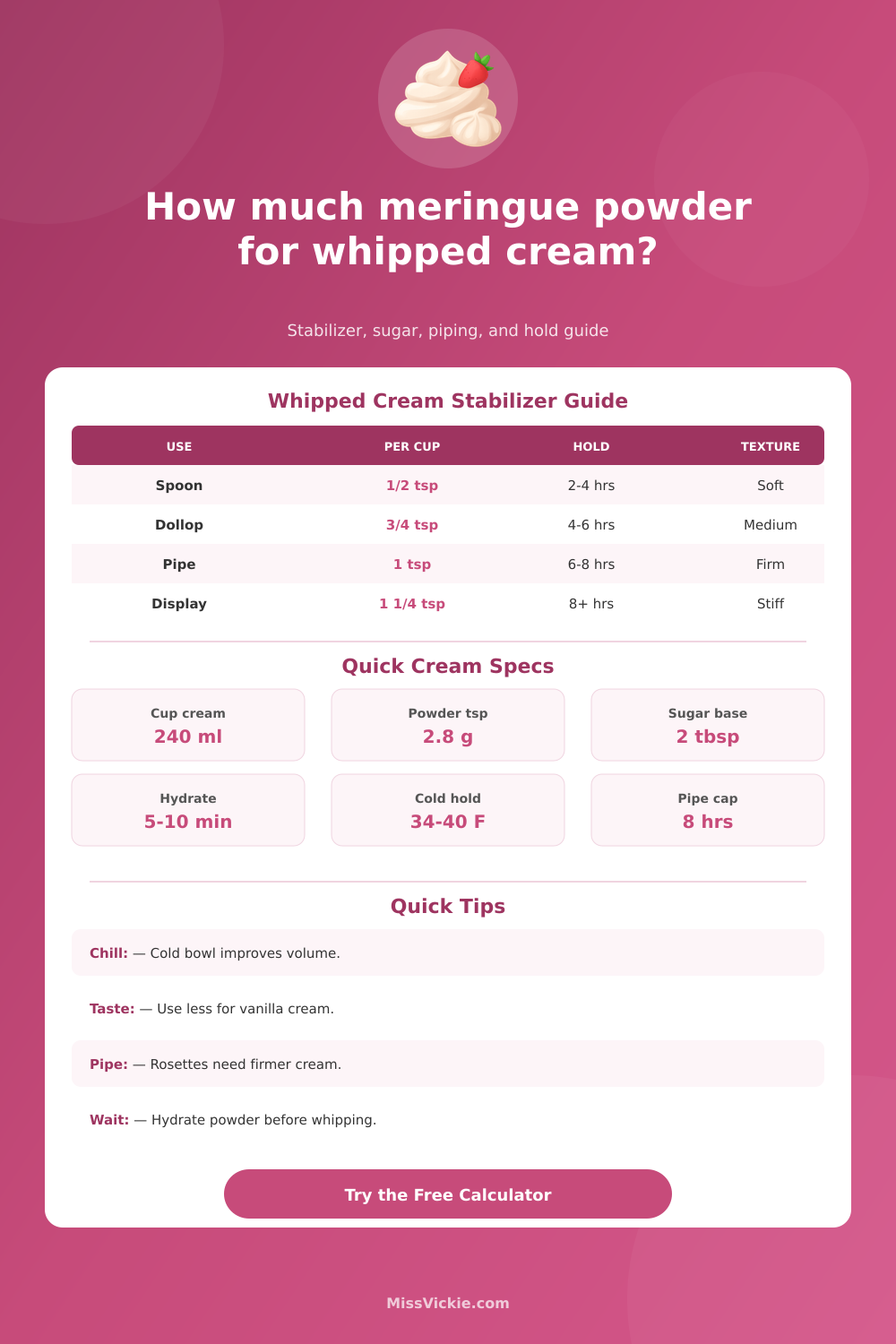
| 1 cup cream | 1/2 tsp powder | 3/4 tsp powder | 1 tsp powder |
| 2 cups cream | 1 tsp powder | 1 1/2 tsp powder | 2 tsp powder |
| 1 pint cream | 1 tsp powder | 1 1/2 tsp powder | 2 tsp powder |
| 1 quart cream | 2 tsp powder | 1 tbsp powder | 1 tbsp plus 1 tsp powder |
💡Practical whipped cream notes
Meringue powder is a cream stabilizer that is often added to whipped cream before it sets to help prevent the whipped cream from losing it’s shape. If meringue powder are not used in the whipping process, the whipped cream may loosen from it’s containers, the peak of the cream may slump, and the cream may weep. However, if the cook adds the correct amounts of meringue powder to the whipped cream, the cream will retain its shape and its ridges will remain sharp.
This type of meringue powder is especially useful for dessert creations that includes rosettes piped onto a cake or dollops of cream that may need to sit out for several hours prior to serving. The amount of meringue powder needed to stabilize whipped cream will depend upon several factor. One factor is the fat percentage of the cream; creams with lower fat percentages requires more meringue powder than creams with higher fat percentages.
How to Use Meringue Powder to Keep Whipped Cream Firm
The type of sugar that is used in the cream will impact the amount of meringue powder as well. Creams that use powdered sugar tend to contain some starch that will provide structural support to the cream, while liquid sweeteners will soften the whipped cream if too much water are added. Additionally, the service temperature of the whipped cream will impact the amount of meringue powder that is required.
For instance, if the cream will be served on a refrigerated tray, less meringue powder will be required than if the cream will be served on a warm buffet. Finally, the piping style will also impact the amount of meringue powder needed; creams that are piped into intricate designs will require more meringue powder than creams that are piped into simple designs. The amount of meringue powder that is added will also impact the flavor of the cream; too much meringue powder can impart a noticeable taste to vanilla cream.
The calculator available online allows for the amount of meringue powder to be determined by entering several different factors relate to the whipped cream. Factors that may be entered include the volume of the cream, the fat level of the cream, the strength of the meringue powder, the amount of sugar that is to be used, the stiffness of the whipped cream, the piping style, the number of hours that the cream will be served, and the temperature of the kitchen in which the cream will be served. The amount of meringue powder that is calculated will also include a “hold score” for the whipped cream.
This hold score will represent how realistic the amount of meringue powder that was calculated will be; the higher the hold score, the more reliable the meringue powder amount. Additionally, you can adjust the hydration method for the meringue powder within the calculator, and changing the hydration method will also change the amount of meringue powder that is recommended. Many individuals attempt to use a rule of thumb that suggests one teaspoon of meringue powder is needed for each cup of cream to be whipped.
Using this method, however, often results in either a tasting of the whipped cream that contains some of the “dust” of the meringue powder, or the whipped cream may collapse when it is removed from its container. Instead, individuals should consider the time frame in which the whipped cream will be served. For instance, if a cake containing whipped cream will be sliced after eight hour, the amount of meringue powder will be higher than if the whipped cream will only be served for two hours.
Additionally, if the dessert is to be served outdoors or near a window, the hold score will be low; the amount of meringue powder will be calculated to account for the high temperature in the area. Another factor in the whipping of cream is the hydration method of the meringue powder. The meringue powder can be mixed into the cream to form a slurry, it can bloom in the cream for ten minutes, or it can be dry sifted into the powdered sugar if powdered sugar is being used.
Additionally, the meringue powder can be sprinkled direct into the cream; however, this method may introduce some of the meringue powder to the cream in such a way that some of the meringue powder grains remains in the whipped cream. Temperature control of the whipping process and the dessert is also important in maintaining the structural integrity of the whipped cream. The cream should be chilled, the bowls should be chilled, and the piping bag should be chilled to minimize the workload placed upon the meringue powder.
If the cream is too warm, or if the kitchen is hot, the meringue powder may not be able to effective compensate for the warm temperatures. The hold score that is calculated will reflect this; high temperatures will result in a low hold score for the whipped cream. Following the calculation of the amount of meringue powder that will be needed, whipping can begin.
The whipping cream should only be whipped to the stiffness level that is required for serving. Over-whipping the stabilized cream will cause the cream to begin to clump or grain faster than if the cream was not stabilized with meringue powder. Finally, once the whipped cream is prepared and piped onto the dessert, it should be covered and kept cold until it is served.
The use of both the meringue powder and temperature control will ensure the structural integrity of the cream once it is piped onto the dessert.