MissVickie kitchen math
Melting Point Calculator
Estimate the practical softening, melting, pouring, or sugar-stage temperature for butter, chocolate, kitchen fats, cheese, and sugar syrup while accounting for batch mass, heat method, altitude, carryover, and texture goal.
Presets fill the ingredient, batch size, texture target, and heat setup. Change any field before calculating.
Full breakdown
Texture and heat readout
Run the calculator to see the best temperature window for your ingredient and method.
| Ingredient | Softening point | Practical melt target | Upper caution zone | Best method | Kitchen note |
|---|---|---|---|---|---|
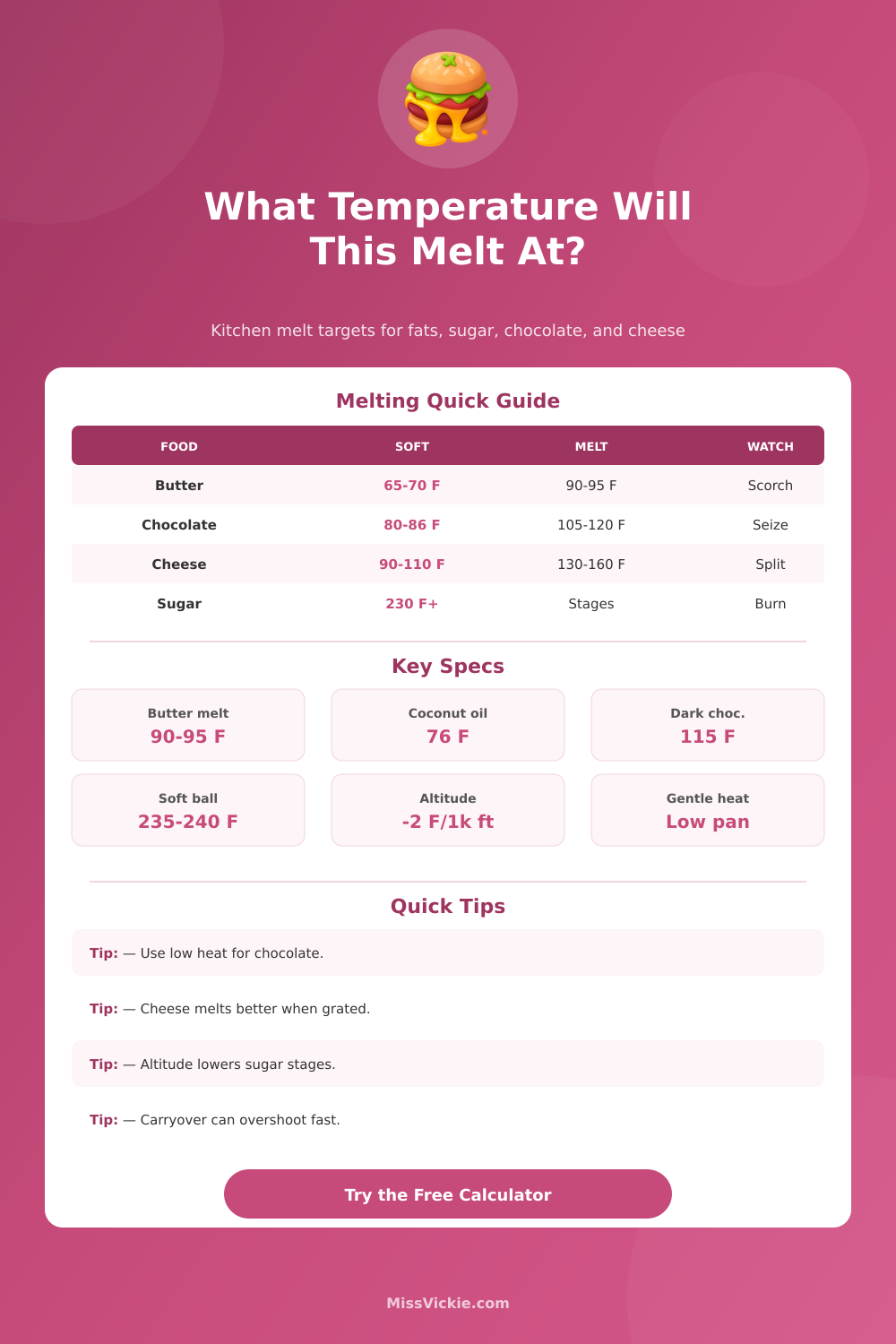
| Butter | 65-70°F / 18-21°C | 90-95°F / 32-35°C | Above 250°F browns milk solids | Low pan or room rest | For baking, softened and melted butter behave very differently. |
| Clarified butter or ghee | 75-85°F / 24-29°C | 95-105°F / 35-41°C | Above 375°F starts smoking for many batches | Low pan | Water and milk solids are mostly removed, so it is more stable. |
| Coconut oil | 72-76°F / 22-24°C | 76-82°F / 24-28°C | Above 350°F can smell toasted | Room rest or water bath | It may liquefy on a warm counter without active heat. |
| Lard | 80-95°F / 27-35°C | 95-115°F / 35-46°C | Above 360°F can smoke | Low pan | Composition varies, so the calculator uses a practical range. |
| Shortening | 95-105°F / 35-41°C | 110-120°F / 43-49°C | Above 360°F can smoke | Low pan or oven | Hydrogenated fats are designed to stay solid longer. |
| Dark chocolate | 80-86°F / 27-30°C | 115-120°F / 46-49°C | Above 125°F raises scorch risk | Double boiler | Keep water out of the bowl to avoid seizing. |
| Milk chocolate | 78-84°F / 26-29°C | 105-113°F / 41-45°C | Above 118°F is risky | Double boiler | Milk solids and sugar make it more delicate than dark chocolate. |
| White chocolate | 76-82°F / 24-28°C | 100-110°F / 38-43°C | Above 115°F is risky | Double boiler | Use gentle heat because it contains cocoa butter but no cocoa solids. |
| Sugar stage | Sea-level target | At 2500 ft | At 5000 ft | Texture check | Common use |
|---|---|---|---|---|---|
| Thread | 230-235°F | 225-230°F | 220-225°F | Thin threads from a spoon | Syrup and glazes |
| Soft ball | 235-240°F | 230-235°F | 225-230°F | Soft ball in cold water | Fudge and fondant |
| Firm ball | 245-250°F | 240-245°F | 235-240°F | Firm but pliable ball | Caramels |
| Soft crack | 270-290°F | 265-285°F | 260-280°F | Flexible brittle strands | Taffy and butterscotch |
| Hard crack | 300-310°F | 295-305°F | 290-300°F | Hard brittle threads | Lollipops and shards |
| Caramel | 320-350°F | 315-345°F | 310-340°F | Amber color and toasted aroma | Caramel sauce and brittle |
| Cheese style | Starts softening | Sauce or flow range | Split risk | Best prep | Kitchen note |
|---|---|---|---|---|---|
| Mozzarella | 90-105°F | 130-150°F | Above 170°F | Shred or slice thin | High moisture stretches well but can weep if overheated. |
| Young cheddar | 95-110°F | 145-160°F | Above 170°F | Grate and add starch | Gentle heat helps fat and protein stay together. |
| Aged cheddar | 100-115°F | 150-165°F | Above 170°F | Use sauce base | Lower moisture and more acid make splitting easier. |
| Processed cheese | 90-105°F | 125-145°F | Above 180°F | Low pan heat | Emulsifying salts make it smoother and more forgiving. |
| Gruyere or Swiss | 95-110°F | 145-165°F | Above 175°F | Grate finely | Good melting cheese, especially with wine or starch in sauce. |
| Cream cheese | 70-85°F | 100-125°F | Above 150°F | Soften first | Softening before mixing prevents lumps in dips and frostings. |
Stop below the target for delicate foods
Chocolate, butter sauces, and cheese continue warming after the bowl leaves the heat. Pull early, stir, and allow the remaining heat to finish the job.
Adjust candy stages for altitude
At higher altitude, water boils at a lower temperature, so sugar reaches the same concentration at a lower thermometer reading. Use the calculator adjustment before judging the stage.
Kitchen note: these are practical cooking ranges, not laboratory melting points. Ingredient brand, moisture, cocoa butter content, cheese age, pan material, thermometer placement, and stirring can shift real results.
A melting point calculator allow a person to predict how the food will behave when heat is applied to the food. The actual melting of the food can be more different from the melting point that is calculated for the food. A melting point calculator allows a person to adjust for the different variable in the kitchen so that food does not burn or separate during the melting process.
The variables that is entered into the melting point calculator will impact the outcome of the melting point calculation. The mass of the batch of food can impact the melting point because a larger batch may require more heat to reach the melting point. The starting temperature of the batch can impact the melting point because food that starts at a lower temperature than food that is at room temperature will take longerly to reach the melting point.
How a Melting Point Calculator Helps in Cooking
The texture that is targeted from the batch of food may impact the melting point because foods that are targeting a texture that is not liquid may require a different melting point than food that is melting to become a liquid. The heat methods that are used can also impact the melting point. Using a double boiler will apply heat that maintains a low and steady temperature.
A double boiler is often use in melting chocolate. Using a low pan will heat the food faster but can lead to hot spots in the pan if the cook does not stir the food while heating. The melting point calculator may include these variables for the time required for the melting point.
Altitude can also impact the melting point of food. For instance, altitude can impact the boiling point of liquid such as sugar syrup. The melting point calculator accounts for altitude so that people dont have to calculate the impact of altitude on the boiling point of sugar syrup.
Carryover heat can impact the melting point of food. Carryover heat occurs when the pans that are used in melting food are very heavy and continue to release heat after they are removed from the stove. This can lead to the food going past its melting point.
The melting point calculator allows for the creation of a buffer for carryover heat. The risk score for food melting also accounts for variable that may impact the melting of the food in the kitchen. Melting butter is a common scenario for melting point calculations.
Butter will soften at room temperature prior to melting. Recipes will often ask for butter that is at room temperature because melting the butter and then refreezing it will change the texture of the butter. A melting point calculator can distinguish between softened butter and melted butter.
Chocolate contains cocoa butter and there are different form of the cocoa butter. Dark chocolate has a higher melting point than milk chocolate because it contains less sugar. If chocolate is allowed to go past 125 degrees the risk of scorching the chocolate increases.
If water touches chocolate it will become grainily. A melting point calculator that features the type of heat methods that are to be used for chocolate will account for this and suggest indirect heat with allowances for carryover heat. Melting cheese contains moisture and protein.
High moisture cheeses, like mozzarella, will stretch when the fat in the cheese melt. High moisture cheeses, however, can weep their excess moisture if they are melted to a high degree. Aged cheeses, like cheddar, contain less moisture and more acid than cheese like mozzarella.
Aged cheese can split if melted to high degree. Melting point calculators can use a texture target to calculate the melting point of cheese because the goal with cheese is to create a sauce. Grating the cheese increases the surface area of the cheese and increasing the surface area of the cheese will decrease the time needed to melt the cheese.
Sugar stage can be impacted by altitude. At sea level, sugar syrup will reach the soft ball stage for sugar at 235 to 240 degrees. At high altitude the boiling point of the sugar syrup is lower so the degree at which sugar syrup reaches the soft ball stage will also be lower.
The melting point calculator will account for the altitude so that the individual does not have to account for the impact of altitude on the boiling point of sugar syrup. Reference tables are also provided to assist the individual with the outcome of the melting point calculator. These tables include information about the softening range of fats, the impact of altitude on candy stages, and the flow temperature of different types of cheeses.
The person may utilize these reference tables if the melting point calculator returns an unexpected melting point or if the ingredient that is being melted does not match the model of the melting point calculator. A melting point calculator is unable to account for each variable in the kitchen. The material of the pan used for melting will impact the melting point of the food.
Thin pans will heat quick to high temperatures and cool quickly while cast iron pans are heavier and will melt the food to a higher temperature without melting the pan as quickly. The placement of the thermometer can also impact the melting point of the food. The temperature at the bottom of a saucepan may differ from the temperature at the top of the saucepan.
The brands of the chocolate and the cheese can also differ in the amount of fat and moisture that they contains. Each of these variables will impact the outcome of the melting point calculator. Therefore, the result that is provided from the melting point calculator should not be the targeted melting point of the food.
A melting point calculator should only be used as a point of decision for the preparation of the food. If a melting point calculator provides a target and a pull point for the melting of the food the individual should still visually assess the food for other indicators of the melting of the food. Melting point calculators allow the individual to use the math to account for the physics of the melting process so that they can focus on the visual cue of the melting of the food.