
The stall happens to all barbecuers at every level, and it can cause panic. It’s the moment when you look into your smoker the third time this hour and notice the temperature hasn’t budged since forty minutes earlier. You’ve got the fire lit right; you’ve prepared the meat properly; now something in laws of physics challenges you. Heat elevates the meat’s temperature while the evaporated moisture on its surface lowers it by cooling.
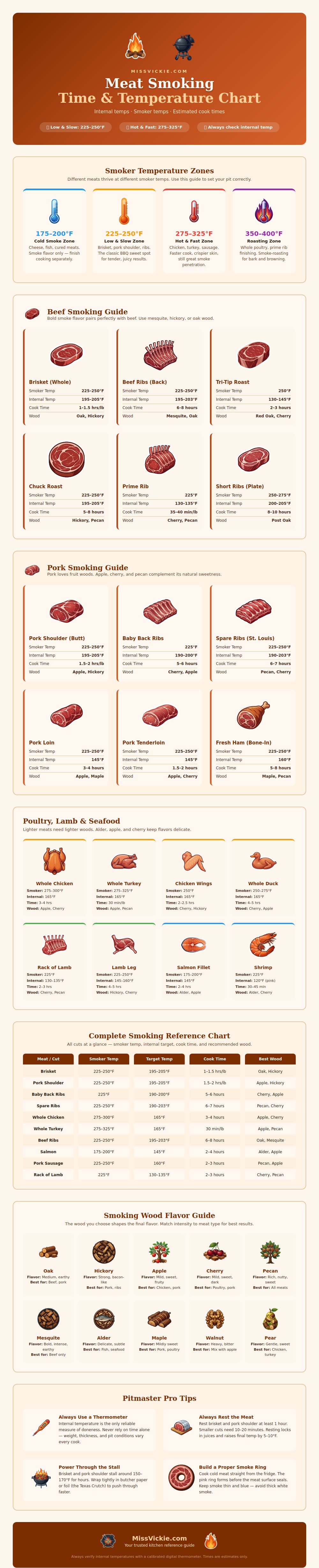
Many people react by opening up the cooker and fanning the flames, which typicaly destroys any hopes of creating bark. That said, as illustrated in the infographic, it’s usually not about adding more heat, but waiting longer or using a wrap to solve the problem.
How to Cook Meat Perfectly on a Smoker
Realizing that internal temperature is more important than the time will get you from being an amateur to a serious cook. For instance, it separates fast cooking methods for poultry from slower, lower-heat methods; pork shoulder and beef brisket has almost exactly the same internal temperature goals (roughly two hundred degrees). Why? Both need time and heat to melt connective tissue into gelatin, which is what create the texture of pulled pork. If you stop too soon, you will end up with a pile of stringy protein fiber.
Temperature isn’t all that matters either, so are wood types. Oak and hickory gives a solid backbone to red meat; milder fruitwood such as cherry and apple add just enough sweetness to complement porks flavor.
Cooking turkey and other poultry can be tricky since you don’t want to treat them like your toughest cuts, as they dry out fast. For this reason, the book recommends using higher temps in the smoker for these birds (sometimes approaching the three hundred mark). Here, you’re looking to develop juicy interiors without breaking down collagen, meaning you want crispy skin more then anything else. So you’ll want to get the birds moving through the “danger zone” sooner but still give them time to soak up some smoke. Lighter woods such as pecan or even applewood are suggested here, with mesquite being too strong for something so delicat as chicken.
Even seafood gets its own dedicated section, emphasizing very low temperatures and mild woods like alder to preserve the natural sweetness of fish.
For starters, avoid the temptation to simply rely on cooking times. That range in the chart is an estimate, until confirmed with a thermometer, that’s just a guess. Depending on how thick the fat is, as well as humidity and wind, a brisket could be ready in 10 hours one day and 14 the next. Use your thermometer to know when the collagen melts; then you’ll know how long it took. And yes: If you pay no attention whatsoever to what your internal reading says and just cook according to the suggested time, you will get a piece of beef that is tough.
Cooking time does not mean it is done; how much heat you use and how thick the meat is determine the time. Insert your probe into the meat farthest from where it was originally suspended (e.g., insert into middle of thick portion, rather than into the bone or around big fat pockets).
When removing from the smoker, the meat must be allowed to rest. Juices are flowing all over the place within the meat’s fibers. If sliced right away, they’ll flow out onto the cutting board and create a dry piece of meat. Letting the meat rest for an hour in a cooler or wrapped in foil lets it reabsorb its own juices and relaxes the fibers. It also allows the temperature to reach a higher point and stabilize.
That nice ring at the outside edge, called a “smoke ring”, is primarily for show, but it shows that there was some good smoke going on during the cook. The thinner the smoke (blue), the better. Thick (white) smoke lays down bitter creosote. Get this right and you would of change barbecues forever. Patience is what makes the fire do its work.