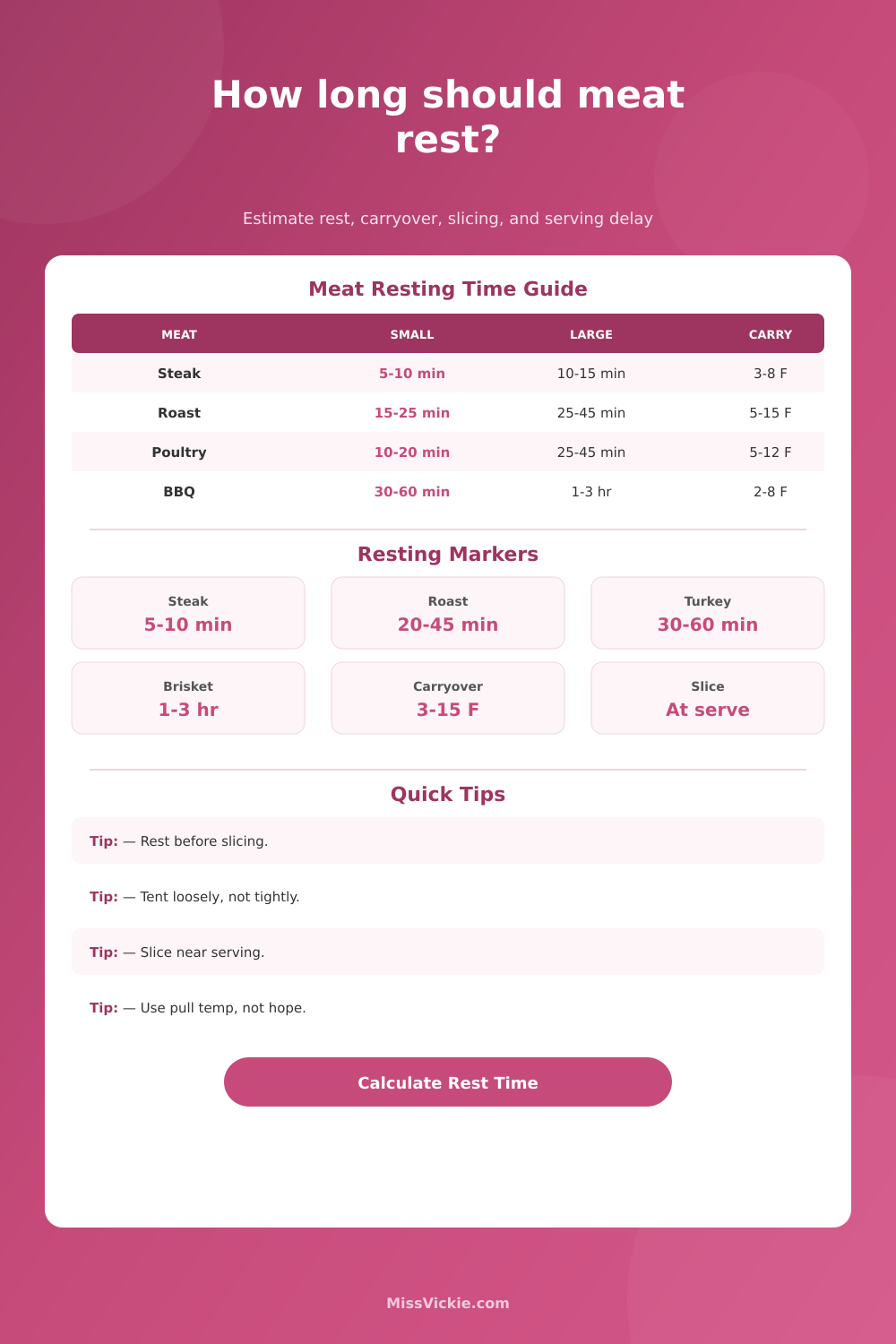
Meat Resting Time Calculator
Estimate meat rest time, carryover temperature, pull temperature, tenting style, slice timing, serving delay, and holding cushion for steaks, roasts, poultry, and barbecue cuts.
🥩 Meat Resting Presets
Choose the closest cook, then adjust weight, thickness, finished temperature, cooking method, carryover, tenting, slicing plan, and serving delay.
⚖ Resting Inputs
Meat resting plan
Your rest, pull temperature, slice timing, and serving window will appear here.
Inputs Used
Resting Adjustment
Service Schedule
📊 Quick Rest Readout
🔥 Tenting And Holding Comparison
Best for crisp steak crust and poultry skin when the room is warm and the rest is short.
Good default for roasts because it slows cooling without trapping too much steam.
Useful for a short delay, but crust, bark, and poultry skin soften faster.
Best for brisket and pork shoulder when the meat must stay hot for a long service window.
📘 Rest Time By Meat Type
| Meat Or Cut | Typical Size | Suggested Rest | Carryover Range | Slice Timing |
|---|---|---|---|---|
| Steak, chop, burger patty | 0.5 to 1.5 lb | 5 to 10 minutes | 3 to 8°F | Slice or serve after rest |
| Thick steak or tomahawk | 1.5 to 3.5 lb | 10 to 18 minutes | 5 to 12°F | Slice at the table |
| Beef roast or lamb roast | 3 to 8 lb | 20 to 45 minutes | 6 to 15°F | Carve close to serving |
| Whole chicken | 3 to 6 lb | 10 to 20 minutes | 5 to 10°F | Carve once juices settle |
| Turkey | 10 to 22 lb | 30 to 75 minutes | 5 to 12°F | Carve near service |
| Brisket or pork shoulder | 5 to 16 lb | 45 minutes to 3 hours | 2 to 8°F | Slice or pull after long rest |
🌡 Pull Temperature And Carryover Table
| Finished Target | Carryover 3°F | Carryover 8°F | Carryover 12°F | Common Use |
|---|---|---|---|---|
| 125°F rare beef | Pull 122°F | Pull 117°F | Pull 113°F | Steak, roast beef |
| 130°F medium rare beef | Pull 127°F | Pull 122°F | Pull 118°F | Steak, prime rib |
| 145°F pork or lamb | Pull 142°F | Pull 137°F | Pull 133°F | Pork loin, lamb |
| 165°F poultry | Pull 162°F | Pull 157°F | Pull 153°F | Chicken, turkey |
| 203°F barbecue | Pull 200°F | Pull 195°F | Pull 191°F | Brisket, pork butt |
🔪 Slicing And Serving Delay Table
| Plan | Best Slice Time | Moisture Risk | Best For | Note |
|---|---|---|---|---|
| Slice at serving | After full rest | Lowest | Steak, roast, poultry | Whole meat holds juice best. |
| Slice 5 minutes early | Rest minus 5 min | Low | Dinner plating | Keep juices on board for serving. |
| Pre-slice platter | After rest, before guests | Medium | Buffet, sandwiches | Cover lightly and sauce if needed. |
| Pull or shred | After long rest | Low | Brisket, pork shoulder | Rest until fibers relax first. |
⏲ Method Effect Table
| Cooking Method | Heat Load | Carryover Tendency | Rest Adjustment | Best Tenting |
|---|---|---|---|---|
| Pan sear or hot grill | High surface heat | Higher | Slightly longer | Uncovered or loose foil |
| Oven roast | Steady dry heat | Moderate | Standard | Loose foil |
| Reverse sear | Low heat plus finish | Moderate | Standard | Loose foil after sear |
| Smoker | Low, long heat | Lower | Longer for large cuts | Foil or cooler hold |
| Sous vide and sear | Even internal heat | Lowest | Shorter | Brief uncovered rest |
💡 Meat Resting Tips
If you cut open a roast right away, what happens? Pressure escapes. Moisture leaks out of the meat. Now why would you want that? Because if you cut it open when the proteins is tight and under pressure, the juices will be pushed outward onto the cutting board, NOT back into the meat where they belong. This means the food will be tough, chewy, and dry.
It’s not a matter of knowing how to cook. It’s a matter of physics. When you heat your meat, the proteins tighten up and squeeze inwardly. When you cut them open, all that juice comes oozing out. But if you give the meat some time to cool down, the proteins will loosens their grip and relax. Then the moisture flows back OUTWARD from the center again … but back into the meat. A few minutes of patience keeps the dish intact.
Why You Must Let Meat Rest Before Cutting
After you input thickness, weight, and cut, the calculator do the math for you. It takes the guesswork out of knowing if food has been off the heat long enough. Carry over cooking is something many cooks forget about until they have ruined their dinner. Roasts, especially dense ones, continue to cook even after they are taken out of oven. The same thing happens with thin steaks, just more slowly.
If you pull your roast at 130 degrees it’s probably going to finish close to 140 degrees depending on how big that roast was. The tool asks for the target final temperature, not the pull temperature. Then it works backwards and tells you when to actualy remove the product from the heat source.
Heat retention, or thermal mass, is more important then most people think. When you sear a thick tomahawk steak, the insides remains hot while the outside has cooled. It won’t reach doneness as fast as a thinner strip steak. Same goes for big roasts. Carryover cooking follows heat retention. That’s why the calculator use thickness and weight to adjust resting times.
Don’t make the mistake of thinking a twelve pound brisket cooks the same as a one pound chop. Big pieces take longer for the core temperature to catch up to the cooler exterior. This results in burnt outsides or raw insides if you don’t account for it. The only solution is to measure it.
Tenting type matters a lot too. For example, loosely draping some foil over the meat reduces cooling without creating steam (which is bad). Wrapping it tightly seals in steam and will soften the skin on cooked poultry or the bark on smoked meats. Just letting it sit uncovered cools the outside quickly while maintaining the crust integrity. It’s laid out clearly on table on the page.
Depending on cut, what you’re aiming for is a balance: How do you preserve texture while holding in heat? For example, if your service delay is long, you need to hold in more heat without destroying the texture. For instance, BBQ brisket can hang in a cooler and be fine because it has another hour or so to go. Smaller roasts can stay in a warm oven. Steaks served right away do best just sitting around uncovered as they rest.
Most plans go wrong with slicing time. If you slice too soon and leave the slices out they’ll dry out. Sliced meat has much more surface area than whole meat. Resting will help keep the moisture in, but it won’t work if you rest it and then don’t use it right away. Ideally, you want to carve right before serving. If you must serve on a pre-sliced platter, covering them slightly will help, but doesn’t solve everything. This is why the tool figures out a delay that includes how long you plan to wait until serving. It can tell you exactly when to begin resting so that food is ready at the exact moment of guest arrival.
There’s also a difference in carryover depending on how you cook it. Sous vide has an even temperature inside, and little risk of carryover. Searing on high heat adds a lot more residual heat to the outside layers. So the calculator takes that into account automatically. All you have to do is pick your style of cooking.
Don’t worry about overcooking something tender like poultry or having rare meat become too rare as the temperature continues to rise while resting. Just hit pull at the perfect moment to end up on target.
Don’t forget poultry. When turkey goes into the oven, it will keep cooking even when the oven door is closed. If you carve too soon, you’ll have dry breast meat. Letting it rest allows the dark meat to stay moist while the white meat settles. Same with pigs and lambs. It’s density that determines how long it takes.
Your clock can help. The calculator provides that guidance, which is derived from actual thermal dynamics. But your thermometer should always trump your clock. Stress is saved by planning ahead. Know your pull temperature. Rest on a timer. Loosely tent. Cut late. Those may sound like no-brainers but they make ordinary meals something better.
Fifteen minutes of patience can be the difference between a juicy piece of meat and a dry roast. There’s nothing fancy required. Just wait. Allow the juices to set. Allow the fibers to relax. Then slice. Sounds counterintuitive when you’re hangry, I get it, but it will work every single time. Waiting allows the meat to hold onto its moisture.