Meat Per Person For Charcuterie Calculator
Plan cured meat portions by guest count, salami, prosciutto, and chorizo mix, slice thickness, roll or fold style, appetizer or meal role, pork-free share, room-temp service time, package trim, and refill buffer.
Choose a cured-meat board setup, then adjust the mix and service details for your table.
Your Cured Meat Plan
Use the calculator to size the meat section of your charcuterie board.
Portion Breakdown
Meat Mix Breakdown
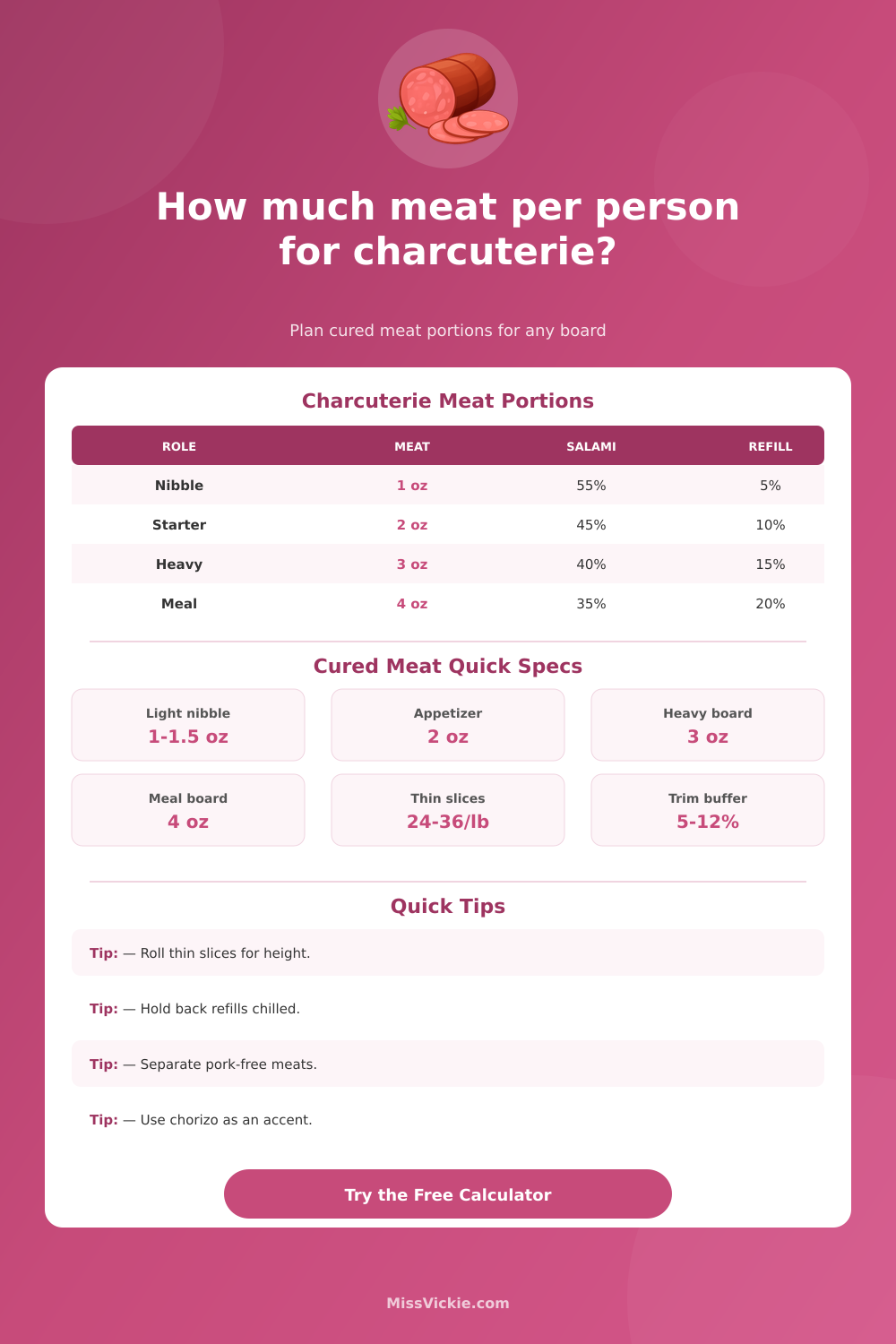
| Board Role | Meat Per Meat-Eater | Best Use | Refill Note |
|---|---|---|---|
| Light nibble | 1 to 1.5 oz | Guests are eating dinner soon | Small refill only |
| Appetizer board | 1.5 to 2.5 oz | Before a meal or with drinks | Hold back 10% |
| Heavy appetizer | 2.5 to 3.5 oz | Several snacks but no plated meal | Hold back 15% |
| Meal-style board | 3.5 to 4.5 oz | Main food with bread and sides | Hold back 20% |
| Reception grazing | 2 to 3 oz | Flowing crowd, mixed appetite | Refill in waves |
| Meat Type | Typical Share | Slices Per Ounce | Board Behavior |
|---|---|---|---|
| Dry salami or soppressata | 35 to 55% | 2 to 4 slices | Stable, easy to fan |
| Prosciutto, speck, or coppa | 25 to 45% | 3 to 5 slices | Best folded loosely |
| Chorizo or firm sausage | 10 to 25% | 2 to 3 coins | Bold flavor accent |
| Bresaola or beef salami | 10 to 30% | 3 to 5 slices | Useful pork-free option |
| Guest Count | Appetizer Meat | Heavy Board Meat | Meal Board Meat |
|---|---|---|---|
| 6 guests | 12 oz | 18 oz | 24 oz |
| 12 guests | 1.5 lb | 2.25 lb | 3 lb |
| 24 guests | 3 lb | 4.5 lb | 6 lb |
| 40 guests | 5 lb | 7.5 lb | 10 lb |
| Service Time | First Layout | Refill Strategy | Food Safety Cue |
|---|---|---|---|
| 1 hour | 85 to 90% | One small refresh | Keep backup chilled |
| 2 hours | 75 to 85% | Refill halfway | Use shallow piles |
| 3 hours | 65 to 75% | Two chilled waves | Refresh exposed slices |
| 4 hours | 55 to 65% | Small frequent trays | Swap trays often |
Balanced salami, prosciutto, and chorizo-style spice.
Softer folds for wine nights and elegant boards.
More firm slices for hearty snack boards.
Use beef salami, bresaola, turkey, duck, or lamb meats.
This calculator sizes cured meat only. Add cheese, crackers, fruit, pickles, nuts, and dips separately so the board stays balanced without underestimating the charcuterie portion.
The calculator builds in a service factor that suggests holding back a portion of meat chilled until halfway through the event if your party lasts two hours. Because guesswork tends to result in either running out or over-serving, it’s important to use a meat portion calculator like this one that does the work for you.
How hungry are your guests? You might end up with too much prosciutto or nothing left at all. How Much Meat? This depends on the role of the board in your meal plan. Is it going to be a small snack at the end of a full dinner course? That would probably only call for 1-ounce per person. Is it going to be the main event? Then significantly more will be required, because those two scenarios require vastly different rates of consumption. A reception table meant to fuel people throughout the night differs from a cocktail hour board. A cocktail hour board is a completely different beast than a reception table which relies on the food to serve as primary fuel. Nail down this difference and avoid the embarrassment of having an empty slate when hungry guest are still searching for substantial eats.
How Much Meat Should You Prepare?
Most meat-and-cheese boards is built around three flavors and textures. Typically that’s a combination of something dry (salami), something folded loosely for volume (prosciutto or speck) and a bolder sausage like chorizo. In the calculator, specify what percentage of your board goes into each category. Why? Because the way those ingredients stack up visually (loose folds for prosciutto for visual volume; fanning out for salami) also affects their holding power. Too much of one texture can result in a flat-looking board no matter how heavy it is. By playing with the percentages, you can control not just taste but interest throughout the party.
It’s not easy when there are dietary concerns, and no one plans for them until it’s too late. If ten percent of your attendees don’t eat pork then you’ll want to carve out a section of turkey or beef salami as well, to avoid contaminating other food with pork. This feature allows you to designate a pork free portion for these kinds of people. That way they still get their fair share of meat without taking away from the overall supply. It is a simple act in logistics, but it demonstrates attention to detail that goes beyond haphazardly piling up some meat.
The least addressed consideration when building a board is service time. Even if it’s a 2-hour party, don’t leave all the meat out; it’ll warm to mushiness and lose flavor over time. Using a service factor, the calculator recommend chilling some meat back until midway through the event. This keeps the board looking good, prevents the ends of the meat slices from drying out or going slimy, and provides extra meat for refills in case of last-minute arrivals or people wanting seconds.
Interestingly enough, perception of plenty depends on slice thickness. You need more weight to make paper-thin deli slices look like a pile than you do with thick hand-slices or small round or stick-shaped pieces. If you’re working with fragile deli slices, the tool will adjust to match. Heavier cuts makes for a more filling meal (think: thicker slices). And you may end up needing less overall weight. How would you like to serve it? Delicate, or robust? Consider this when deciding between preparing multiple thin cuts or fewer thick ones.
There’s also the issue of trim waste with packaged cured meats. Because there are end pieces and slices that is either too thick or thin for presentational purposes, there’s no way you can use every last bit of the stick. A trim percentage allows you to purchase sufficient product so that what remains will ultimately fit into the space once the unusable parts are discarded. It may sound like nothing, but those wasted ends add up fast on a big order. Planning for it up front will ensure that when you’re ready to lay things out, you don’t end up with an empty-looking layout at the end.
While choosing items for your charcuterie board matters, so does pacing. You don’t want to fill people up too quickly by making one item the focus. You also don’t want too many things going on. It’s all about striking the right balance between texture, thoughtful refill options, and meat portioning. This creates something that will hold their attention throughout the meal without overwhelming their palates before they’ve even had a chance to start. Because a well-curated charcuterie board isn’t just filling, it should of been a conversation starter, and you need just enough (but not too much) to ensure that happens.