Meat Freezer Shelf Life Calculator
Estimate best-quality freezer time for beef, pork, lamb, poultry, and ground meat using cut size, fat level, wrapping style, freezer temperature, freeze date, thaw plan, and serving goal.
🥩 Meat Freezer Presets
Choose a package style close to what is in your freezer, then adjust the date, temperature, wrapping, thickness, fat level, and planned thaw method.
⚖ Freezer Package Details
Your Freezer Quality Window
A package-specific freezer plan will appear here.
Package Inputs
Timing Breakdown
Use Plan
- Calculate to see package guidance.
📊 Freezer Quality Markers
📋 Raw Meat Freezer Reference
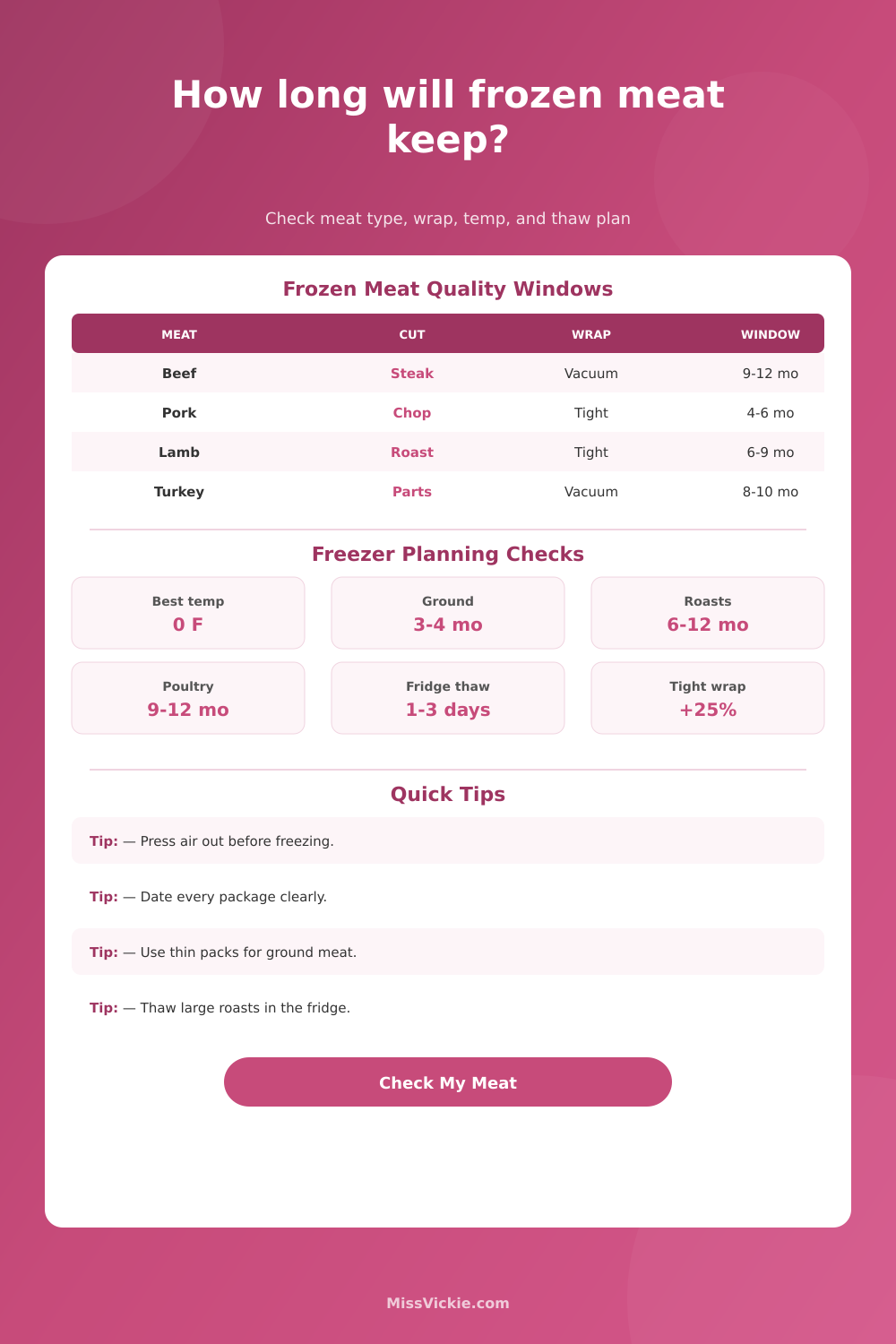
| Meat Type | Typical Cuts | Best-Quality Window | Notes For Texture |
|---|---|---|---|
| Beef steaks | Ribeye, strip, sirloin, tenderloin | 6 to 12 months | Vacuum sealing helps protect exposed edges and marbling. |
| Beef roasts | Chuck, round, brisket, rib roast | 6 to 12 months | Large pieces hold quality better than thin slices. |
| Pork chops | Chops, tenderloin, cutlets | 4 to 6 months | Lean pork dries faster if wrapped loosely. |
| Pork roasts | Shoulder, loin, ribs, belly portions | 4 to 12 months | Fatty cuts need tighter wrapping to limit stale flavors. |
| Lamb cuts | Chops, stew pieces, leg, shoulder | 6 to 9 months | Strong aroma can increase when air reaches fat. |
| Poultry | Whole birds, breasts, thighs, wings | 9 to 12 months | Skin and bone protect some pieces, but tray wrap is weak. |
| Ground meat | Ground beef, pork, lamb, turkey, sausage | 3 to 4 months | More surface area means faster quality loss. |
| Cooked meat | Roast slices, shredded meat, cooked poultry | 2 to 6 months | Sauce or broth improves texture after reheating. |
These are quality windows, not a safety promise. Meat kept continuously frozen stays safer than thawed meat, but flavor and texture still change over time.
🧊 Packaging And Temperature Adjustments
| Storage Factor | Better Choice | Riskier Choice | Calculator Effect |
|---|---|---|---|
| Wrap contact | Vacuum pouch or tight double wrap | Loose tray film with air pockets | Can add or remove several weeks of good quality. |
| Freezer reading | 0°F or below | Above 5°F with frequent door opening | Warmer storage shortens the target window. |
| Piece size | Thick roast, whole bird, compact pack | Thin chop, loose ground pack, exposed edges | Small pieces lose moisture and aroma faster. |
| Fat level | Lean trim, minimal exposed fat | Fatty sausage, skin-on pieces, belly cuts | Higher fat slightly reduces best-flavor time. |
| Thaw plan | Covered refrigerator thaw | Microwave thaw with delayed cooking | Cook timing after thaw becomes tighter. |
⏱ Thaw Planning Reference
| Package Style | Refrigerator Thaw | Cold-Water Thaw | Cook Timing After Thaw |
|---|---|---|---|
| Thin steaks, chops, cutlets | 8 to 18 hours | 30 to 90 minutes | Cook within 1 to 2 days. |
| Ground meat brick | 12 to 24 hours | 45 to 120 minutes | Cook within 1 day for best texture. |
| Poultry pieces | 18 to 36 hours | 1 to 3 hours | Cook within 1 to 2 days. |
| Large roast or whole bird | 1 to 4 days | Several hours, water changed often | Cook once thawed through. |
| Cooked sliced meat | 8 to 24 hours | Usually not needed | Reheat gently once thawed. |
🧾 Freezer Stash Comparison Grid
Ground meat, sausage, and thin patties have the shortest best-quality window.
Large beef or lamb roasts usually keep texture longer when tightly wrapped.
Removing air is the biggest improvement for long freezer storage.
Original store wrap is fine for short storage but weak for several months.
📘 Meat Category Planning Table
| Category | Best For Freezer Rotation | Check Before Cooking | Good Cooking Use Near Limit |
|---|---|---|---|
| Beef steaks | Label by cut and thickness | Dry pale spots on edges | Marinated grill, skillet sauce, steak bites |
| Pork | Separate chops in flat layers | Gray edges or stale fat smell after thaw | Braise, stew, pulled pork, sauced roast |
| Lamb | Wrap fat surfaces closely | Strong fat aroma after thaw | Slow roast, curry, tagine, stew |
| Poultry | Freeze pieces in meal-size packs | Ice crystals under loose skin | Soup, casserole, braise, shredded filling |
| Ground meat | Flatten to thin, dated packs | Large ice pockets or sour odor after thaw | Chili, meat sauce, meatballs, patties |
💡 Freezer Rotation Tips
Without some sort of rotation system, most people’s home freezer turns into a graveyard of forgotten protein. During a sale, you bag up that big ol’ pork shoulder, stick a date on it, and cross your fingers. Guess what? Hope is not a form of preservation.
Generally speaking, the problem isn’t so much about food safety, as food are safe at zero degrees Fahrenheit and colder. Instead, it is about degradation. Air touching meat ruins the flavor and texture over time. But how does it work? The calculator on this page takes all of that into account. It look at your freezer condition, your freeze date, thickness of package, the cut type, and fat content to calculate a quality window.
How To Keep Meat Fresh In The Freezer
For example, vacuum-sealed beef steak will hold for as much as a year; ground meat, however, may only stay good for three to four months. Taking those baselines and adjusting them based off your freezer temperature and wrapping method makes sense, since freezer paper outlasts grocery store plastic wrap well before a vacuum bag would. That’s not good; air is the enemy of frozen foods. That air leads to freezer burn… That unpleasant grayish white damage, and it indicates that your food have lost moisture.
Choosing a packaging type in calculator means you’re informing the algorithm about your ability to seal out that air. If you vacuum seal, nearly none remains, and you gain a lot more time in prime quality period. If you loosely wrap, then ice crystals turns into gas away from the outer meat surface, only to refreeze on other spots within the bag. Tough, dry fiber awaits you at the end of that process, so know the tradeoffs before deciding if it’s worthwhile to rewrap older packs with something sturdier.
Fat behaves different than lean muscle tissue. For example, fat on lamb roasts or even a belly of pork will pick up airborne old tastes faster then a lean meat such as tenderloin. To compensate for that the calculator’s estimate shorten the shelf-life window somewhat for very fatty combinations. Because you don’t want odor (or moisture) to be absorbed in sausage, which is also true of ribeye steaks, etc. That are wrapped. You need something between it and the air to keep out both.
Freezer temperature: The warmer the freezer (above zero), the quicker the decline. Consistent cold beats periodic deep freezes. Surprisingly, thawing also affects perceived quality. Slowly thawing a big roast over days in the fridge maintains a safe temperature during defrost but also allows the meat return to a cookable state. Thawing in microwave might cause the outside of the meat to begin cooking before the inside has thawed, leaving an uneven texture. The calculator takes into account how you will thaw the meat, and adjusts accordingly.
Want to grill a steak for friends? That’s one thing. Plan to braise the meat in a sauce? You can stretch the quality window even longer. Texture problems becomes less noticeable under a saucy covering than they would on an otherwise plain cut.
Ground meat deserves special mention. With all that exposed surface area, ground meat is less likely to keep a long time even when frozen. Because it has been ground, it’s exposed to bacterial growth for longer pre-freeze, meaning it won’t last as long post-freeze. Be prepared to use your ground meats (beef, turkey) sooner than you think they’ll last.
Flatten them into bricks before freezing so they are easier to fit in the freezer and quicker to defrost. If you freeze a brick of ground meat too thick, it will take forever to warm up in the fridge, spending extra time in the danger zone more than needed. Thinner packs will defrost quicker and also is cooked more evenly.
The #1 thing: Write the date on each package when it goes into the freezer. That way, there’s no guessing about that mysterious bag from last year. Use the calculator as a guide, but you must make the ultimate judgment. Your nose and your eyes. When thawed, if something seems off smelling-wise or looking dry, it’s time to go.
Quality is best when frozen fresh. Invest in good stuff first, then stash it. Think of your freezer like a pantry. It’ll save you money, prevent waste from having to go out for more, and simplify dinner time.
Invest in good stuff first, then stash it. Your dinners will be as close to fresh as possible for months to come. You should of used the calculator earlier. Actualy, the moddern way is much easier.