Daily calories, macros, snacks, leftovers, batch servings, and prep days
Meal Plan Calorie Calculator
Turn a calorie target into meal calories, snack calories, macro grams, prepared portions, leftover meals, and batch counts for a practical weekly meal plan.
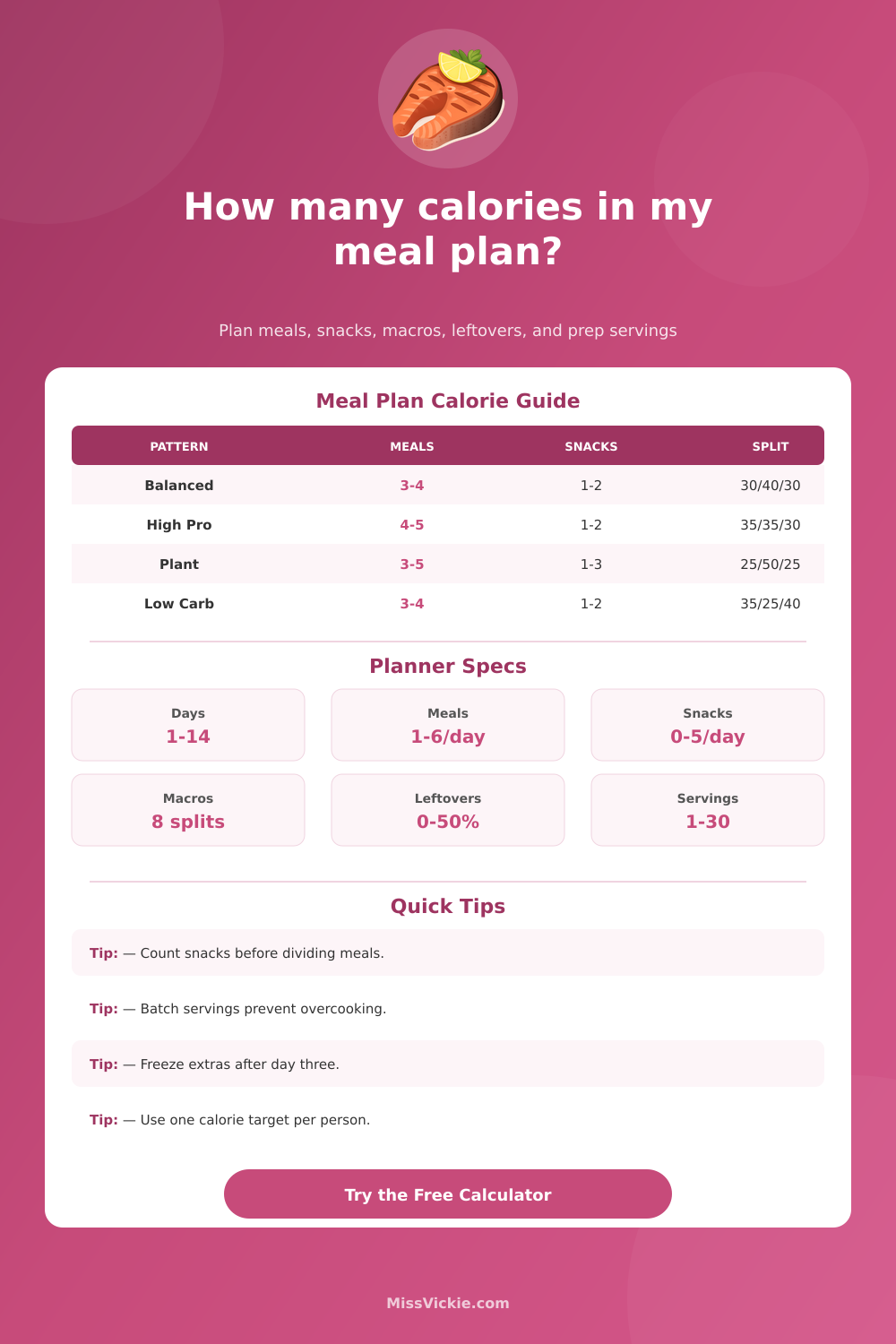
Choose a starting pattern for the week, then fine-tune calories, snacks, macro split, leftovers, and how many servings each prep batch makes.
Meal Plan Breakdown
Spreads calories across cooked meals with a modest snack allowance.
Works well when snacks are planned and meals need to stay smaller.
Keeps more calories available for meals around workouts or active days.
Adds leftovers and batch counts so prepared portions do not run short.
| Daily Target | 3 Meals + 1 Snack | 3 Meals + 2 Snacks | 4 Meals + 1 Snack | Best Use |
|---|---|---|---|---|
| 1600 calories | 483 per meal | 433 per meal | 362 per meal | Light meal prep or smaller appetites |
| 2000 calories | 617 per meal | 567 per meal | 462 per meal | Balanced weekly prep for many adults |
| 2400 calories | 750 per meal | 700 per meal | 562 per meal | Active weeks or larger portions |
| 2800 calories | 883 per meal | 833 per meal | 662 per meal | Training weeks or high-energy jobs |
| Split | Protein | Carbs | Fat | Planning Note |
|---|---|---|---|---|
| Balanced | 30% | 40% | 30% | Easy to portion with protein, grain, vegetables, and fat. |
| Lean | 35% | 40% | 25% | Raises protein without making carb portions too small. |
| Training | 25% | 55% | 20% | Best when rice, pasta, potatoes, oats, or fruit are planned. |
| Low carb | 35% | 25% | 40% | Uses larger protein and fat portions with more non-starchy vegetables. |
| Plant-forward | 25% | 50% | 25% | Works with beans, lentils, tofu, grains, and vegetable-heavy bowls. |
| Servings Per Batch | 20 Meals | 35 Meals | 50 Meals | Useful For |
|---|---|---|---|---|
| 4 servings | 5 batches | 9 batches | 13 batches | Small skillet meals and fresh lunches |
| 6 servings | 4 batches | 6 batches | 9 batches | Sheet-pan dinners and rice bowls |
| 8 servings | 3 batches | 5 batches | 7 batches | Soup pots, casseroles, and family trays |
| 12 servings | 2 batches | 3 batches | 5 batches | Freezer meals and large batch cooking |
| Plan Length | Leftover Add-On | Fridge Share | Freezer Share | Storage Note |
|---|---|---|---|---|
| 1 to 3 days | 0 to 8% | Most portions | 0 to 10% | Keep sauces and crisp items separate. |
| 4 to 5 days | 8 to 15% | First 3 days | 15 to 30% | Freeze later meals if texture allows. |
| 6 to 7 days | 12 to 20% | First 3 to 4 days | 30 to 50% | Label portions by meal and date. |
| 8 to 14 days | 15 to 30% | Rotating meals | 50% or more | Use freezer-friendly recipes and batch in waves. |
Meal planning begin when a person determine the number of calorie they would like to consume each day. However, meal planning becomes more complex when a person must account for snacks, leftovers, the number of peoples that will be eating the meals, and for how many planning day the meals will be prepared. The macro calculator will mathematically calculate the number of food container required based off the number of calories that a person would like to consume each day, the number of people that will be eating the meals, for how many planning days the meals will be prepared, and the number of meals and snacks that will be prepared during each planning day.
A persons daily calorie target represent the average number of calories that they require each day, a number that include the calories that they will consume with snacks. The snack calories will first be subtracted from the total daily calorie target to determine the number of calories that will be allotted to each meal that is to be prepared. By allocating more calories to snacks, there will be fewer calories available for each meal.
Plan Meals and Count Food Containers
The number of people that will eat the prepared meals and the number of planning days are two separate variable that will work together to calculate the total number of servings of food that will need to be prepared. The more people or the more planning days that there are, the more total servings of food that will be required. The number of people that will eat and the number of planning days will be multiplied together to create a base number of servings.
The number of meals that are to be prepared each day and the number of snacks that are to be eaten each day can create a tradeoff between the size of each meal. The fewer meals that are prepared each day, the more calories that will be contained within each of those meals. The more meals that are prepared each day, the fewer calories that will be contained within each of those meals.
The pattern selector within the calculator allows a person to adjust the meal and snack sizes to reflect these different choice. Macro splits allow for a person to allocate their calories to protein, carbohydrates, and fat. Each of these nutrient serves a different purpose within the body, and as such, they are not interchangeable.
A higher-protein macro split will require a person to prepare foods that contain more protein than a macro split that is higher in carbohydrates or fat. The same is true for a macro split that is higher in carbohydrates or fat than one that is higher in protein. The person will apply the macros to each meal that is to be prepared to ensure that each meal contains the same number of gram of protein, carbohydrates, and fat.
The inclusion of the percentage for the number of meals that will be left overs and the prep buffer will account for the varying appetite that a person may have, as well as provide extra servings in case a person would like to have an additional portion of food that is prepared for eating. Leftovers provide extra servings in case a person does not have time to prepare a meal at the start of the day. Both of these variable are incorporated into the total number of servings that the person will prepare.
The number of servings that will be prepared within each batch of a recipe can impact the time required for meal planning. The more servings that are prepared within each batch, the fewer cooking session that will be required to prepare meals for the number of people that will eat those meals. Additionally, the style in which the meals will be contained in containers can impact meal planning.
Single containers hold less food than shared family tray. The calculator will update these variables to allow a person to determine if there kitchen is sufficient for meal preparation according to the meal plan that is create by the calculator. A persons choice regarding the storage of meals will be based on the numbers that are produced by the calculator.
The shorter the meal plan, the more meals that can be stored in the refrigerator. A longer meal plan will require the prep of meals that can be stored in the freezer. The storage reference table will allow a person to determine the length of time that meals should be frozen.
Additionally, a person may need to decide if certain food must be stored separately from other food in the meal to ensure that the food maintain its quality. While the calculator can create the number of food containers that are required to meet the demand of a persons meal plan, the calculator cannot determine whether a person will find the meals prepared interesting enough to eat. A meal that contains the same protein and grain each day may become boring for the person that prepare the meals.
To avoid boredom, a person may rotate the types of meals that are prepared throughout the week. A person may need to change the meal plan in the middle of the week due to social or other unexpected event. To change the number of calories that are consumed by a person, the number of calories that are allocated to snacks can be reduced.
Because the number of calories for snacks is calculated separately from the calories that are allocated to meals, only the meal will need to be recalculated. The calculator allows a person to determine the number of food container that are required to create a meal plan that meets a persons requirement. Once the number of food containers are equal to the number of people that will eat the meals, the number of planning days, and the eating pattern that the person would like to utilize, the meals can be prepared.
Alot of work goes into this process, and you’ll see that the results are worth it. It is more better to plan ahead than to wing it.