Protein, carbs, fats, vegetables, oil, sauce, servings, and cooked yield
Meal Calorie Calculator
Estimate the calories in a homemade meal by choosing the protein, carb, fat, vegetable portion, cooking fat, sauce, serving count, and cooked yield.
Start with a common plate or batch style, then adjust the portions, oil, sauce, and yield to match the meal you actually cooked.
Meal Calorie Breakdown
| Protein | Calories Per 100g | Protein Per 100g | Typical Cooked Portion | Yield Note |
|---|---|---|---|---|
| Chicken breast | 165 kcal | 31g | 120 to 180g | Lean meat loses water during cooking. |
| Lean ground turkey | 170 kcal | 29g | 120 to 180g | Drain consistently for repeatable logging. |
| Lean ground beef | 217 kcal | 26g | 100 to 170g | Fat level changes calories quickly. |
| Salmon fillet | 206 kcal | 22g | 120 to 180g | Higher natural fat than white fish. |
| Shrimp | 99 kcal | 24g | 120 to 200g | Low calorie protein with high yield. |
| Tofu | 144 kcal | 17g | 120 to 220g | Pressing removes water but not calories. |
| Ingredient Group | Example | Calories Per 100g | Common Portion | Planning Note |
|---|---|---|---|---|
| Cooked rice | White or brown rice | 123 to 130 kcal | 120 to 220g | Use cooked weight for plate calories. |
| Potatoes | Roasted or baked | 90 to 93 kcal | 150 to 300g | Added oil belongs in the oil field. |
| Cooked pasta | Plain pasta | 158 kcal | 140 to 260g | Sauce can add more than the pasta expects. |
| Vegetables | Broccoli, greens, salad | 17 to 45 kcal | 120 to 300g | Vegetables add weight more than calories. |
| Avocado | Fresh avocado | 160 kcal | 30 to 80g | Useful fat add-in for bowls and salads. |
| Cheese or nuts | Cheddar, almonds | 403 to 579 kcal | 15 to 40g | Small weights can add many calories. |
| Add-In | Serving Basis | Approx Calories | What To Watch |
|---|---|---|---|
| Olive or canola oil | 1 tsp, about 4.5g | 40 kcal | Count only the absorbed or served oil. |
| Butter | 1 tsp, about 4.7g | 34 kcal | Butter includes some water and milk solids. |
| Cooking spray | 1 second spray | 8 kcal | Long sprays can count like oil. |
| Salsa or marinara | 30g | 9 to 15 kcal | Low calorie but still counts in batches. |
| Ranch or vinaigrette | 30g | 130 to 145 kcal | Dressing can dominate salad calories. |
| Peanut sauce | 30g | 90 kcal | Often combines fat and sugar. |
| Cooking Result | Yield Setting | Calorie Effect | Density Effect | Example Meal |
|---|---|---|---|---|
| Soupy or saucy | 100 to 115% | Total calories stay the same | Lower kcal per 100g | Stew, chili, saucy pasta |
| Normal plate | 88 to 98% | Total calories stay the same | Moderate kcal per 100g | Rice bowl, skillet meal |
| Roasted tray | 70 to 88% | Total calories stay the same | Higher kcal per 100g | Sheet pan chicken and veg |
| Reduced sauce | 60 to 80% | Total calories stay the same | Much higher kcal per 100g | Curry, pan sauce, glaze |
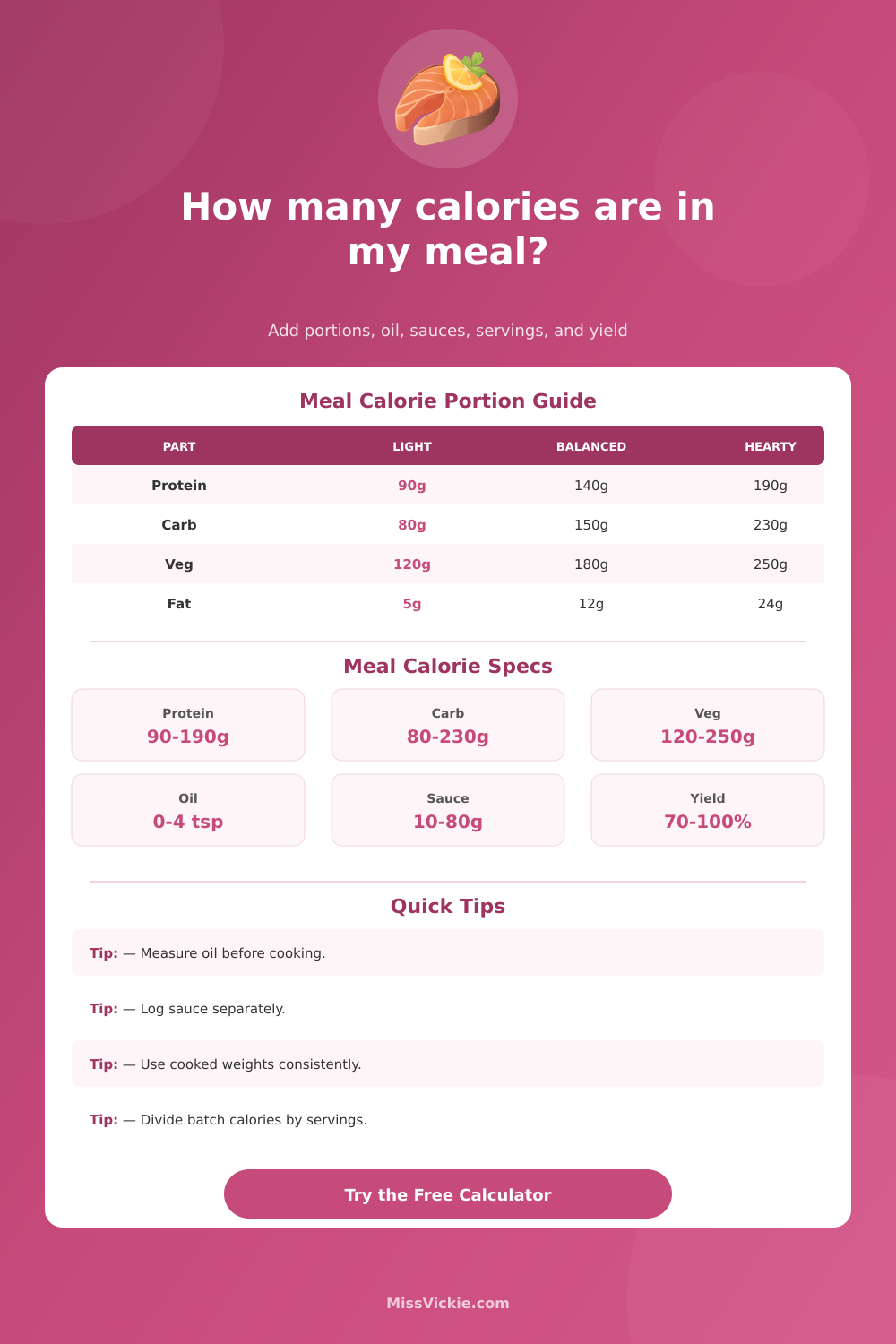
More protein and vegetables, less oil, lighter sauce, and a modest starch portion.
A measured protein, starch, vegetables, small fat add-in, and one sauce portion.
Larger protein and starch portions with more oil, cheese, nuts, or dressing.
Calories depend on the sauce base and how much fat stays in the finished dish.
When you cook food at home, there is often a difference between the calorie counts that you find for a finished meal and the calorie count that are represented in the nutrition label for that meal. The reason for this difference is because of the evaporation of the moisture from the food during the cooking process, because of how the food often absorbs the oil in an unequals manner, and because the portion of the food that you serve may not be the same as the portion that was measured prior to cooking. Thus, due to these three reason, there is often a mismatch between the calories that you think you ate and the calories that actualy came from the meal.
Many people find it frustrating to track calories due to these issues. The inputs in the calculator are each the different variables that change when heat is applied to the food. For instance, each of the variables for the protein, starch, and vegetables should be the weight of that component of the meal after it has been cooked.
Why cooked food has different calories
The amount of cooking fats should be entered, such as oil or butter, that was added to the pan to cook the meal, but the amount of that fat that remained within the food itself should also be entered separately. These separate calories for sauces should also be entered into the calculator, as well as the yield percentage. The yield percentage account for the water that evaporates during roasting, for instance, or the liquid that remains within a meal such as curry.
These different inputs allow the tool to calculate the number of calories per serving of the meal, as well as a density of the meal. The density of the meal indicates whether it is considered to be a light meal, a moderate meal, or a hearty meal, based off the weight of the meal that has been cooked. Many of the decisions that are made in the kitchen have the potential to impact the total number of calories that are contained within a meal.
For instance, adding oil to a meal can increase the calories; a teaspoon of oil contains roughly forty calories, and most of that oil will remain within the food if the food was prepared through stir-fry techniques. Additionally, adding sauce to a meal can increase the calories; the sauce may be light in flavor, but it can contain one hundred calories in a few spoonfuls of the sauce. Furthermore, vegetables can be added to a meal to increase the feeling of fullness after eating, and because vegetables contains very few calories.
These variables are accounted for in the calculator. One of the most common error that home cooks make is treating the raw ingredient weights as if they are the finished weights of the ingredients after they were cooked. For instance, if raw chicken breast is grilled, the chicken will lose some of its moisture.
A portion of 150 gram of raw chicken breast may weigh 120 grams of cooked chicken breast. Thus, if the home cook enters the raw weight of the chicken breast into the calculator, the calories will be understated. The yield percentage allows for this error to be corrected.
A lower percentage can be utilized in a recipe that features roasting, when the ingredients lose some of their water weight, or a higher percentage can be used for meals that retain the liquid weight of the food. Thus, this percentage is the most likely to change if the home cook adjusts the recipe. Another of the common errors is the difference between the oil that is added into the pan in which the meal is prepared versus the oil that is absorbed by the food.
If oil is added into a pan, the oil may remain in the pan after the meal is plated; it should not be counted in the total number of calories of the meal. Thus, the oil percentage allows for this to be accounted for in the calculation of the meal’s calories. The same percentage can be used in meals that are prepared in batches.
For instance, if a batch of chicken and vegetables is cooked in the batch, the total calories will be the same regardless of how many portion of that batch are prepared. However, the calories are distributed differently within the batch depending upon the portion of the batch that is used. The settings for lean meals, hearty meals, and plant-forward meals allow for each meal that is prepared in the kitchen to be adjusted to reflect the way in which that meal was cooked.
For instance, if the meal includes alot of fat, a hearty meal setting can account for that. A lean meal will reduce the contribution of fat calories to the meal. A hearty meal setting allows for the inclusion of oil or cheese in the meal.
Additionally, a plant-forward meal features ingredients like beans, tofu, or vegetables in place of protein, and does not require the cooks to enter the gram of each ingredient. These adjustments may seem small, but they help to indicate how many calories were within the meal that was cooked. One of the most useful habits for individuals to develop is to be consistent in the way that each individual weighs the food that they prepare for themselves.
If an individual decides that they will weigh the raw ingredients or the finished, cooked meals, they should continue to use that variable in all meals that is cooked. For instance, if an individual prepares a meal that includes sauce, they should weigh the finished meal after the sauce has been stirred into the food. Additionally, if an individual prepares a batch of food, they should calculate the calories for the entire batch first, weigh the batch of cooked food, then divide that weight by the number of portions of the food that are prepared from that batch.
These steps will reduce the number of errors that an individual may make when logging their meals with the calculator. Another of the factors that can affect an individual’s feelings after eating is the portion size of the meal. For instance, a portion of five hundred calories may contain alot of vegetables and protein; the portion may appear large.
However, the same portion of five hundred calories that contains alot of cheese and nuts may appear to be small. These perceptions are correlated with the density of the meal; the density of the meal is calculated based upon the weight of the meal itself. Thus, understanding the density of the meal is more important than the total number of calories within the meal.
Over time, individuals will begin to recognize the patterns within their eating habits. For instance, meals that contain roasted vegetables and lean protein will contain fewer calories per gram of food than meals that contain alot of cheese. Additionally, meals that contain fat and sugar will have a higher density of calories than meals that do not contain those ingredients.
Thus, individuals will begin to be able to recognize these ingredients and account for their calorie content before they even add the ingredients to the meal. Thus, the goal is not perfect accuracy in logging the calories for each meal that is cooked. However, there should be enough accuracy to the number of calories in each meal that the individual’s plans regarding the meals that are prepared are not undermined.