🍯 Mead Priming Sugar Calculator
Calculate the exact amount of priming sugar for perfectly carbonated mead
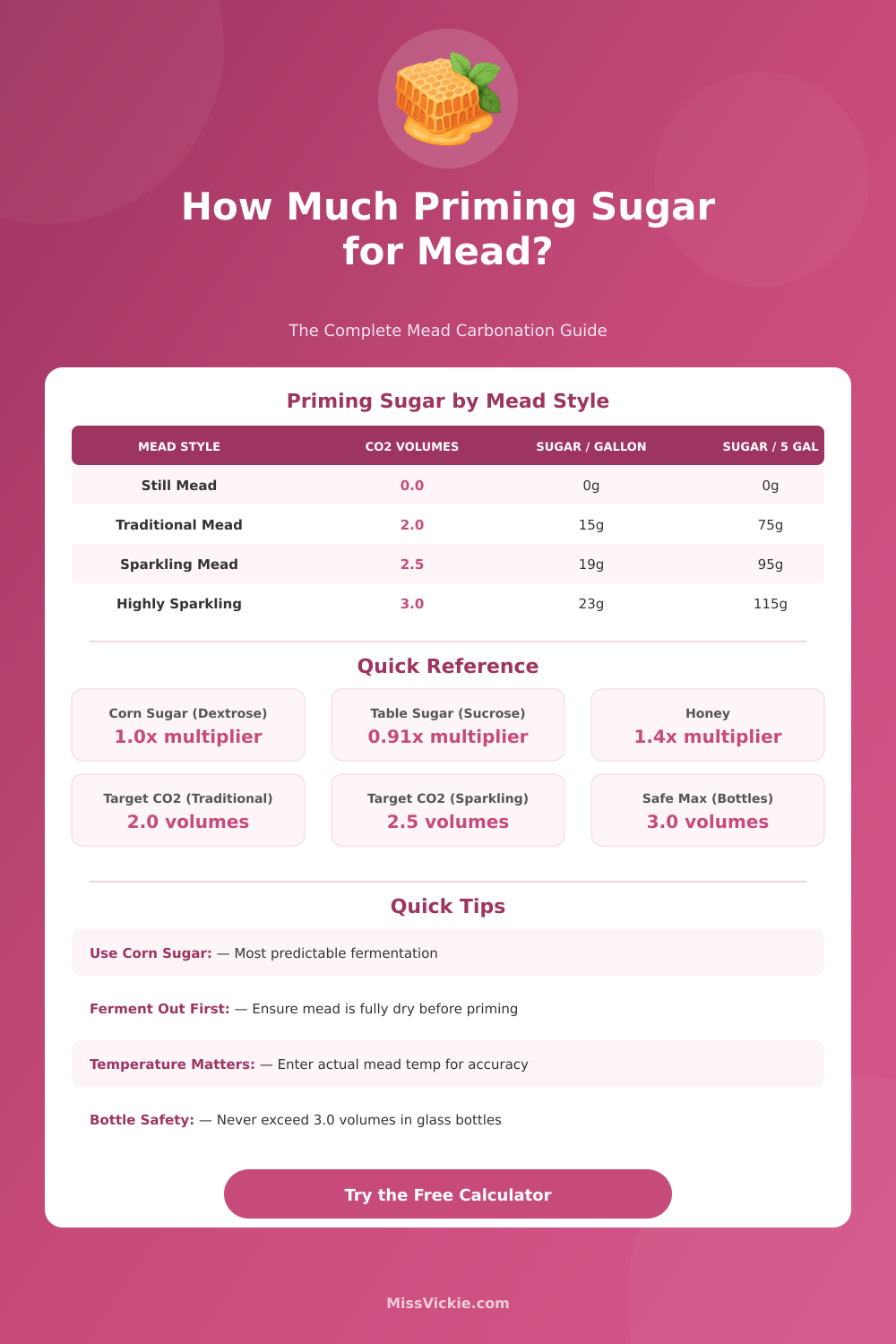
| Batch Size | Sugar (grams) | Sugar (oz) | Approx. Tsp |
|---|---|---|---|
| 1 gallon (3.8 L) | 14g | 0.5 oz | 3 tsp |
| 3 gallons (11.4 L) | 43g | 1.5 oz | 9 tsp |
| 5 gallons (18.9 L) | 72g | 2.5 oz | 15 tsp |
| 6 gallons (22.7 L) | 86g | 3.0 oz | 18 tsp |
| 10 gallons (37.9 L) | 144g | 5.1 oz | 30 tsp |
| Sugar Type | Amount (grams) | Amount (oz) | Notes |
|---|---|---|---|
| Corn Sugar (Dextrose) | 72g | 2.5 oz | Most predictable; standard reference |
| Table Sugar (Sucrose) | 65g | 2.3 oz | Slightly less by weight; works well |
| Honey (Raw) | 101g | 3.6 oz | ~71% fermentable sugars; use by weight |
| Dry Malt Extract | 89g | 3.1 oz | ~80% fermentable; adds slight flavor |
| Turbinado / Raw Sugar | 67g | 2.4 oz | Similar to table sugar; trace minerals |
| Temperature | Residual CO2 (vol) | Effect on Priming |
|---|---|---|
| 32°F (0°C) | 1.72 vol | Much less sugar needed |
| 45°F (7°C) | 1.33 vol | Less sugar needed |
| 55°F (13°C) | 1.07 vol | Slightly less sugar needed |
| 65°F (18°C) | 0.84 vol | Near typical priming baseline |
| 68°F (20°C) | 0.77 vol | Standard reference temperature |
| 75°F (24°C) | 0.66 vol | Slightly more sugar needed |
| 80°F (27°C) | 0.58 vol | More priming sugar required |
Mead; also called honey wine (is simply fermented honey with water). Here is the base, at least. You add extra ingredients, like fruits, spices, grains or hops, to create interesting variations.
The alcohol level ranges between around 3.5% and even more than 18% according to the amount of honey used. For the most basic recipe you require only three things: honey, water and yeast. Mix them, let the fermentation work and result in a nice golden drink full of taste
What is mead and how is it made
This drink probably belongs to the oldest alcoholic drinks that folks have prepared. Archaeologists found traces of mead-like drinks in burial rooms, also one bound to King Midas, that date back almost 8,000 years. For a long time it stayed almost unknown.
You met it chiefly in medieval fairs or historic reconstructions, nowhere else. Now everything changed: it gets big popularity. Folks that want to go away from the same old beers and seltzers, turn to it attentivly.
Meaderies appear everywhere in the land, from little shops to big commercial companies.
Here where mead becomes especially interesting compared to wine and beer. It uses the natural sugars from honey for fermentation, while wine uses fruit sugars and beer uses malted grains. Although you call it „honey wine”, actual wine it is knot, simply a wrong name.
Same you can not say about wines fermented with honey, that some people call mead. They are not. Mead is similar to wine in production methods and alcohol strength.
Even as a drink it is like wine, especially because of the high ABV. Note: it costs too much more to produce than wine.
You can prepare mead still, carbonated or sparkling. The taste ranges from dry to semi sweet or entirely sweet. Adding fruit during the first fermentation is a classic mode for fruit meads.
Fruits deliver nutrients that honey alone does not have, and that helps the fermentation. Changing the sugar initially is genuinely easy. For one pound of honey in a gallon?
Simply add it. Two pounds? Do that.
The serving size depends on the kind of mead. Mild, in beer-high strength, works well for a 12-ounce glass. Medium meads between 8 and 15 % ABV fit better in a wine or whiskey glass, in around four ounces.
A normal five-ounce pour suits 12-percent mead. Strong specialities require smaller three-ounce parts. Sparkling meads work well cooled to around 45 degrees in a wine glass, especially if more than 8 % ABV.
You also can serve them a bit chilled or with ice, if you like. For pairings it works well with salty foods (olives), roasted nuts, seafood, smoked salmon or tangy goat cheese. Even in the kitchen it works as an ingredient, substituting white wine for dishes like mussels pasta.