🍯 Mead Nutrient Calculator
Calculate TOSNA & staggered nutrient additions for Fermaid-O, Fermaid-K, and DAP
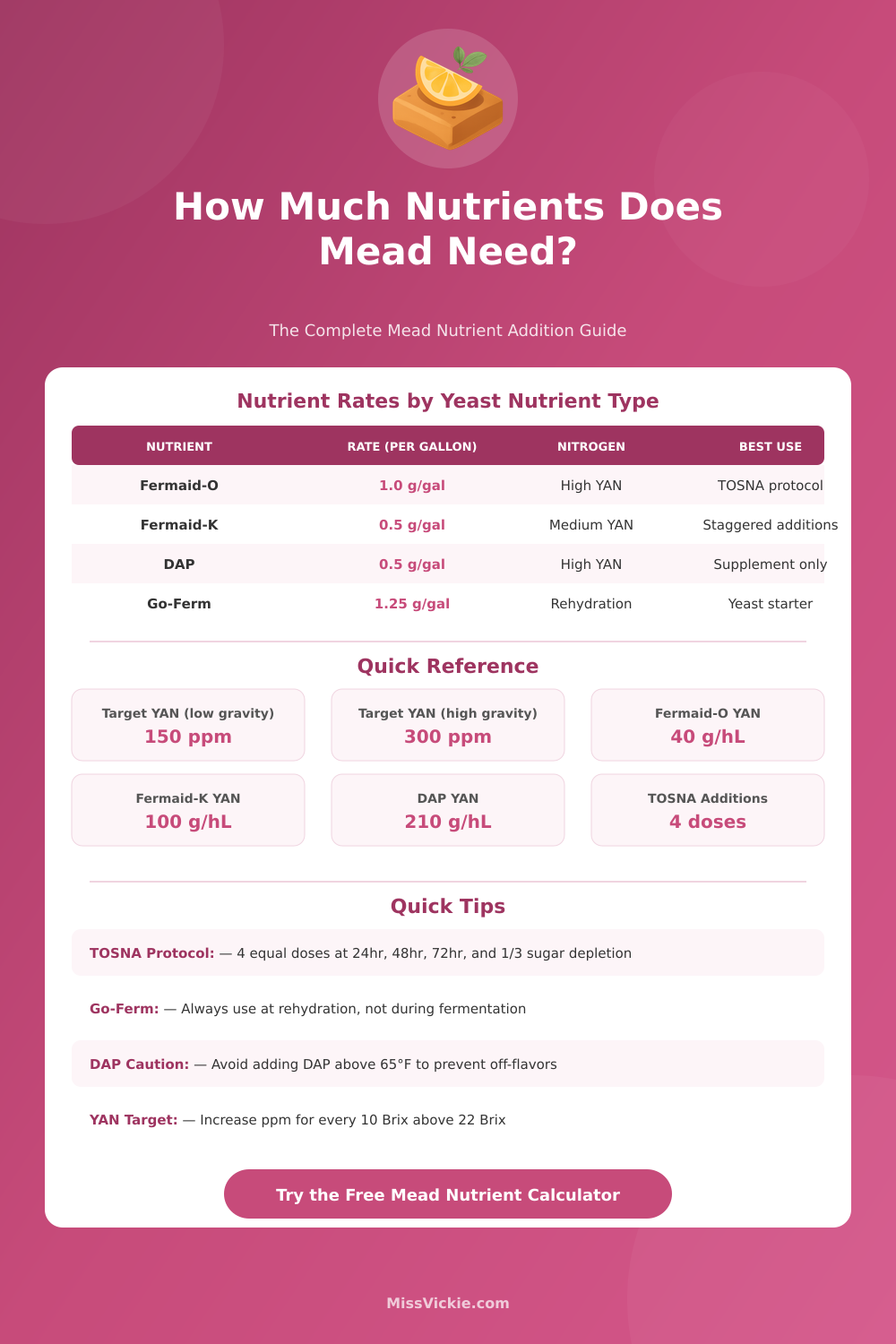
| Batch Size | Fermaid-O (TOSNA) | Fermaid-K | DAP | Go-Ferm |
|---|---|---|---|---|
| 1 gallon | 3.8 g total | 1.9 g total | 1.9 g total | 4.7 g at pitch |
| 3 gallons | 11.4 g total | 5.7 g total | 5.7 g total | 14.2 g at pitch |
| 5 gallons | 18.9 g total | 9.5 g total | 9.5 g total | 23.6 g at pitch |
| 6 gallons | 22.7 g total | 11.4 g total | 11.4 g total | 28.4 g at pitch |
| 10 gallons | 37.9 g total | 18.9 g total | 18.9 g total | 47.3 g at pitch |
| Dose | Timing | Gravity Checkpoint | Notes |
|---|---|---|---|
| Dose 1 | 24 hours after pitch | Start of lag phase | Yeast are actively multiplying |
| Dose 2 | 48 hours after pitch | Active fermentation begins | CO2 visible, temp rising |
| Dose 3 | 72 hours after pitch | 1/3 sugar depleted | Check gravity: ~(OG - FG) x 0.33 |
| Dose 4 | 96 hours / 1/3 drop | Confirm 1/3 sugar gone | Final nutritional boost |
| Original Gravity | Brix Approx. | Target YAN (ppm) | Notes |
|---|---|---|---|
| 1.060 – 1.075 | 14.7 – 18.3 | 150 ppm | Session mead, low ABV |
| 1.076 – 1.095 | 18.4 – 22.9 | 200 ppm | Standard traditional |
| 1.096 – 1.115 | 23.0 – 27.0 | 250 ppm | Medium-high gravity |
| 1.116 – 1.130 | 27.1 – 30.4 | 300 ppm | High gravity mead |
| Above 1.130 | 30.5+ | 350+ ppm | Sack mead / extreme gravity |
| Nutrient | Type | YAN / g / hL | Typical Rate | Best For |
|---|---|---|---|---|
| Fermaid-O | Organic (yeast hulls) | 40 mg N | 1.0 g/gal total | TOSNA, clean ferment |
| Fermaid-K | Inorganic + organic blend | 100 mg N | 0.5 g/gal total | Staggered additions |
| DAP | Inorganic (chemical) | 210 mg N | 0.5 g/gal total | Supplement with Fermaid-K |
| Go-Ferm | Rehydration nutrient | 0 (no YAN) | 1.25 g/gal | Yeast rehydration only |
| Go-Ferm Protect | Rehydration + sterols | 0 (no YAN) | 1.25 g/gal | High gravity / stressed yeast |
Mead, you might call it honey wine… Is simply fermented honey with water. You commonly mix in other ingredients: fruits, spices, grains or hops, depending on what you want.
The alcohol content ranges from around 3.5% to more than 18% In the first look it seems entirely easy: mix honey, water and yeast, leave it work, and here you have a golden drink. It can be still, bubbly or fully sparkling. About the taste, it ranges from dry to semi-sweet or even very sugary.
What is mead?
This drink probably is one of the most ancient drinks that folks made. Archaeologists found traces of mead-like drinks in old graves, also linked to King Midas, dating back around 8,000 years. For a long time it lived in a weird place, that kind of drink that you found only in medieval fairs or history reenactments.
But now the situaton changes. More and more average drinkers are curious about it as an alternative to beer or seltzer. Meaderies appear everywhere, from little shops to big companies.
Here is what separates mead from wine and beer. It bases on sugars of honey that yeast convert, while wine comes from fruits and beer from malted grains. Mead is like wine in how it is made and the alcohol punch.
Even the style of how you drink it is more like wine than beer, mostly because of the higher ABV. Even so calling it honey wine does not make it real wine, and wine sweetened with honey is not mead. Adding honey just for sweeten does not match that.
Here the difficult part: pure honey itself is too thick because of sugar for naturaly ferment. That high density stops it. So you must dilute it with water, so that yeast indeed work.
The charm of mead is its flexibility. From the start you control the sugar amount. One pound of honey per gallon?
Do that. Two pounds? Pour two.
It is that simple.
You commonly put fruit during the first fermentation. Fruits add nutrients that honey lacks and help yeast. You can be creative with other additions, creating many kinds of meads.
Some producers make entire lines; more than a dozen different variants, that show the range of that drink.
The serving depends on the strength. For light meads with beer-like ABV, fill a 12-ounce glass. For medium stuff from 8 to 15 %, use a wine glass or whiskey glass with around 4 ounces.
For a standard 5-ounce pour, aim for meads around 12 % ABV. Strong meads above 18 %? Three ounces suffice.
Sparkling meads taste best cooled to around 45 degrees. They pair well with salty bites. Olives, roasted nuts, seafood, smoked salmon, goat cheese…
Like that.