🍾 Mead Carbonation Calculator
Calculate priming sugar or honey to achieve the perfect CO2 level in your mead
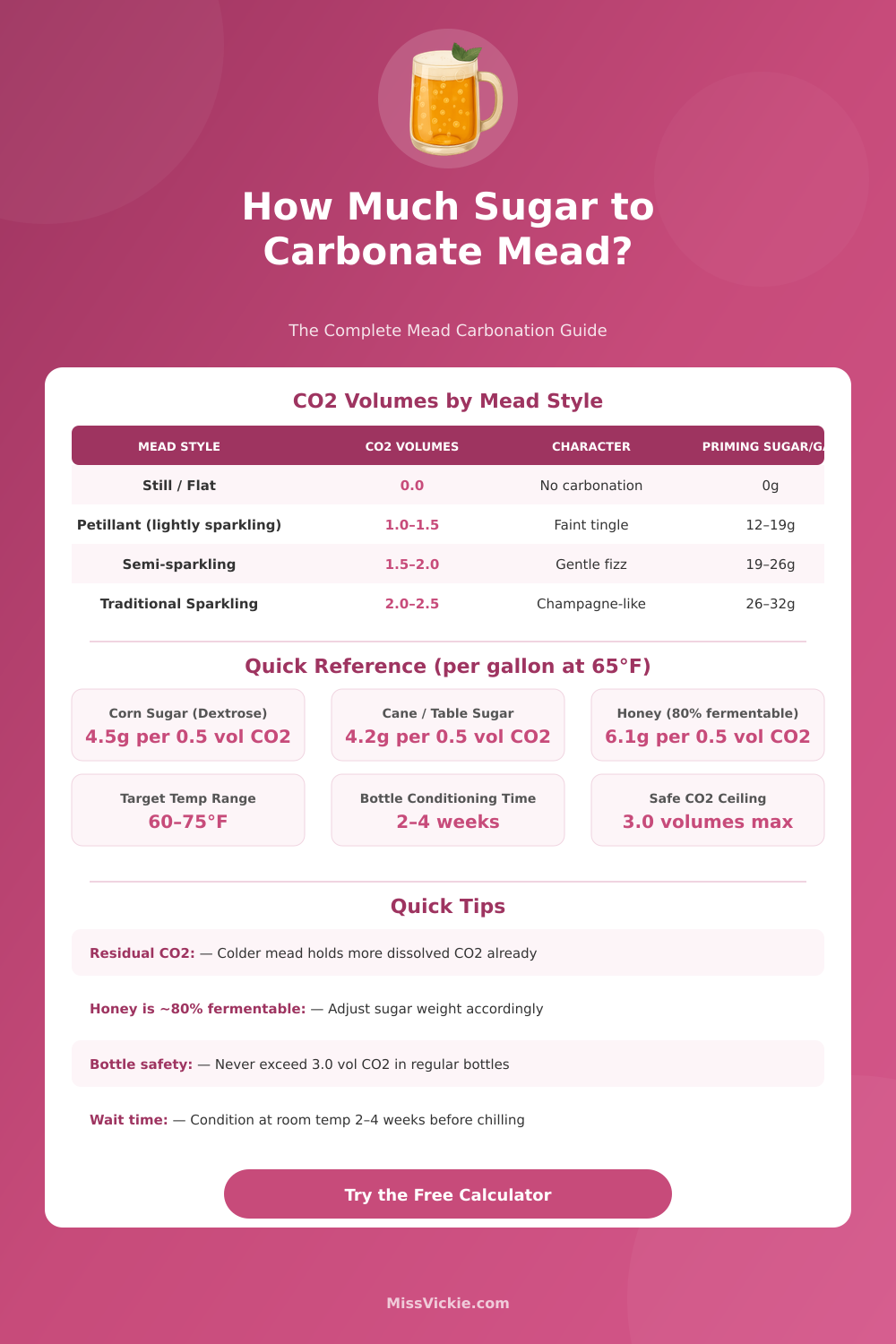
| Sugar Type | Fermentability | Per 1 Gallon | Per 5 Gallons | Notes |
|---|---|---|---|---|
| Corn Sugar (Dextrose) | 100% | ~18g (0.63 oz) | ~90g (3.2 oz) | Most common, clean flavor |
| Cane / Table Sugar | 100% | ~17g (0.60 oz) | ~85g (3.0 oz) | Slightly less by weight |
| Honey | ~80% | ~23g (0.81 oz) | ~115g (4.1 oz) | Adds mild honey character |
| Dry Malt Extract | ~68% | ~27g (0.95 oz) | ~135g (4.8 oz) | Adds slight malt note |
| Temperature | Residual CO2 (vol) | Priming Adjustment | Notes |
|---|---|---|---|
| 32°F (0°C) | 1.68 | Use less sugar | Near freezing — very high residual |
| 40°F (4°C) | 1.45 | Use less sugar | Cold crash temperature |
| 50°F (10°C) | 1.18 | Slightly less | Cellar temperature |
| 60°F (16°C) | 0.93 | Standard range | Cool room temp |
| 65°F (18°C) | 0.82 | Standard range | Common fermentation temp |
| 68°F (20°C) | 0.74 | Standard range | Typical room temp |
| 75°F (24°C) | 0.61 | Slightly more sugar | Warm room |
| 85°F (29°C) | 0.45 | Use more sugar | Summer / warm climate |
| Bottle Type | Max Safe CO2 | Best For | Notes |
|---|---|---|---|
| Standard Beer Bottle (cap) | 3.0 vol | Up to semi-sparkling mead | Most common for homebrewers |
| Belgian Cork & Cage | 3.5–4.0 vol | Sparkling & champagne-style | Designed for high pressure |
| Champagne Bottle (cork) | 5.0+ vol | Highly carbonated meads | Thick glass, wire cage essential |
| Flip-top / Grolsch | 2.5–3.0 vol | Low–medium carbonation | Gasket condition matters |
| PET Plastic Bottle | 2.5 vol | Short-term use only | Squeeze to check pressure |
| Wine Bottle (cork) | Not recommended | Still mead only | Not rated for pressure |
Mead, also called honey wine, is an alcoholic drink made by fermenting honey mixed with water. Sometimes extra things like fruits, spices, grains, or hops are added. The alcohol content ranges from about 3.5% ABV to more than 18%.
On paper mead is a simple drink; honey, water, yeast. Ferment it and you get a golden drink. But the range of what mead can be is pretty wide.
Mead: What It Is and How to Make and Serve It
Mead is possibly one of the oldest known alcoholic drinks. Archaeological digs have turned up mead-like drinks in burial chambers, including one linked to King Midas, and evidence goes back as long as 8,000 years ago. Today it is making a comeback.
Mead is similar to wine, but instead of being made from fruit juice, it is made from honey diluted with water, often called “must.” Undiluted honey is so dense with sugar that it will not normally ferment on its own. Mead is fermented from honey, beer from malted grain, and wine and cider from fruit juice. Those are the key differences.
The cost of making mead is rather expensive compared to wine because honey is relatively low yielding and tricky to harvest. The price of mead cannot be pushed down easily because you cannot just clear fields and plant more bees.
Mead may be still, carbonated, or sparkling. It may be dry, semi-sweet, or sweet. Adding fruit in the primary fermentation is a popular method for making fruit meads.
Fruit typically has extra nutrients not found in honey, which helps the fermentation process. It is also easy to adjust sweetness by changing how much honey goes in. One pound of honey per gallon gives a lighter result, while two pounds per gallon makes it stronger and sweater.
Serving sizes depend on the strength. For mild meads with an ABV equal to beer, the ideal portion is 12 ounces. Medium meads in the 8% to 15% ABV range should be poured in a wine or whiskey glass, with about four ounces making one serving.
One standard serving is about five fluid ounces of mead at 12% ABV. Sparkling meads taste best served chilled at around 45 degrees. A light, crisp mead pairs nicely with salty snacks like olives, roasted nuts, seafood, smoked salmon, or goat cheese.
Mead is not very tolerant of mistakes in the production process. When mead goes wrong, it goes really wrong. Mead can also work as a cooking ingredient.
It can stand in for white wine when cooking things like mussels for a pasta dish. Mead andcheese pairing is another thing worth exploring.